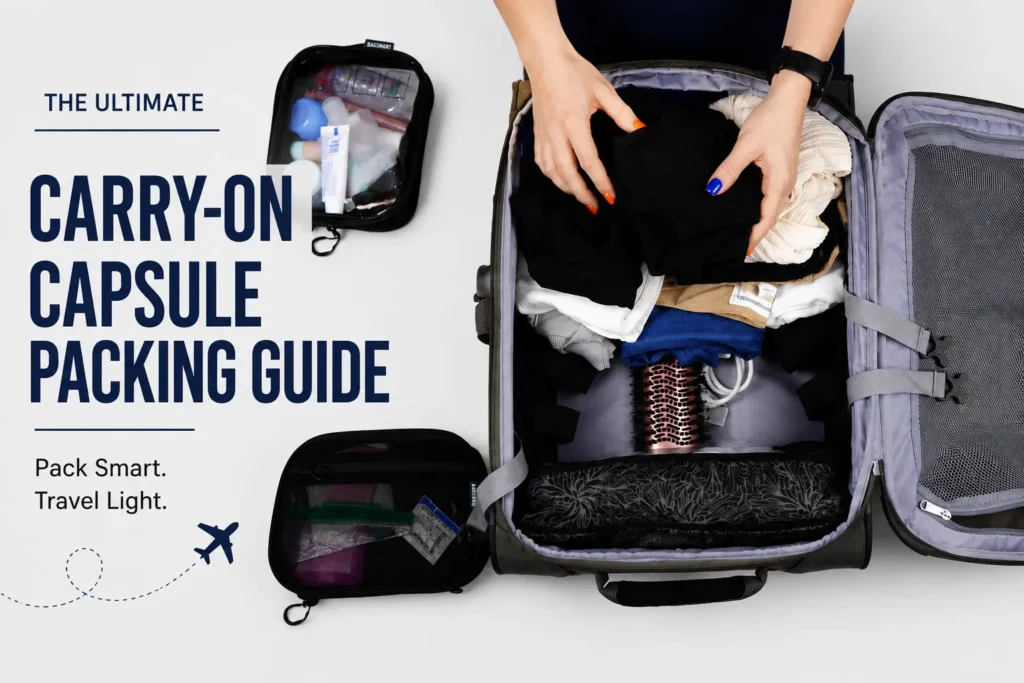
Most carry-on capsule wardrobe guides have the same blind spot. They’ll tell you which twelve pieces to pack, then finish with a cheerful line about how it “all fits in a carry-on”, and never once mention what size that carry-on actually is.
That’s a problem, because the bag is the whole constraint. A 12-piece capsule that slides comfortably into an American Airlines overhead bin will get you stopped at a Ryanair gate and charged more than the flight cost.
The clothes aren’t the hard part. The clothes are easy. Matching the clothes to the litres you’re actually allowed is the part nobody writes about.
So that’s what this article does. You’ll get the 12-piece capsule, the colour formula, and the outfit maths, but you’ll also get the exact dimensions of your bag, the packed volume of every garment on the list, and proof that the two numbers work together.
What a Carry-On Capsule Wardrobe Actually Is
A carry-on capsule wardrobe is a small, deliberately coordinated set of clothing, usually 10 to 15 pieces, where every top works with every bottom, every layer works over everything, and the whole thing fits inside airline cabin baggage limits.
The principles are identical; what changes is that a hard volume limit sits underneath every decision. (If the whole concept is new to you, it’s worth reading what a capsule wardrobe is first, this guide assumes the basics and focuses on the bag.)
Two ideas are doing the work here.
- Cohesion. In a capsule, pieces aren’t chosen individually. They’re chosen for how they combine. A shirt that only goes with one pair of trousers has failed the test, however much you like it. This is why capsules feel like they contain more clothes than they do.
- Constraint. The carry-on isn’t an inconvenience you work around. It’s the design brief. Once the bag is fixed, every decision gets easier, because there’s a clear answer to “should I bring this?” Does it earn its litres?
The payoff is real, and it compounds. No checked bag fees. No waiting at the carousel. No lost luggage. And no decision fatigue at 7am in a hotel room when everything you own goes with everything else you own.
Step One: Know Your Bag Before You Pick a Single Garment
This is the step almost everyone skips, and it’s the one that determines whether the rest works.
There is no universal carry-on size. There are roughly three tiers, and which one applies to you depends on your airline and, increasingly, your fare type.
The Three Bag Tiers
| Tier | Typical dimensions | Rough capacity | Who it’s for |
| Full carry-on (overhead bin) | 22 × 14 × 9 in / 56 × 36 × 23 cm | 35–45 L | US majors, most full-service carriers |
| European cabin bag (overhead, paid) | 55 × 40 × 20 cm | 30–40 L | Ryanair, Wizz, Vueling with priority |
| Personal item (under seat) | 18 × 14 × 8 in / 45 × 36 × 20 cm | 18–25 L | Basic Economy, budget-fare travellers |
The 22×14×9 inch figure is the closest thing to a standard. IATA (International Air Transport Association) has proposed it as a universal cabin baggage dimension, and most major carriers have already aligned with it, but as of 2026 it remains a recommendation, not a mandate, so it does not override any individual airline’s published rule.
2026 Carry-On Limits by Airline
United States
| Airline | Carry-on | Personal item | Notes |
| American | 22 × 14 × 9 in | 18 × 14 × 8 in | Basic Economy includes a full carry-on again |
| Delta | 22 × 14 × 9 in | 18 × 14 × 8 in | Softer under-seat definition, lenient enforcement |
| United | 22 × 14 × 9 in | 17 × 10 × 9 in | Notably smaller personal item |
| Southwest | 24 × 16 × 10 in | 16.25 × 13.5 × 8 in | Most generous carry-on in the US |
| JetBlue | 22 × 14 × 9 in | 17 × 13 × 8 in | Blue Basic = personal item only |
| Frontier | Paid | ~18 × 14 × 8 in | Strictest active budget carrier; gate fees up to $100 |
US domestic carriers rarely weigh cabin bags. Size is the constraint, not weight.
Europe
| Airline | Free under-seat bag | Larger cabin bag | Weight |
| Ryanair | 40 × 30 × 20 cm | 55 × 40 × 20 cm (Priority) | 10 kg on the larger bag |
| Wizz Air | 40 × 30 × 20 cm | 55 × 40 × 23 cm (WIZZ Priority) | Enforced strictly by size |
| easyJet | 45 × 36 × 20 cm | 56 × 45 × 25 cm (paid) | 15 kg under-seat |
| Jet2 | – | 56 × 45 × 25 cm | 10 kg, included |
| British Airways | Small personal item | 56 × 45 × 25 cm | Generous |
| Lufthansa / Swiss | – | 55 × 40 × 23 cm | 8 kg, actively weighed |
Verify before you fly. Cabin bag rules changed substantially across 2025–26, and enforcement tightened at the same time. Ryanair, Wizz, easyJet and Jet2 all revised policies. Treat this table as a planning tool and confirm on the airline’s own baggage page before departure.
The Three Rules That Actually Save You Money
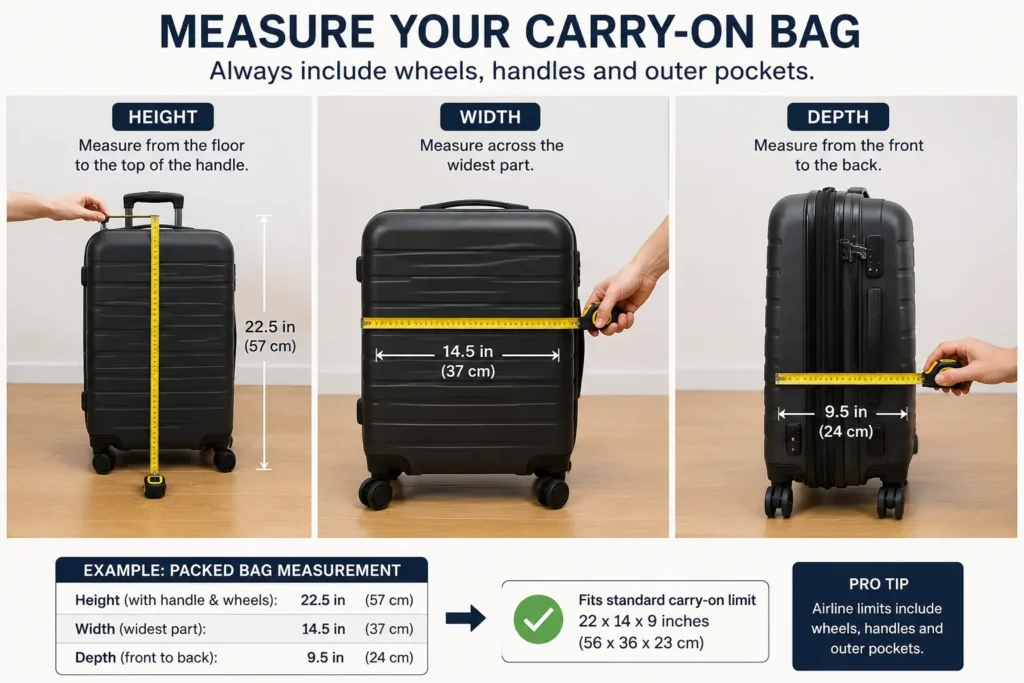
- Measure your bag packed, not empty. Published dimensions include wheels, handles, and outer pockets. A 22-inch hardshell can measure 23.5 inches once the handle housing and wheels are counted, and soft bags bulge when full. Take a tape measure to your loaded bag at home.
- Read your fare, not your airline. Basic Economy, Blue Basic, easyJet Essential and Ryanair’s base fare all restrict you differently. The airline’s headline allowance is often not your allowance.
- Buy the bag upgrade online, never at the gate. Adding a cabin bag at booking typically costs a fraction of the gate price, where fees commonly run £40–£60 or $65–$100. On some routes, checking a 10 kg bag online is cheaper than a gate upgrade.
If you fly a mix of carriers, the safe target is 55 × 40 × 20 cm, which clears most European overhead limits and stays inside US dimensions with room to spare.
Multi-country European itineraries are where this matters most, a trip that touches three budget airlines is governed by the strictest of the three, which is worth planning around when you’re packing a capsule wardrobe for Europe.
The Capsule Formula: How 12 Pieces Become 30+ Outfits
The mechanism behind every capsule wardrobe is multiplication, not addition, the same principle you’d use when building a capsule wardrobe for home, just applied to a much smaller number of pieces.
The 3-3-3 Method (also called the Sudoku method)
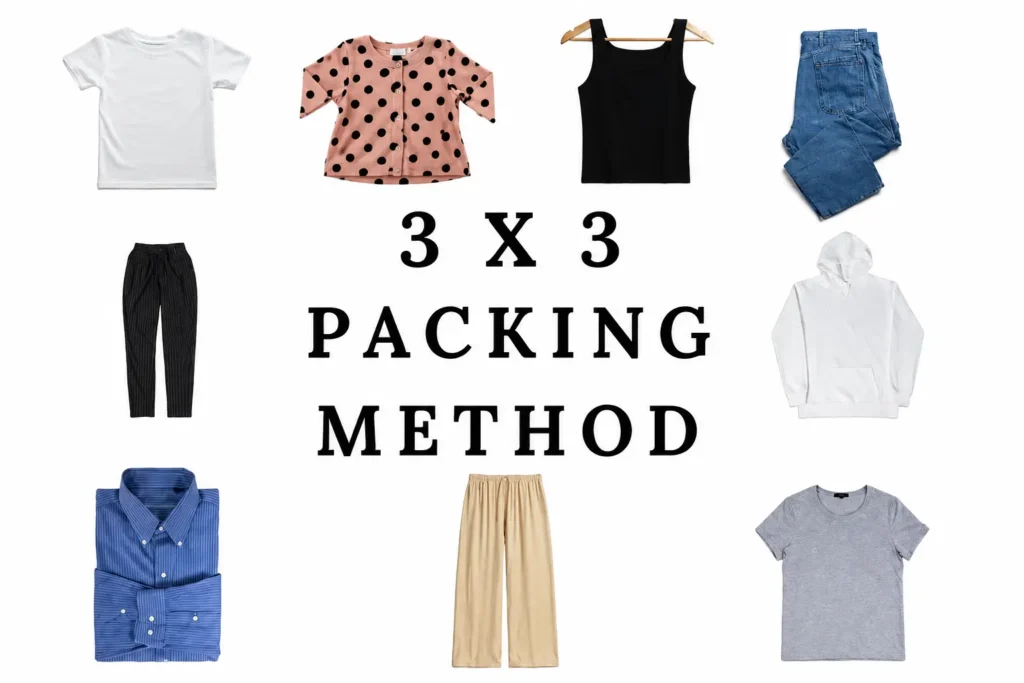
Build a 3 × 3 × 3 grid:
- 3 tops
- 3 bottoms
- 3 layers
Any top works with any bottom, works with any layer. That’s 3×3×3=27 combinations from nine garments.
In practice, you get more, because the grid understates reality:
- Pieces cross categories. A button-down shirt is a top and a layer. A knit waistcoat is both. Each dual-purpose piece multiplies rather than adds.
- Two-piece outfits count. In warm weather, you drop the layer entirely, which creates a whole second set of nine.
- Garments transform. Zip-off trousers become shorts. A reversible dress is two dresses.
- Dresses and jumpsuits break the grid usefully. One dress replaces a top-and-bottom pairing, adding options without adding volume.
- Accessories restyle the same outfit. A scarf changes a look at a cost of roughly 0.5 litres.
The Alternative: The Ratio Formula
If grids don’t suit how you think, use ratios instead:
Bottoms = trip days ÷ 2
Tops = bottoms × 2
Layers = 2
Shoes = 2–3
This scales naturally and matches how most people actually re-wear: bottoms get two or three wears, tops get one.
Scaling by Trip Length
| Trip length | Pieces | Laundry needed? |
| 3 days | 7–8 | No |
| 1 week | 10–12 | No |
| 2 weeks | 12–14 | Once, mid-trip |
| 1 month+ | 12–14 | Weekly |
Notice that the piece count stops climbing after about two weeks. Past one week, you’re not packing for more days, you’re packing for laundry.
A month-long trip needs the same capsule as a fortnight, plus a washing plan. This is the single most useful thing to understand about long-trip packing, and it’s why a five-week trip and a ten-day trip can share an identical bag.
Choosing your colour palette
Colour is what turns a pile of clothes into a capsule. The formula is simple.
Pick One Neutral Base
Everything anchors to it. Navy, black, charcoal, grey, beige, olive and brown all work.
Navy is arguably the most useful: it dresses up more easily than black, hides wear better than beige, and reads appropriately in every season.
This restraint is exactly the logic behind the French capsule wardrobe, a tight neutral palette elevated by fit and fabric rather than colour, which happens to be ideal for travel.
Add One or Two Accent Colours
Rust, burgundy, forest green, teal, mustard, and soft pink all sit comfortably against most neutrals. Accents belong on tops and accessories, where they’re most visible and cheapest to swap.
Keep Bottoms Neutral
Bottoms get the most wears and the most stains. Neutral bottoms go with every top you own; a patterned pair goes with three.
Three refinements that separate a good palette from a great one:
- Your neutrals don’t need to match exactly. Two slightly different navies read as intentional if the textures differ, a cotton and a knit, say. Matching is a lower bar than coordinating.
- Be cautious with pure white bottoms. They’re beautiful, and they show everything. If you’re the kind of traveller who ends up wearing part of lunch, go one shade darker.
- Neutral doesn’t mean plain. A black-and-white stripe, a subtle check, a tonal print, if it goes with everything, it counts as a neutral.
Fabric Guide: What to Pack and What It Actually Weighs
Fabric choice is where you win or lose litres. Two visually identical sweaters can differ by 300 grams and half a litre of packed volume.
| Fabric | Weight | Dry time | Wrinkles | Odour resistance | Best for |
| Merino wool | Very light | 4–8 hrs | Minimal | Excellent | Tops, base layers, socks |
| Merino blend (with nylon) | Very light | 4–6 hrs | Minimal | Excellent | Everyday tops, more durable than pure merino |
| Tencel / Lyocell | Light | 6–10 hrs | Low | Good | Blouses, dresses |
| Technical / performance blend | Very light | 2–4 hrs | Very low | Good | Travel trousers, leggings |
| Linen | Light | 3–6 hrs | High (by design) | Moderate | Hot, dry climates |
| Lightweight cotton blend | Moderate | 8–12 hrs | Moderate | Poor | Tees, when merino isn’t an option |
| Denim | Heavy | 18–24 hrs | Low | Good | One pair maximum |
| Thick cotton (hoodies, jersey) | Very heavy | 24 hrs+ | Moderate | Poor | Leave at home |
Why Merino Keeps Appearing in Packing Guides
It regulates temperature in both directions, resists odour naturally so it can be worn several times between washes, and dries overnight.
That combination, fewer garments needed, faster laundry turnaround, is why it dominates one-bag travel.
Merino blends with a small percentage of nylon are usually the better buy than 100% wool: more durable, less prone to itch, easier to care for. If wool welfare matters to you, look for certified mulesing-free sourcing.
The Denim Question: Should You Pack Jeans?
Denim is heavy and slow to dry, and it’s still worth one pair for most trips. It goes with everything, needs washing rarely, and covers you when the laundry backs up. One pair, worn on the plane, never packed.
What to avoid: thick cotton hoodies, heavy knits, anything dry-clean-only, and anything that needs ironing. If a garment can’t be hand-washed in a sink and hung dry, it doesn’t belong in a carry-on.
The 12-Piece Carry-On Capsule Wardrobe
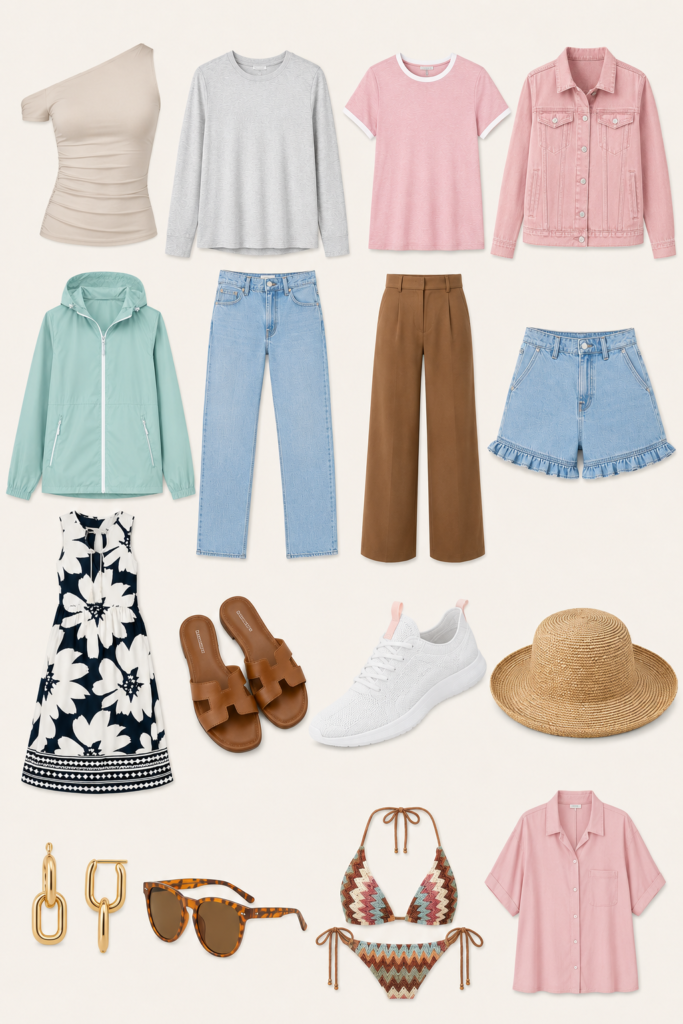
This is the heart of a carry-on capsule wardrobe. Instead of packing for every possible situation, you pack 12 versatile clothing pieces that mix and match into 30+ outfits.
Shoes and accessories are counted separately because they serve multiple outfits without taking up much clothing space.
Tops (5 Pieces)
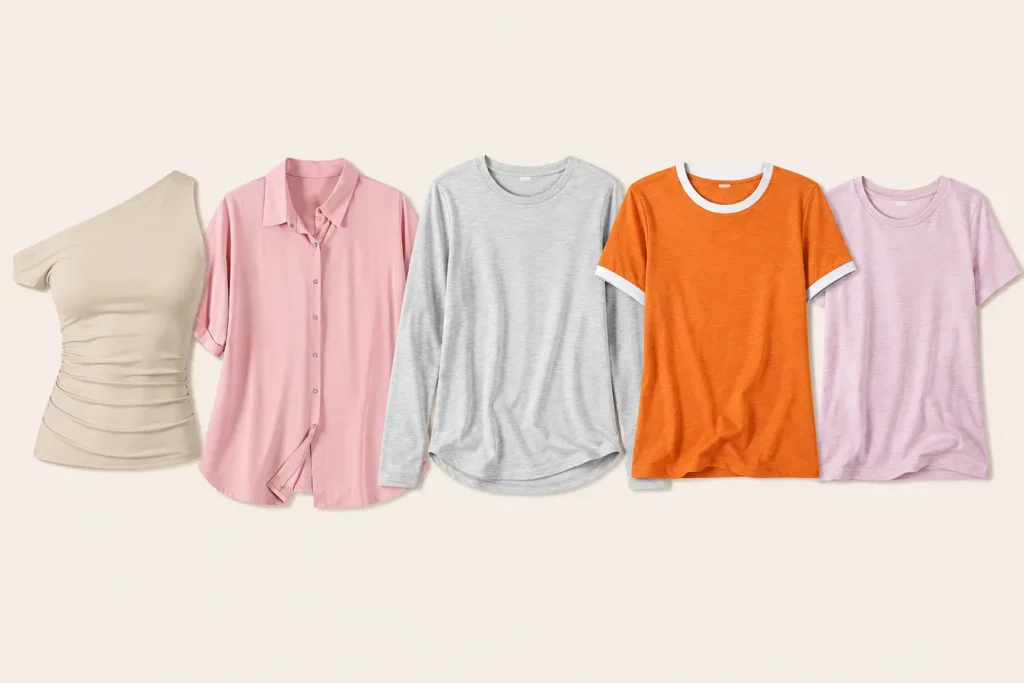
1. Neutral T-Shirt (Merino or Performance Blend)
Neutral color T-shirt is the foundation of your capsule. Wear it on its own during warm days or layer it under a cardigan, jacket, or button-down when temperatures drop.
Merino wool or a quality performance blend stays fresh longer, making it ideal for travel. It folds into roughly 0.7 litres of luggage space.
2. Second T-Shirt (Accent Colour or Stripe)
One more T-shirt in a different colour or subtle stripe instantly creates new outfit combinations without adding much bulk. It gives your wardrobe variety while taking up only 0.7 litres of space.
3. Long-Sleeve Top
A lightweight long-sleeve shirt protects against cool evenings, air-conditioned transport, and strong sun. It also layers well beneath jackets or sweaters, making it one of the most flexible pieces in the capsule. Packed size is approximately 0.9 litres.
4. Button-Down Shirt
Arguably the hardest-working item in the entire wardrobe. Wear it buttoned as a shirt, open over a T-shirt as a lightweight layer, or tied around your waist for a casual look. It works across sightseeing, flights, and dinners while occupying only 1.0 litre.
5. Elevated Top or Blouse
Instead of packing a completely separate evening outfit, include one polished blouse or elevated top. Pair it with your travel trousers or skirt for restaurants, theatre visits, or evenings out. It packs down to about 0.8 litres.
Bottoms (3 Pieces)
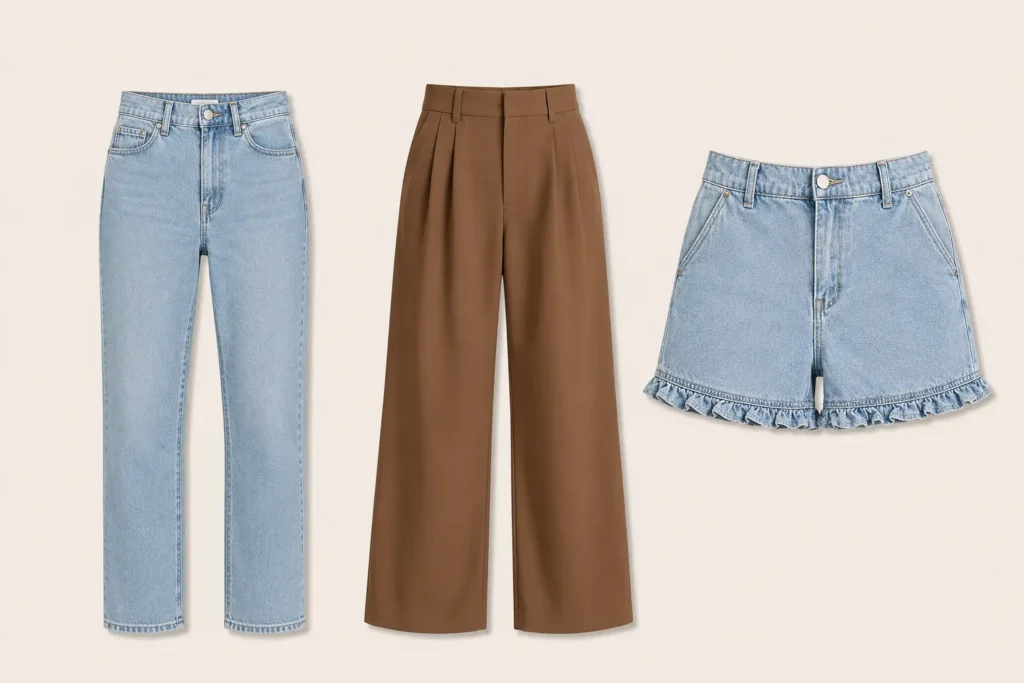
6. Jeans or Travel Trousers (Wear on the Plane)
Your bulkiest bottoms should never go inside your suitcase. Wear your jeans or travel trousers during the flight to save valuable luggage space. Since they’re worn rather than packed, they take up 0 litres in your bag.
7. Lightweight Trousers
Choose a lighter, more breathable pair that can be dressed up or down. These are perfect for city exploring, dinners, and warmer climates while taking around 1.4 litres of space.
8. Skirt, Shorts, or a Third Pair of Trousers
Your final bottom depends entirely on the destination and season. Pack shorts for tropical trips, a skirt for versatile styling, or another lightweight pair of trousers for cooler destinations. Expect roughly 1.0 litre of packed volume.
Layers & Outerwear (3 Pieces)
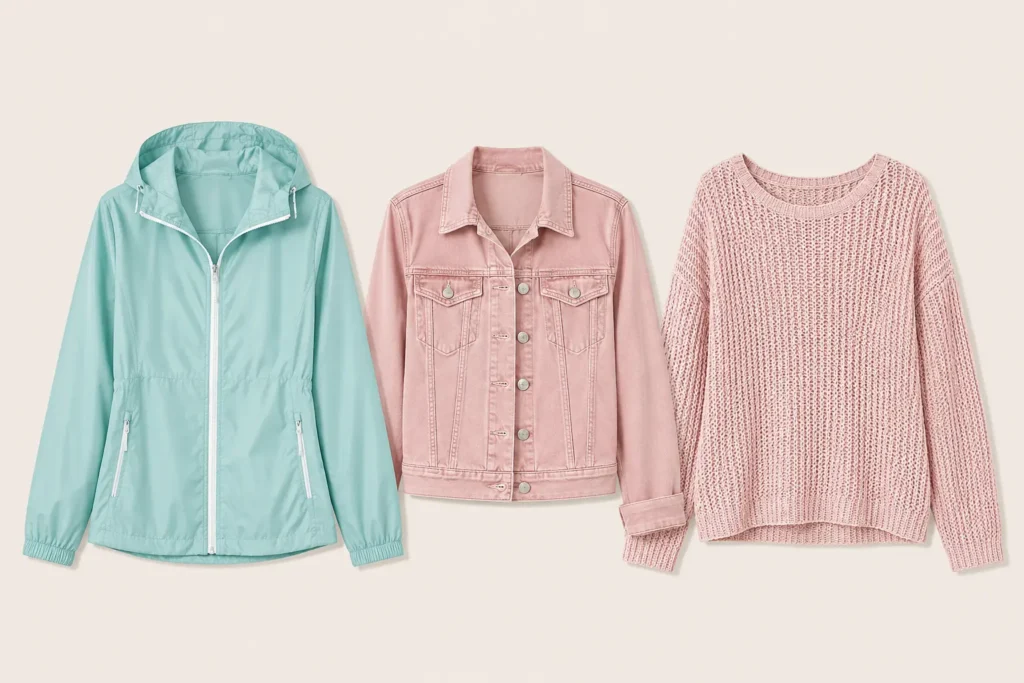
9. Cardigan or Lightweight Sweater
A soft cardigan or lightweight knit becomes your everyday layering piece. It adds warmth on flights, chilly mornings, and evenings without making your bag noticeably heavier. It occupies around 1.3 litres.
10. Structured Jacket, Blazer, or Utility Jacket (Wear on the Plane)
Whether you prefer a blazer, denim jacket, or lightweight utility jacket, wear your outer layer while travelling. It completes outfits throughout the trip without taking any suitcase space.
11. Packable Rain Jacket
Weather can change unexpectedly. A lightweight waterproof jacket compresses into a very small pouch yet can save an entire day of sightseeing. Packed size is approximately 0.8 litres.
One-Piece Outfit (1 Piece)
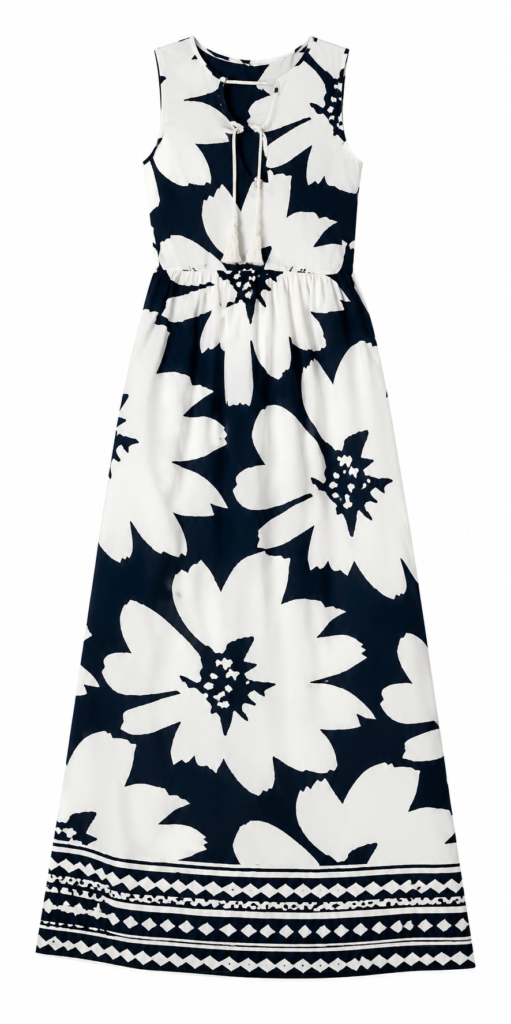
12. Day-to-Night Dress or Jumpsuit
This single piece offers the highest return for the space it occupies. During the day, pair it with trainers or sandals for sightseeing. In the evening, switch to smarter shoes and jewellery for dinner or events. It requires virtually no outfit planning and packs into only 0.9 litres.
If your trip has formal nights, and most ships schedule at least one or two, a cruise capsule wardrobe needs a second dressier option that this list doesn’t include.
Shoes (Maximum of Three Pairs)
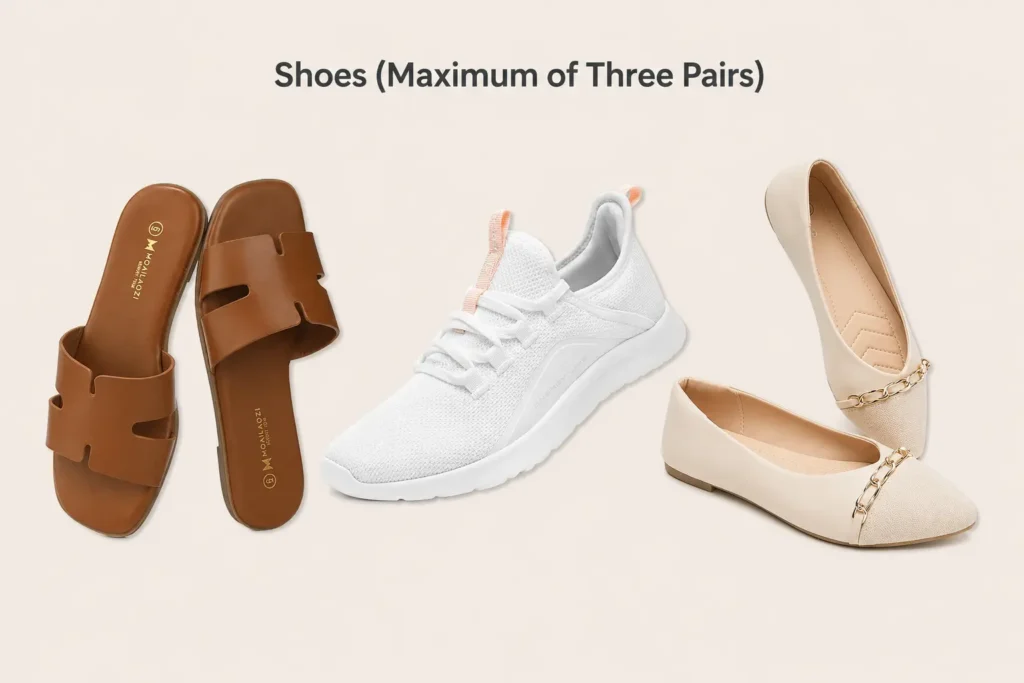
Shoes consume more luggage space than almost anything else, so limit yourself to three pairs.
- Walking shoes or trainers – Wear these on the plane since they’re usually the bulkiest.
- Flats, loafers, or sandals – Ideal for everyday sightseeing and casual meals. They typically occupy around 2.5 litres.
- One dressier pair (optional) – Pack only if your itinerary genuinely requires it. A compact pair usually needs about 2.0 litres and can be skipped on casual holidays.
To maximise space, fill packed shoes with socks, underwear, chargers, or small accessories. Every empty shoe is wasted storage.
Accessories & Base Layers
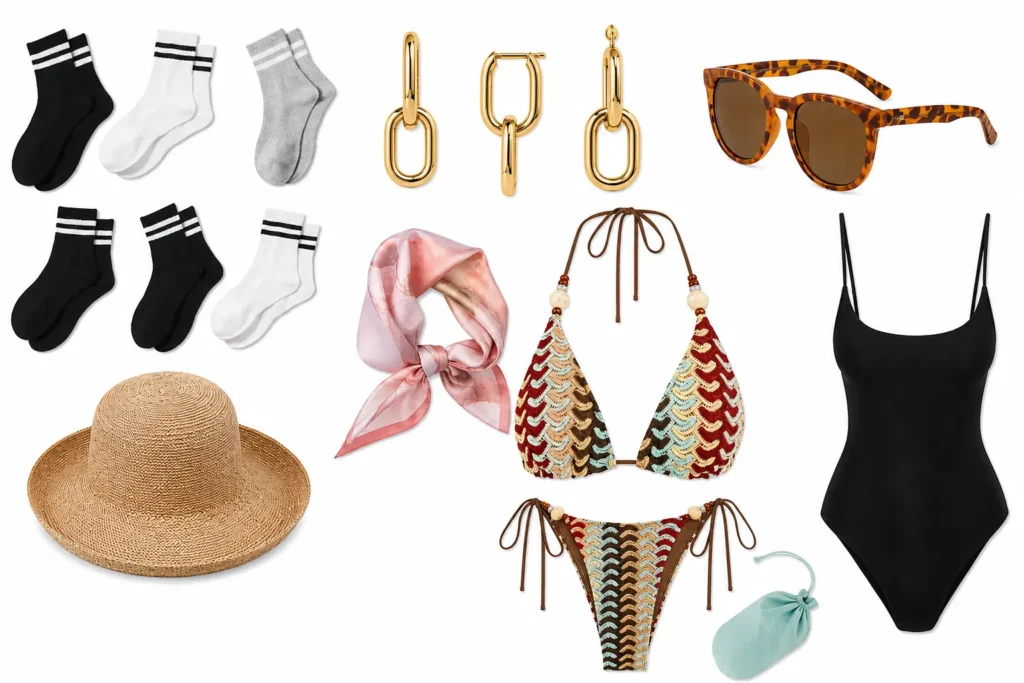
Accessories add versatility without significantly increasing luggage weight.
Pack:
- 1 lightweight scarf
- 1 Sunglasses
- Simple jewellery in one metal tone
- A crossbody bag or packable tote
- 4–5 pairs of underwear
- 3–4 pairs of socks
- Sleepwear
- Swimwear (if needed)
Small accessories like these often deliver the biggest impact while occupying the least amount of space.
Does it actually fit? The volume maths
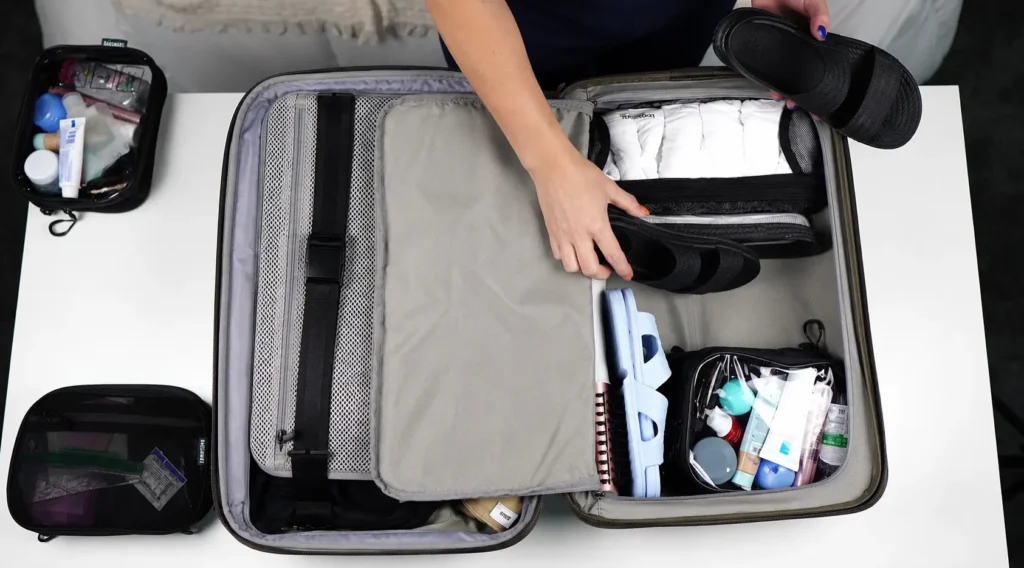 Here’s the section every other guide leaves out.
Packed clothing volume:
| Category | Volume |
| 5 tops | 4.1 L |
| 2 bottoms (one worn) | 2.4 L |
| 2 layers (one worn) | 2.1 L |
| 1 dress | 0.9 L |
| 2 pairs of shoes | 4.5 L |
| Underwear, socks, sleepwear | 2.5 L |
| Accessories | 1.0 L |
| Total, uncompressed | ≈ 17.5 L |
With compression packing cubes, expect 12–14 L. Compression works on soft goods, knits, tees, layers, and does nothing for shoes or structured items, so real-world savings land around 20–25%, not the 50% the packaging suggests.
Against your bag:
| Bag | Capacity | Clothing | Remaining |
| Full carry-on (22 × 14 × 9 in) | ~40 L | 13 L | 27 L |
| European cabin bag (55 × 40 × 20 cm) | ~35 L | 13 L | 22 L |
| Personal item (18 × 14 × 8 in) | ~20 L | 13 L | 7 L |
The remaining space is not spare. It absorbs toiletries (2–3 L), tech and cables (2–3 L), documents, a book, medication, and whatever you buy along the way.
The conclusion: this capsule fits comfortably in a full carry-on, fits a European cabin bag with room to spare, and fits a personal item only if you cut one pair of shoes and one top. That’s the honest answer, and it’s the one you need before you start packing rather than after.
Summer Carry-On Capsule Wardrobe
Heat changes the maths. You lose the layer from most outfits, which means you need more tops, but each one takes less space. The pieces themselves are the same ones you’d choose for a summer capsule wardrobe at home the difference is that here you’re picking twelve of them instead of thirty.
Swap in: linen or cotton-blend shorts · a second lightweight dress · sandals in place of the dressier closed shoe · a sun hat that packs flat
Swap out: the sweater (keep the shirt as your only layer) · the long-sleeve top, unless you’re somewhere with strong sun · the third pair of shoes
Keep regardless: one long-sleeve piece and one light layer. Air conditioning, evening sea breezes, aircraft cabins and mountain day trips are all colder than the forecast suggests. Every capsule should contain one “unseasonable” item.
Hot and humid destinations need their own thinking. Linen and loose cotton beat technical synthetics for comfort, but nothing dries quickly in humidity, assume 12+ hours, and pack one extra top rather than relying on overnight washing.
Conservative-dress destinations, many temples, mosques, churches, and much of South and Southeast Asia and the Middle East, need covered shoulders and knees. Loose long trousers and a scarf solve almost every case and stay cooler than shorts in direct sun.
Fall Carry-On Capsule Wardrobe
Autumn is the best season for capsule dressing, because layering is doing the work anyway. If you’re adapting pieces you already own, a fall capsule wardrobe is the natural starting point, you’re mostly subtracting from it rather than shopping.
The same applies in reverse for shoulder-season spring travel, where mornings and evenings run cold but afternoons don’t: the layering logic below works identically for a spring capsule wardrobe, with lighter fabrics in the mid layer.
Swap in: a second knit · ankle boots in place of sandals · a heavier scarf · tights or leggings if you’re packing a skirt
Swap out: shorts · the summer dress · sandals
The layering logic: three thin layers beat one thick one. A merino base, a shirt, and a cardigan give you four distinct warmth levels, and pack smaller than a single chunky sweater. Bulk is the enemy in a carry-on, not warmth.
Fall weather is the least predictable of the year, which makes the packable rain jacket non-negotiable and makes checking the extended forecast the day before you fly genuinely worth doing.
Winter & Cold-Weather Carry-On Capsule Wardrobe
Counterintuitively, cold-weather packing is often easier. The activity range narrows, no beach, no swimming, fewer wardrobe registers to cover. The challenge isn’t variety, it’s bulk: a winter capsule wardrobe built for home can be halved for travel simply by choosing thinner layers over thick ones.
The layering system:
- Base: merino long-sleeve top and thermal leggings
- Mid: shirt, sweater, or both
- Outer: insulated jacket, worn on the plane
Bulk management is the whole game:
- Wear your heaviest coat and boots to the airport. They cost zero litres that way.
- Choose down over synthetic where you can, it compresses far smaller for the same warmth.
- Skip fleece-lined trousers. Regular trousers with thermal leggings underneath are warmer, more versatile, and take less space.
- Accessories carry disproportionate weight in the cold: a hat, gloves and a warm scarf together take under a litre and change your comfort range by several degrees.
Men’s Carry-On Capsule Wardrobe
Almost every capsule wardrobe guide online is written for women. The principles transfer exactly; only the piece list changes.
Tops (5): two neutral tees · one long-sleeve merino · one Oxford or flannel shirt · one polo or elevated knit
Bottoms (3): dark jeans (worn on the plane) · chinos or travel trousers · shorts or a second chino, season-dependent
Layers (3): merino crewneck sweater · overshirt or unstructured blazer · packable rain jacket
Shoes (2): leather sneakers, worn on the plane · one smarter shoe, a leather sneaker in a dark colour often covers both and saves 2 litres
Men’s capsules tend to run smaller because the formality range is narrower. Dark jeans, a merino crew and clean leather sneakers pass in most restaurants that aren’t actively enforcing a dress code, which means one pair of shoes often genuinely suffices.
Adjusting Your Carry-On Capsule for Petite, Tall & Plus Sizes
Standard packing lists assume a standard body, and the volume maths shifts if yours isn’t. The formula doesn’t change, the litres do. (Style priorities shift too: if you want a fuller take on proportion, coverage and fabric weight, the capsule wardrobe over 50 guide goes deeper than a packing article can.)
Petite: garments are smaller, so you get roughly 10–15% more space back. Use it for a third pair of shoes or an extra top. Watch proportions rather than volume, cropped layers and shorter hems keep a small capsule from overwhelming your frame.
Tall: longer inseams and sleeves add volume. Expect 10–15% more packed bulk than the tables above, and compensate by cutting one top or choosing thinner fabrics. Merino is especially valuable here, it delivers warmth at a fraction of the thickness.
Plus size: more fabric per garment means more litres per garment, typically 20–30% above the baseline. Three responses work well: lean harder on lightweight technical and merino fabrics, use compression cubes on every soft item, and reduce shoes to two pairs. A structured layer that works over multiple tops is also worth more here than an extra top would be, the plus size capsule wardrobe guide covers which silhouettes earn their space.
None of this changes the formula. It changes the volume budget you’re working inside, which is exactly why measuring your own capsule beats copying someone else’s list.
Laundry: The Secret to Packing Light for Longer Trips
Once you understand that a month-long trip needs the same clothes as a two-week trip, laundry stops being a chore and starts being the strategy.
Detergent that passes security. Laundry sheets and single-dose powder packets are solid, so they don’t count against liquid restrictions. Liquid detergent does, it must fit inside your 100 ml / 3.4 oz containers in the quart-sized bag. Sheets weigh almost nothing and work for both machine and hand washing.
The sink-wash method:
- Fill the basin with warm water, add half a sheet or a small amount of powder.
- Agitate for two minutes, then leave to soak for ten.
- Rinse until the water runs clear.
- The step people skip: lay the garment on a dry towel, roll it up tightly, and press or stand on the roll. This removes more water than wringing and cuts dry time roughly in half, and it doesn’t stretch knitwear.
- Hang on a hanger, not draped over a rail, so air can circulate on both sides.
Realistic dry times (after towel-rolling, in a normally ventilated room):
| Garment | Dry time |
| Merino top, underwear, socks | 4–8 hours |
| Technical trousers | 4–6 hours |
| Cotton tee | 8–12 hours |
| Denim | 18–24 hours |
When to use a laundromat instead. For trips over two weeks, one full machine wash per week beats nightly sink washing on both time and results. In most of Europe, a service wash costs less than a restaurant lunch. Airbnbs and aparthotels with a washing machine are worth paying a small premium for on longer trips, they effectively reduce the number of clothes you need to bring.
Extending wears between washes: hang garments to air overnight rather than folding them straight back into the bag. Merino in particular recovers almost completely with a night on a hanger. Trousers reliably manage three to four wears; jeans manage far more.
Packing Techniques That Actually Save Space
 Rolling vs folding vs bundling
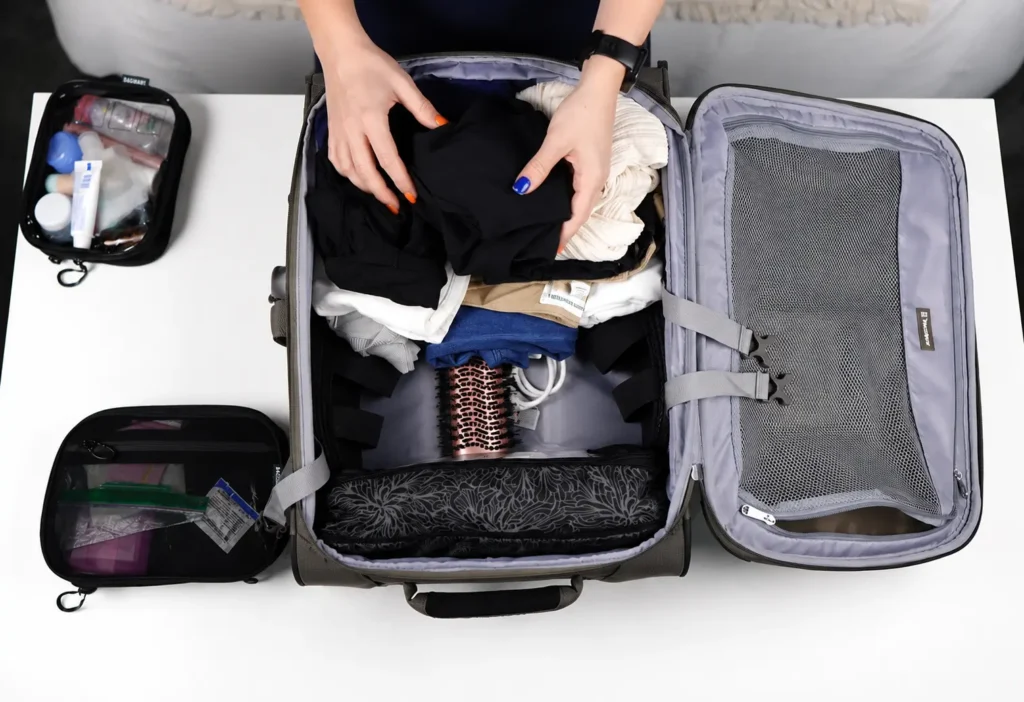 Rolling vs folding vs bundling
- Rolling suits soft, casual items, tees, knitwear, underwear. Slight space saving, good wrinkle performance, easy to see everything at once.
- Folding suits structured items, button-downs, blazers, anything with a crease that should stay. Fold along existing seams.
- Bundle wrapping, wrapping every garment around a central core of soft items, produces the fewest wrinkles of any method. It’s genuinely the best for formal clothing and genuinely annoying for daily use, because getting one item out means unwrapping everything. Use it for a wedding or a work trip, not a backpacking route.
Most travellers land on a hybrid: roll the casual items, fold the structured ones, and keep the fold-worthy pieces on top.
Compression cubes. Worth it, with realistic expectations. They compress air out of soft goods, so knitwear and tees shrink meaningfully while shoes and structured jackets barely move. Budget for around 20–25% total volume savings, not 50%. Their bigger benefit is organisational: outfits stay grouped, the bag stays tidy through a week of living out of it, and you never unpack the whole thing to find one shirt.
Free space, cheaply:
- Wear the heaviest items, coat, boots, jeans, through the airport. This alone can move 5+ litres out of the bag.
- Fill your shoes. Socks, underwear, chargers, sunglasses cases.
- Pack a flat, foldable tote. It weighs nothing on the way out and becomes your souvenir bag on the way home.
- Decant toiletries. Solid shampoo bars, toothpaste tablets, and a solid deodorant remove three of the largest liquid items entirely, and remove them from your quart bag, where space is tightest.
Sample outfit plans
7-day city trip
| Day | Outfit |
| 1, Travel | Jeans + tee + cardigan + jacket + sneakers |
| 2, Sightseeing | Trousers + long-sleeve top + sneakers |
| 3, Museums | Jeans + button-down + cardigan + flats |
| 4, Casual dinner | Dress + jacket + flats + scarf |
| 5, Day trip | Trousers + tee + shirt as layer + sneakers |
| 6, Exploring | Skirt or shorts + accent tee + sneakers |
| 7, Nice dinner | Trousers + elevated top + dressier shoes + jewellery |
Every piece appears at least twice. That repetition is the point, not a compromise.
14 days
Run the same seven days twice, with one laundry cycle on day 7 or 8. Rotate the scarf and jewellery between the two weeks and the outfits read as new. Nobody, including you, will notice the loop.
Common mistakes to avoid
- Too many shoes. Three pairs maximum, one worn. Shoes are the single largest volume cost in any carry-on.
- “Just in case” items. If you can buy it at your destination, don’t carry it across a continent.
- “Maybe” clothes. If you’re not excited to wear it at home, you won’t wear it abroad.
- Multiple statement pieces. A capsule supports one. Let the basics carry the load.
- Ignoring the personal item. It’s free, on every fare, and it’s 18–20 litres you already own.
- Shopping for a whole new travel wardrobe. Start with what’s in your cupboard. Most people already own 80% of a working capsule and have never looked at it that way.
- Buying the bag last. Choose the bag first. It’s the constraint every other decision answers to.
The post-trip review
Do this once, and your next capsule gets meaningfully better.
When you unpack, sort into three piles: worn constantly, worn once or twice, and never worn.
The third pile is your answer. Those pieces don’t come next time. The first pile tells you what to buy more of. Two or three trips of this and your capsule stops being a template you copied and becomes genuinely yours, which is the whole point.
Final Thoughts
Don’t start with the clothes. Measure your bag, confirm what your fare actually allows, and work out your litres. Then choose one neutral base, build the 3 × 3 × 3 grid from what you already own, and add the dress, the rain jacket and the accessories.
If it helps to work from a printed list, the capsule wardrobe checklist covers the pieces most people forget.
Pack it. Weigh it. Measure it against a sizer at home, not at the gate.
Then take the post-trip review seriously, because the second version of your capsule will be better than the first, and the third will be the one you keep.
Frequently Asked Questions
How Many Pieces Should a Carry-On Capsule Wardrobe Have?
Ten to fifteen pieces work well for most trips. Twelve is the sweet spot because it provides enough variety to create 30+ outfit combinations while still fitting comfortably in a carry-on with space left for toiletries and tech. For trips longer than two weeks, doing laundry is far more effective than packing additional clothes.
Can a Capsule Wardrobe Really Fit in a Carry-On?
Yes. A well-planned 12-piece capsule wardrobe typically packs down to around 17 litres uncompressed, or 12–14 litres with compression packing cubes, leaving plenty of room in a standard 40-litre carry-on. If you’re travelling with only a personal item, simply remove one pair of shoes and one top.
What Size Is a Standard Carry-On?
Most US airlines allow carry-on bags measuring 22 × 14 × 9 inches (56 × 36 × 23 cm), including wheels and handles. European airlines vary more, with some allowing only a small under-seat bag on basic fares. Always check your airline’s baggage allowance before travelling.
How Many Pairs of Shoes Should I Pack?
Three pairs should be your maximum, while two pairs are ideal for most trips. Wear your bulkiest shoes during the flight and use the packed pairs to store socks, chargers, or other small items to maximise luggage space.
What Colours Work Best?
Choose one neutral base colour such as black, navy, charcoal, beige, or olive, then add one or two accent colours through your tops and accessories. Keep your bottoms neutral because they are worn more frequently and pair easily with every top.
What’s the Best Fabric for a Travel Capsule Wardrobe?
Merino wool and merino blends are among the best travel fabrics because they are lightweight, regulate body temperature, resist odours, and dry quickly after washing. TENCEL™ and technical performance blends are also excellent choices. Thick cotton and fabrics that wrinkle easily are generally best avoided.
How Do I Do Laundry With a Carry-On Capsule Wardrobe?
Wash clothes in the sink using laundry sheets or powder packets, which don’t count towards liquid restrictions. Roll each garment inside a towel before hanging it to dry, as this removes excess moisture and significantly shortens drying time. For trips lasting more than two weeks, one machine wash per week is usually easier than hand washing every night.
Does What I Wear on the Plane Count as Part of the Capsule?
Yes. Your travel outfit should include your bulkiest clothing, such as jeans, trainers or boots, and your heaviest jacket. Wearing these items instead of packing them can save 5 litres or more of valuable suitcase space.
Olivia Bennett is a travel wardrobe expert who helps women pack lighter without sacrificing style. She specialises in creating practical capsule wardrobes for every destination, season, and trip length, making travel simpler and more organised. Through her guides, Olivia shares packing strategies, outfit ideas, and carry-on tips that help travellers feel confident wherever they go.