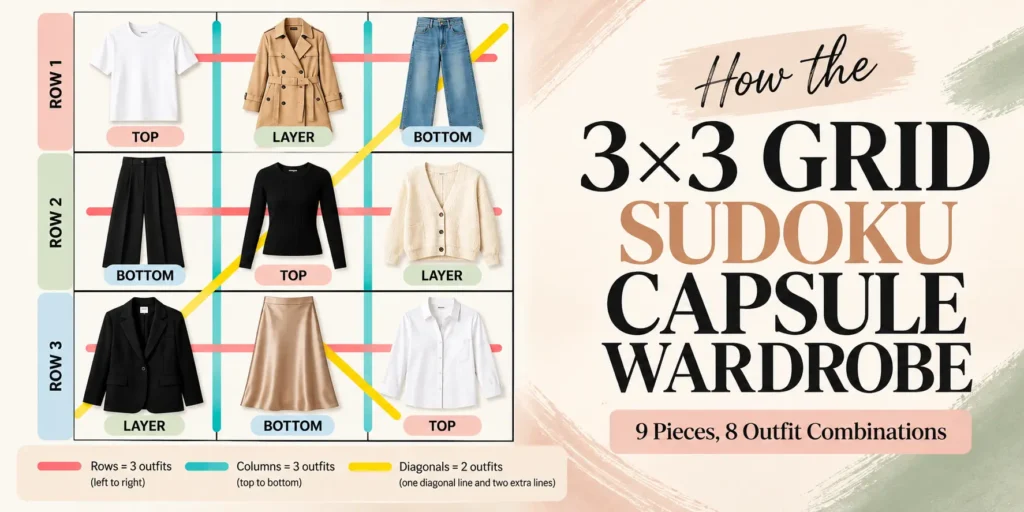
Most of us pack the same way a pile of “maybe” pieces, a suitcase that won’t zip, and the same two outfits worn all trip. The sudoku capsule wardrobe fixes that with one small grid. You pick nine pieces, arrange them by a simple rule, and every straight line on the grid hands you a ready-made outfit.
This guide explains exactly how the grid works, how many outfits you really get, and how to build one for any trip or season. You’ll also find example grids and free printable grid templates (PDF) you can fill in tonight.
What Is a Sudoku Capsule Wardrobe?
A sudoku capsule wardrobe is a 9-piece wardrobe of 3 tops, 3 bottoms, and 3 layers, laid out in a 3×3 grid like a sudoku puzzle.
Each row and column holds one of each category, so every line forms a complete outfit, and mixing all pieces creates up to 27 combinations.
You’ll also see it called the sudoku packing method, packing sudoku, the 3-3-3 method, or wardrobe sudoku. The names differ, but the idea is the same: fewer pieces that all work together, organized so you can see every outfit at a glance.
It started as a travel capsule wardrobe trick for carry-on packing. It works just as well for a work week, a seasonal closet edit, or a decluttering session at home.
The One Rule That Makes the Grid Work
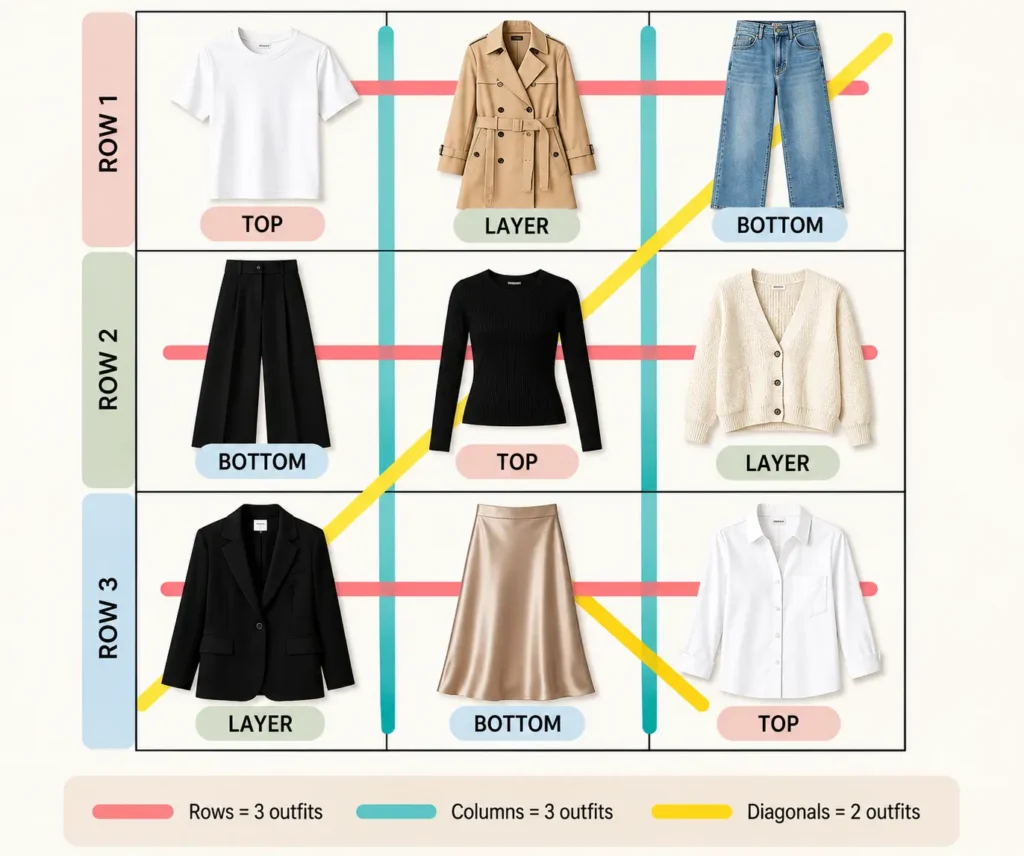
Every row and every column must contain exactly one top, one bottom, and one layer. That single rule is what makes it “sudoku.” No category repeats in a line, so any straight line you trace is a full outfit.
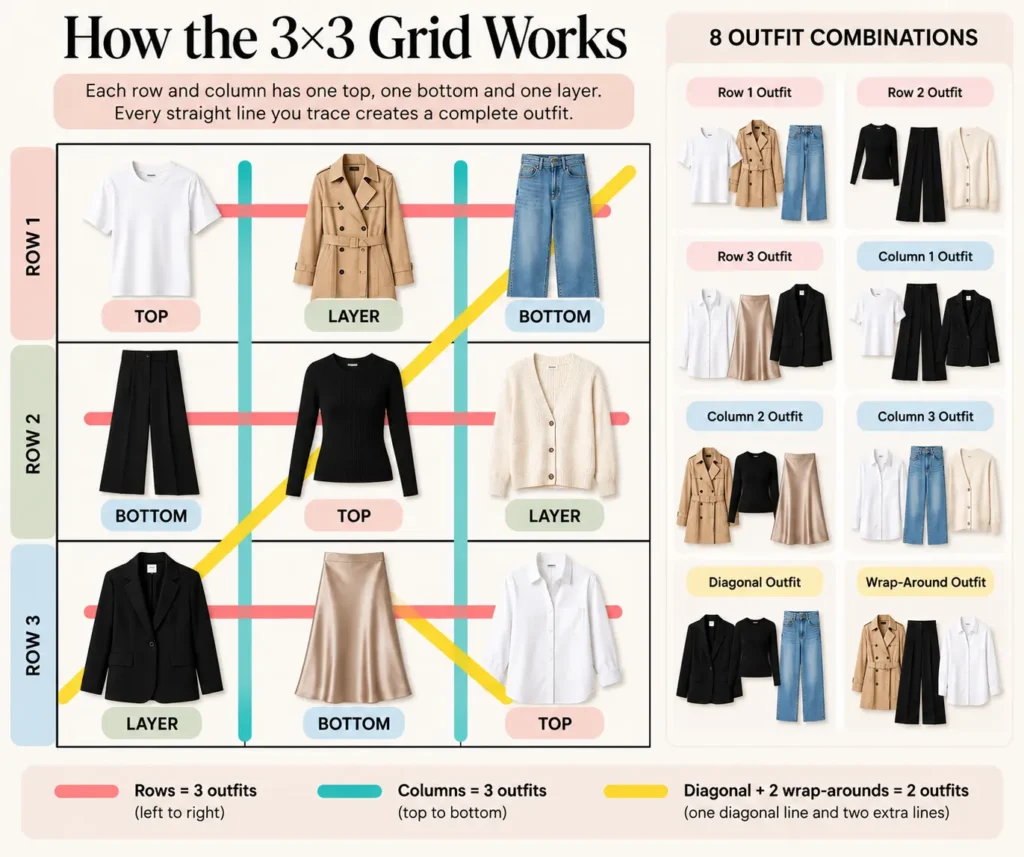
Mathematicians call this pattern a Latin square. You don’t need the term, but it explains why the grid never hands you two tops and no pants.
Here is the standard layout:
| Column 1 | Column 2 | Column 3 |
|---|---|---|---|
Row 1 | Top | Layer | Bottom |
Row 2 | Bottom | Top | Layer |
Row 3 | Layer | Bottom | Top |
Read it any way you like:
- Rows (left to right): three outfits.
- Columns (top to bottom): three more outfits.
- Diagonal from top-right to bottom-left: bottom, top, layer. Another outfit.
Why only one diagonal works
Look at the other diagonal, from top-left to bottom-right. It runs Top, Top, Top. Three tops and nothing else is not an outfit.
This is a side effect of the layout, not a mistake. You can flip the grid, and the working diagonal flips with it. Many guides tell you only one diagonal counts but never say why. Now you know.
Bonus lines most people miss
The working diagonal has two “wrap-around” partners. Each takes one square from every row and every column:
- Row 1 col 1 + Row 2 col 3 + Row 3 col 2 = top, layer, bottom
- Row 1 col 2 + Row 2 col 1 + Row 3 col 3 = layer, bottom, top
Add these to the rows, columns, and diagonal, and you get 9 ready-made line outfits, with each piece used exactly three times.
Small L-shapes work too. For example, Row 1 col 2 → Row 1 col 1 → Row 2 col 1 gives layer, top, bottom. Any three squares holding one of each category make a valid outfit, so the lines are a starting point, not a limit.
How Many Outfits Do You Really Get? (9 vs 27 vs 36)
You get 9 guaranteed line outfits, 27 full combinations, or 36 if you count looks without a layer. Different articles quote different numbers because they count different things. Here’s what each number means:
| Count | How it’s calculated | What it means for you |
|---|---|---|
| 9 line outfits | 3 rows + 3 columns + 3 diagonals | Planned looks you can read straight off the grid |
| 27 outfits | 3 tops × 3 bottoms × 3 layers | Every top, bottom, and layer combined, if all pieces truly match |
| 36 outfits | 27 layered + 9 top-and-bottom looks with no layer | Adds warm days when you skip the layer |
| 10 outfits (4×4) | 4 rows + 4 columns + 2 diagonals | The original 16-piece wardrobe sudoku |
Be honest with yourself about the 27. Some combinations will look almost identical, and a few won’t feel like you. That’s normal.
The number that matters most is the 9 line outfits. If those 9 all look good, you have more than a week of variety. Everything beyond that is a bonus.
What about the 4×4 grid?
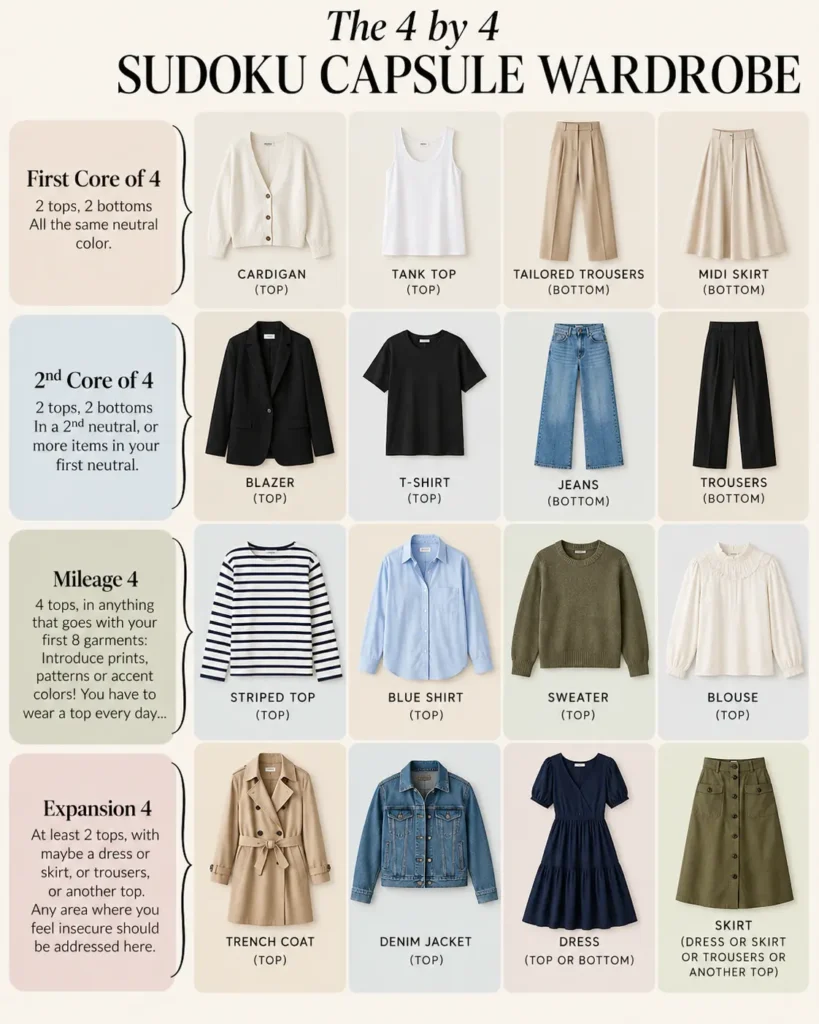
The older version uses 16 squares instead of 9. Style consultant Colleen Hammond popularized it, and it often includes shoes and accessories in the grid. You get 4 row outfits, 4 column outfits, and 2 diagonal outfits, for 10 in total.
Choose the 4×4 for trips longer than a week, or when you want shoes planned into each look. Choose the 3×3 for carry-on trips and quick decisions.
How to Build Your Sudoku Capsule Wardrobe in 6 Steps
You can build a grid in under an hour from clothes you already own. If you’re new to capsules, our guide on how to build a capsule wardrobe covers the basics. Then follow these steps in order.
- Check the trip or season first. Note the weather range, how much walking you’ll do, and the dressiest event on the plan. A rainy city break and a beach week need very different layers.
- Pick a tight color palette. Choose 2–3 neutrals (black, navy, camel, white, gray, denim) and 1–2 accent colors or one print. Keep whites the same shade. Bright white next to off-white looks like a mistake, not a choice. Our capsule wardrobe color palette guide has ready-made combinations.
- Choose 3 tops, 3 bottoms, and 3 layers. Give each piece a different job. For tops, mix sleeve lengths or fits: a fitted tank, a relaxed tee, a long-sleeve or button-down. For bottoms, vary the shape: jeans, a softer trouser, a skirt or shorts. For layers, vary the weight: a knit, a jacket, a coat or vest.
- Lay them out on the grid. Put them on your bed in the 3×3 pattern from the table above. Then trace every row, column, and diagonal and check that each outfit actually works.
- Swap out any orphan piece. An orphan is something that only looks good in one line. Replace it with a piece that works in all three of its lines. This step is what separates a real capsule from a random pile.
- Photograph the finished grid. Save the photo to your phone as your outfit menu. Each morning, pick a line and get dressed in two minutes.
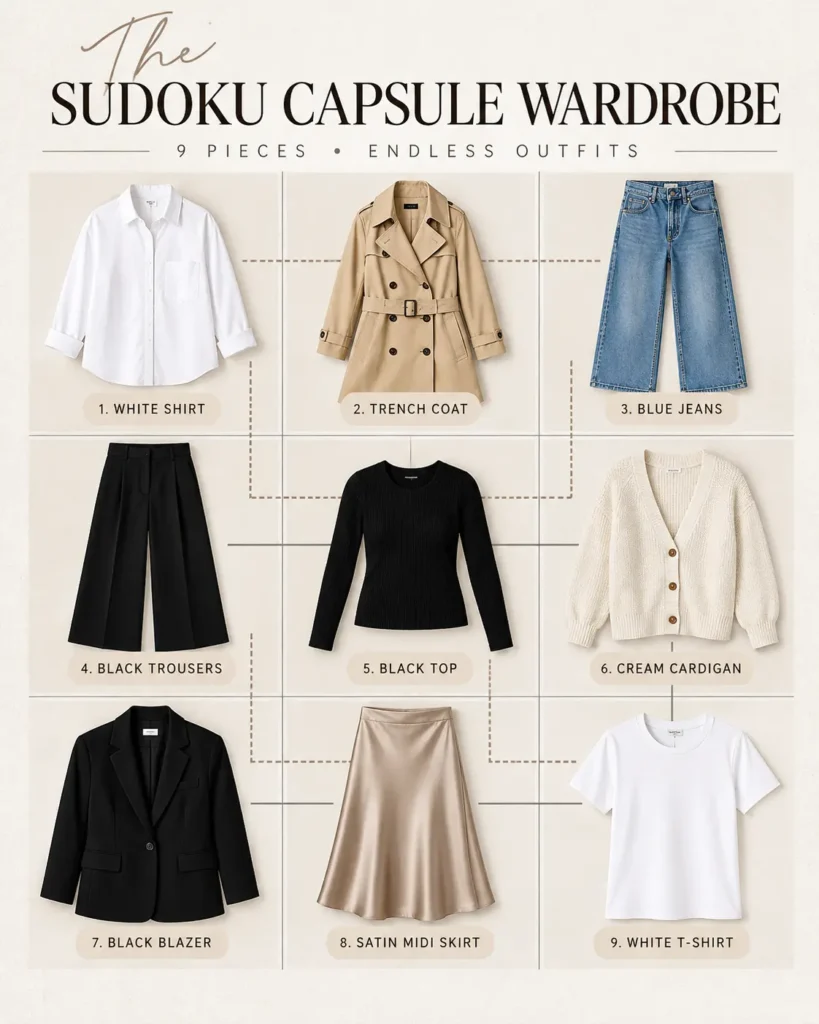
Tip: Look for pieces that do double duty. A denim shirt can be a top or a layer. A reversible tee gives you two necklines. A slip dress can act as a bottom under a sweater. Double-duty pieces quietly add outfits without adding weight.
Example Sudoku Capsule Grids for Every Trip
Each grid below follows the same layout, so every row, column, and diagonal is an outfit. Swap in your own pieces and keep the positions.
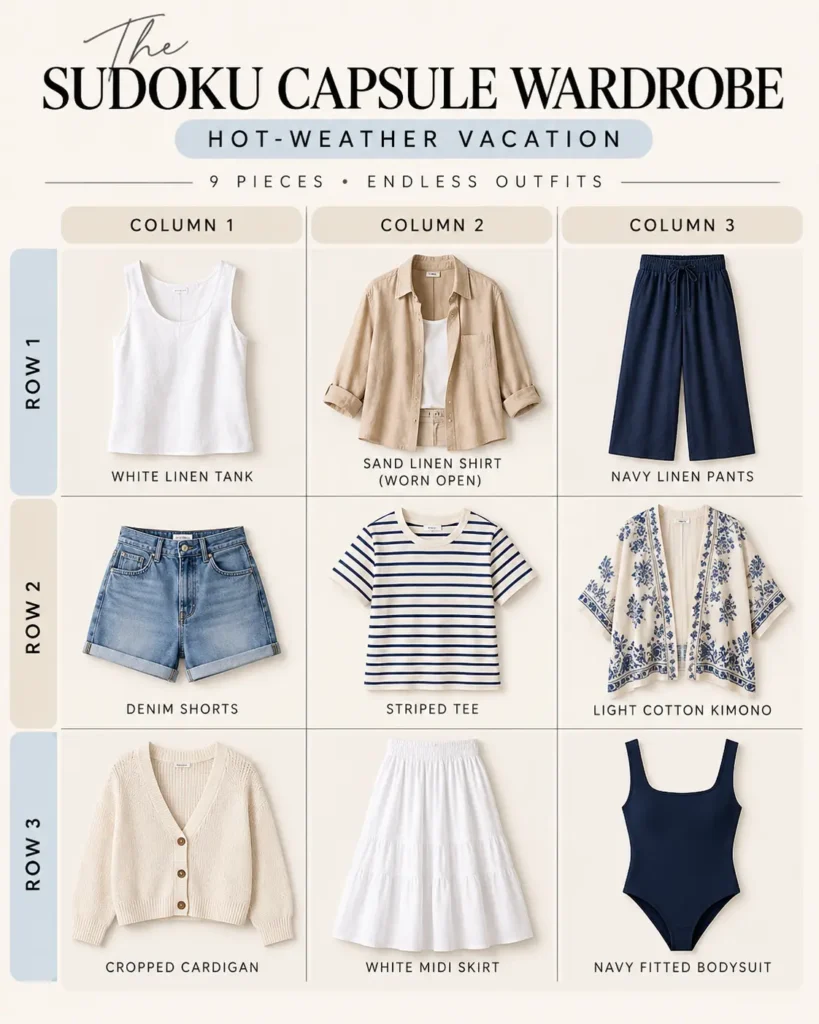
Hot-weather vacation grid
Palette: white, sand, navy, with one blue-and-white stripe. For more warm-weather ideas, see our beach vacation capsule wardrobe and summer capsule wardrobe.
| Column 1 | Column 2 | Column 3 | |
|---|---|---|---|
| Row 1 | White linen tank | Sand linen shirt (worn open) | Navy linen pants |
| Row 2 | Denim shorts | Striped tee | Light cotton kimono |
| Row 3 | Cropped cardigan | White midi skirt | Navy fitted bodysuit |
Sample outfits: striped tee + navy linen pants + open sand shirt for a lunch out; navy bodysuit + white midi skirt + kimono for dinner. Shoes: flat sandals, white sneakers, one dressy sandal.
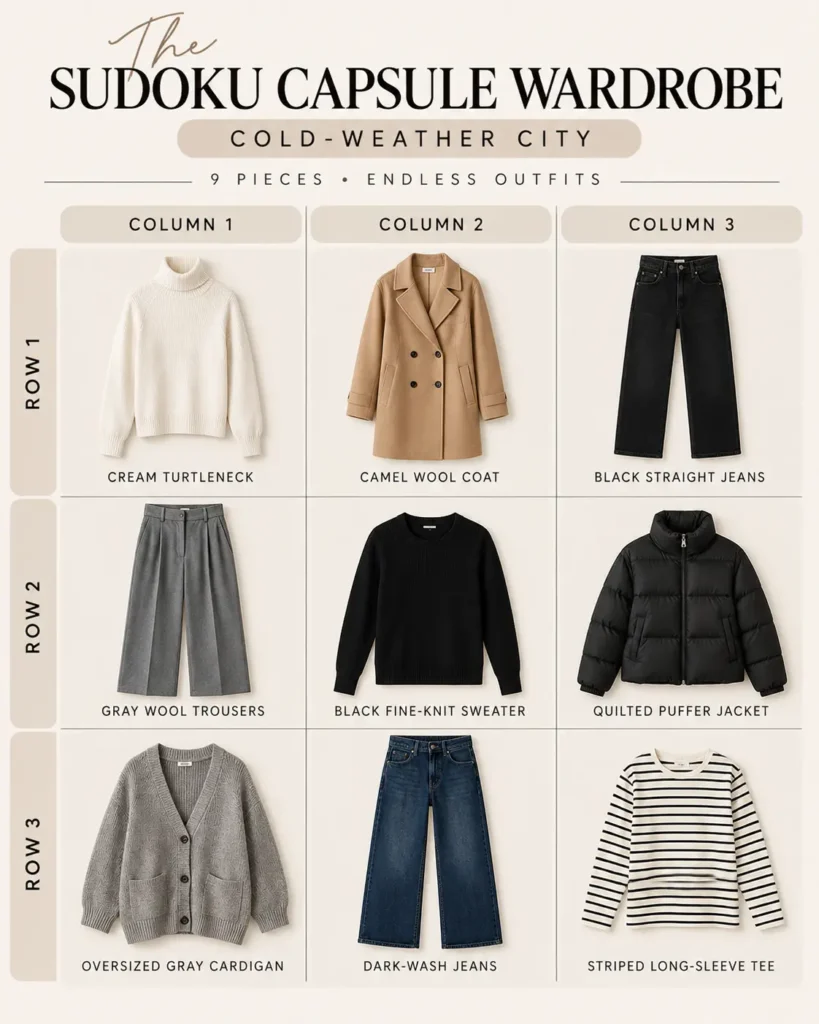
Cold-weather city grid
Palette: black, camel, gray, cream.
| Column 1 | Column 2 | Column 3 | |
|---|---|---|---|
| Row 1 | Cream turtleneck | Camel wool coat | Black straight jeans |
| Row 2 | Gray wool trousers | Black fine-knit sweater | Quilted puffer jacket |
| Row 3 | Oversized gray cardigan | Dark-wash jeans | Striped long-sleeve tee |
Wear the coat on the plane to save space. Shoes: waterproof ankle boots and leather sneakers. Add a scarf and gloves outside the grid. Our winter capsule wardrobe guide has more cold-weather pieces.
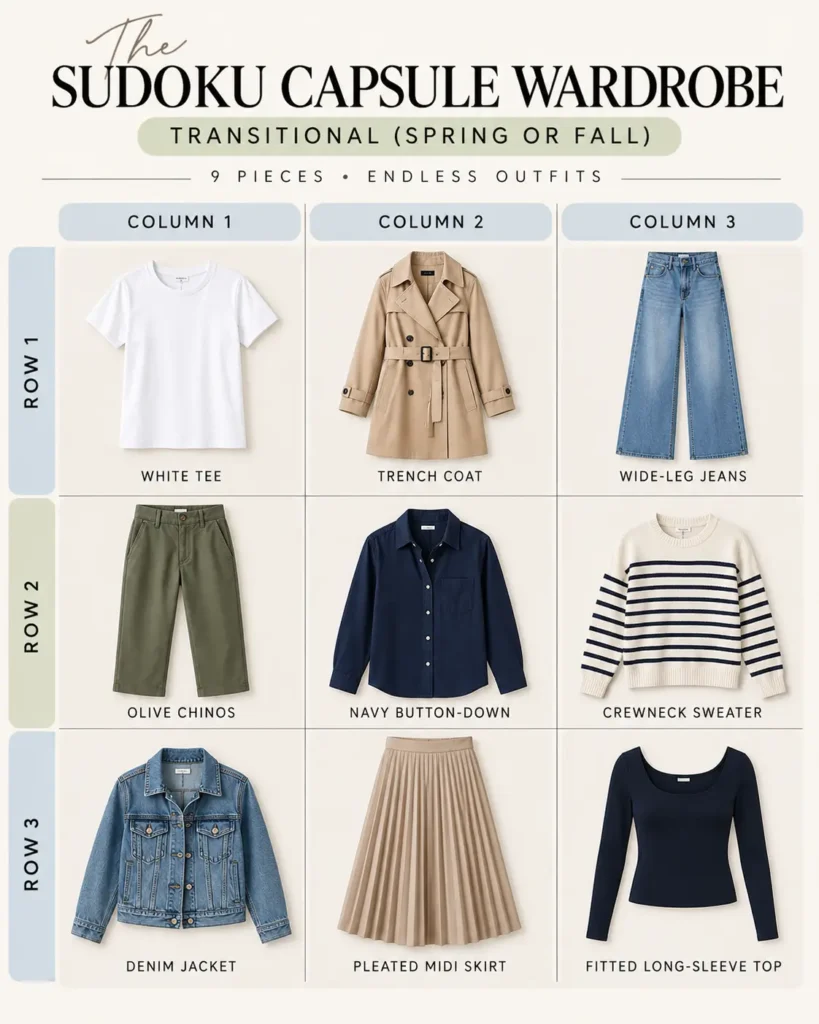
Transitional (spring or fall) grid
Palette: navy, white, olive, denim. For a full seasonal closet, see our spring capsule wardrobe and fall capsule wardrobe guides.
| Column 1 | Column 2 | Column 3 | |
|---|---|---|---|
| Row 1 | White tee | Trench coat | Wide-leg jeans |
| Row 2 | Olive chinos | Navy button-down | Crewneck sweater |
| Row 3 | Denim jacket | Pleated midi skirt | Fitted long-sleeve top |
The button-down can also be a layer over the tee, which adds extra looks. Shoes: loafers or ballet flats, plus sneakers.
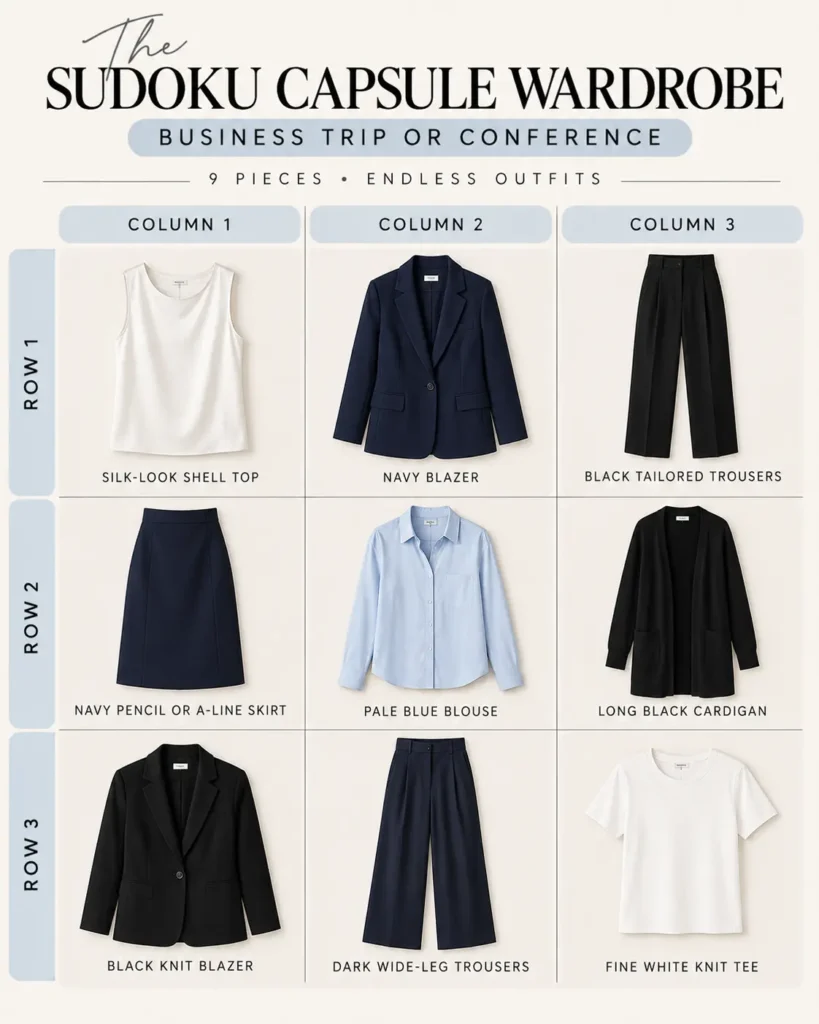
Business trip or conference grid
Palette: navy, black, white, with one soft blue.
| Column 1 | Column 2 | Column 3 | |
|---|---|---|---|
| Row 1 | Silk-look shell top | Navy blazer | Black tailored trousers |
| Row 2 | Navy pencil or A-line skirt | Pale blue blouse | Long black cardigan |
| Row 3 | Black knit blazer | Dark wide-leg trousers | Fine white knit tee |
Wrinkle-resistant fabrics matter most here. Shoes: one pair of polished flats or low heels, plus clean sneakers for the airport. For an everyday office version, see our business casual capsule wardrobe.
Men’s sudoku capsule grid
Palette: navy, gray, olive, white.
| Column 1 | Column 2 | Column 3 | |
|---|---|---|---|
| Row 1 | White Oxford shirt | Navy unstructured blazer | Dark selvedge jeans |
| Row 2 | Gray chinos | Navy crewneck tee | Olive overshirt |
| Row 3 | Gray quarter-zip sweater | Olive chinos | Striped Breton tee |
The grid rule works the same for menswear. Shoes: white leather sneakers and brown suede desert boots. One belt in brown covers every outfit. For more menswear staples, read our capsule wardrobe for men.
Shoes, Bags and Accessories: What Counts?
In the 3×3 version, shoes and accessories sit outside the nine pieces. They’re how you change the mood of an outfit without packing more clothes.
- Three shoes, three jobs. One casual pair for walking, one polished pair for dinners or meetings, and one that suits the trip (hiking shoes, sandals or boots). Wear the bulkiest pair on the plane. Our shoe capsule wardrobe guide helps you choose the right three.
- One bag, or two that nest. Choose a crossbody or shoulder bag that goes with everything. If you need an evening option, pack a small clutch inside your main bag.
- Small swaps, big change. A belt defines the waist and dresses up a loose top. A scarf adds color and warmth. One statement necklace or pair of earrings turns a day outfit into an evening one.
If you want shoes planned into every look, switch to the 4×4 template and give shoes their own category.
Where Do Dresses and Jumpsuits Fit?
Treat a dress or jumpsuit as a bottom, or use it as a wild card square. Both approaches work.
- As a bottom: A slip dress or knit dress takes a bottom square. In its lines, you skip the top or wear the top over it as a layer (a sweater or tee tucked or knotted at the waist works well). The layer square goes on as normal.
- As a wild card: Keep your full 3×3 grid and pack one dress or jumpsuit as a tenth piece. It works with any layer in the grid and covers the one dressy night.
For a summer trip, you can swap one or two layers for dresses, since you’ll need fewer layers in the heat.
How Long Will a Sudoku Capsule Last?
A 3×3 grid covers a 3- to 7-day trip comfortably. Beyond a week, use a 4×4 grid or plan one laundry stop.
Tops are the limit, not bottoms. Jeans and layers can be worn several times. Tops touch your skin, so most people want a fresh one every day or two.
| Trip length | Suggested setup |
|---|---|
| Weekend (2–3 days) | 3×3 grid, possibly fewer layers |
| 4–7 days | 3×3 grid + 1–2 lightweight extra tops |
| 8–14 days | 4×4 grid, or 3×3 + one laundry day |
| 2+ weeks | 3×3 or 4×4 + laundry every 5–7 days |
What goes outside the grid
These don’t count toward your nine pieces. For everything else to pack, use our capsule wardrobe checklist.
- Your travel-day outfit (the one you wear on the plane or in the car)
- Sleepwear and loungewear
- Underwear, socks and bras
- Swimwear and cover-ups
- Workout clothes
- Rain jacket or umbrella, if the forecast calls for it
How to Pack Your Sudoku Grid in a Carry-On
Nine pieces plus three shoes fit easily in a standard carry-on. Most US airlines allow a bag of around 22 × 14 × 9 inches, but check yours before you fly. For a longer packing list, see our carry-on capsule wardrobe guide.
- Wear your heaviest pieces. Put on the coat or bulkiest layer, your largest shoes, and your jeans for the flight.
- Use one packing cube per grid row. Each cube then holds a top, a bottom, and a layer, so you can pull out a full outfit without unpacking everything.
- Roll knits and tees, fold structured pieces. Rolling saves space and limits creases in soft fabrics. Fold blazers and button-downs flat on top.
- Stuff your shoes. Fill them with socks or chargers, then place them along the edges of the bag.
- Keep a photo of the grid on your phone. You won’t need to dig through the bag to remember what goes with what.
Not the same thing: You may also see “sudoku packing” used for a suitcase technique that fits items together like puzzle pieces. That method is about arranging space in the bag. The sudoku capsule wardrobe is about choosing which clothes to bring. Use both together for the lightest bag.
Common Sudoku Capsule Mistakes (and How to Fix Them)
Most grids fail for one of five reasons. Each one is easy to fix before you pack.
| Mistake | Why it hurts | Fix |
|---|---|---|
| Three tops that are too similar | Your 27 outfits look like 9 | Vary sleeve length, fit, or neckline |
| Whites in different shades | Off-white next to bright white looks mismatched | Keep every white the same tone |
| A layer that won’t fit over a top | Puffy sleeves won’t go under a fitted jacket | Test every layer over every top |
| Too many prints | Prints fight each other in some lines | Limit the grid to one print |
| “Just in case” extras | The bag gets heavy, and the grid loses its point | If it doesn’t fit the grid, leave it at home |
One more check: put on each line outfit once before you leave. Ten minutes in front of the mirror at home saves a disappointing morning abroad.
Sudoku vs Other Capsule Wardrobe Methods
The Sudoku grid is the most structured capsule method. Here’s how it compares with the other popular approaches:
| Method | Pieces | Outfits | Best for |
|---|---|---|---|
| Sudoku 3×3 | 9 clothing pieces | 9 line outfits, up to 27 combinations | Carry-on trips of 3–7 days |
| Sudoku 4×4 | 16 pieces, often including shoes | 10 line outfits | Longer trips, outfits planned with shoes |
| 4×4 Wardrobe (The Vivienne Files) | 16 pieces chosen in groups of four by color | Open-ended | An everyday wardrobe built around a palette |
| 5-4-3-2-1 packing | About 15 items across categories | Open-ended | Quick packing lists without a grid |
| 10×10 challenge | 10 pieces | Worn over 10 days | Testing a small wardrobe at home |
| Project 333 | 33 items | Worn for 3 months | Long-term minimalism |
The main difference is visibility. Other methods tell you how many pieces to bring. The sudoku grid shows you which outfits those pieces make before you leave. For longer-term approaches, read our guides to Project 333 and the 10-item wardrobe.
Beyond Travel: Using the Sudoku Method at Home
The grid works just as well in your closet. Professional organizer Vicky Silverthorn has described it to Stylist as a modern take on the capsule wardrobe, and suggests adapting the grid to suit your needs.
- Declutter: Build a grid from your most-worn pieces. Anything that never fits into a grid is a candidate to donate.
- Plan a work week: One 3×3 grid gives you a different outfit every weekday for almost two weeks.
- Rotate by season: Build a new grid each spring and fall and store the rest out of sight.
- Shop smarter: Before buying something new, check whether it would fit into at least three lines of your current grid.
Where the Sudoku Method Came From
The sudoku grid is a newer branch of an older idea. The term “capsule wardrobe” is usually credited to London boutique owner Susie Faux in the 1970s. Designer Donna Karan made the idea famous in 1985 with her “Seven Easy Pieces” collection.
Grid-based wardrobe planning came next. Colleen Hammond’s 16-piece wardrobe sudoku, where rows, columns, and both diagonals form outfits, was already being shared on style and sewing blogs by 2017. Around the same time, The Vivienne Files popularized the 4×4 wardrobe.
The smaller 3×3 version took off on TikTok and Instagram. Travel creator Natalie Shaquer helped make it viral and has trademarked her version as Packing Sudoku, according to AARP. It has since been featured on Good Morning America and in major travel and style publications.
Start Your First Grid Tonight
The sudoku capsule wardrobe comes down to one rule: one top, one bottom, and one layer in every row and column. Follow it, and nine pieces give you nine planned outfits and up to 27 combinations.
Pick your palette, lay your pieces on the bed, and test every line. Then download the sudoku-capsule-wardrobe-templates and plan your next trip in under an hour.
Sudoku Capsule Wardrobe FAQ
Does the Sudoku method work with colors and prints?
Yes. The grid only cares about categories, not colors. Keep one print and make sure every other piece picks up at least one of its colors. Bold palettes work as long as each line looks good together.
Does a dress count as a top or a bottom?
Count it as a bottom, or pack it as a wild card tenth piece. As a bottom, pair it with the layer in its lines and treat the top square as optional.
Do shoes count in the 9 pieces?
Not in the 3×3 version. Shoes, bags, and accessories sit outside the grid. Most people bring three pairs. The 4×4 version can include shoes as a fourth category.
How many days does a 3×3 grid last?
About 3 to 7 days. Bottoms and layers can be worn several times between washes, but tops usually need refreshing. Add one or two light tops or plan a laundry stop for longer trips.
Is the sudoku method the same as the 3-3-3 method?
They use the same pieces: 3 tops, 3 bottoms, and 3 layers. The 3-3-3 name describes the count. The Sudoku name describes the grid, where every row and column holds one of each category.
Does the sudoku capsule work for men?
Yes. Use shirts, tees and polos as tops; jeans and chinos as bottoms; and overshirts, sweaters or a blazer as layers. The grid rule is identical.
Can I make a 5×5 grid?
You can, with five categories such as top, bottom, layer, shoes, and accessory. It’s useful for long trips, but it’s harder to keep every line working. Most people find the 3×3 or 4×4 easier to manage.
Emma studied fashion but could never get her own closet under control. Capsule wardrobes finally fixed that. Now she writes about what actually worked for her, in the hope it saves you a few frustrating mornings.