I counted my closet once. Really counted, hangers and all, and the number was embarrassing enough that I’m not going to type it here. What stung more was realizing I wore maybe fifteen of those pieces on repeat and completely ignored the rest.
So when I first heard about the 10 item wardrobe, my reaction was somewhere between “that’s impossible” and “wait, could that actually fix this?”
Turns out the idea isn’t new at all. It comes from the way French women dress, made popular by Jennifer L.
Scott after she spent a year living with a chic Parisian family and noticed they got by beautifully on a fraction of what most of us own. Ten good pieces, worn in rotation, and they always looked put together.
I’ll be honest, ten sounded terrifying to me too at first. But once you see what actually counts (and the long list of extras that don’t), it gets a lot less scary.
So here’s everything: where it came from, a real list you can copy, seasonal versions, outfit ideas, and a printable checklist to make it easy.
What Is a 10 Item Wardrobe?
A 10 item wardrobe is a small, intentional collection of ten core clothing pieces, chosen to be versatile and worn in heavy rotation across a season. The magic word there is core.
Those ten pieces are the backbone of your outfits, and they’re supported by a handful of “extras” like t-shirts, sweaters, outerwear, shoes, and accessories that don’t count toward the ten.
Think of the ten item wardrobe as a focused version of the capsule wardrobe. A capsule is any curated, mix-and-match collection of clothes.
The 10 piece wardrobe simply tightens that idea down to its most essential center, so getting dressed becomes almost effortless.
As the concept’s best-known advocate puts it, the less choice you have, the easier it is to get dressed. A closet stuffed with pieces you half-like only makes the morning harder.
This isn’t about deprivation or owning nothing. It’s about owning the right things: quality over quantity, pieces that fit your body and your life, worn with intention rather than guilt.
Where the 10 Item Wardrobe Came From (The French Origin)
The modern 10 item wardrobe was popularized by Jennifer L. Scott in her book Lessons from Madame Chic and her widely watched TEDx talk. Scott developed the idea after living as an exchange student in Paris, where she stayed with a host family she affectionately calls “Madame Chic.”
She noticed that stylish French women dressed very differently from their American counterparts. Their closets were small, yet they always looked polished, because they wore a handful of high-quality pieces in constant rotation rather than chasing trends or hoarding options.
That observation became the heart of the philosophy she shares on her blog and YouTube channel, The Daily Connoisseur.
The French approach values a few beautiful, well-made garments over a closet bursting with fast fashion. It’s the same sensibility behind a classic French capsule wardrobe: effortless, quality-driven, and quietly elegant.
One small point of clarification, since it confuses online. There is also a separate book titled The 10 Item Wardrobe by Eden Kaminsky, which offers her own take on the number ten. Both are worth reading, but when most people refer to the ten item wardrobe concept, they’re describing the French-inspired approach Jennifer L. Scott made famous. That’s the version this guide is built around.
How the 10 Item Wardrobe Works: Core Items vs Extras
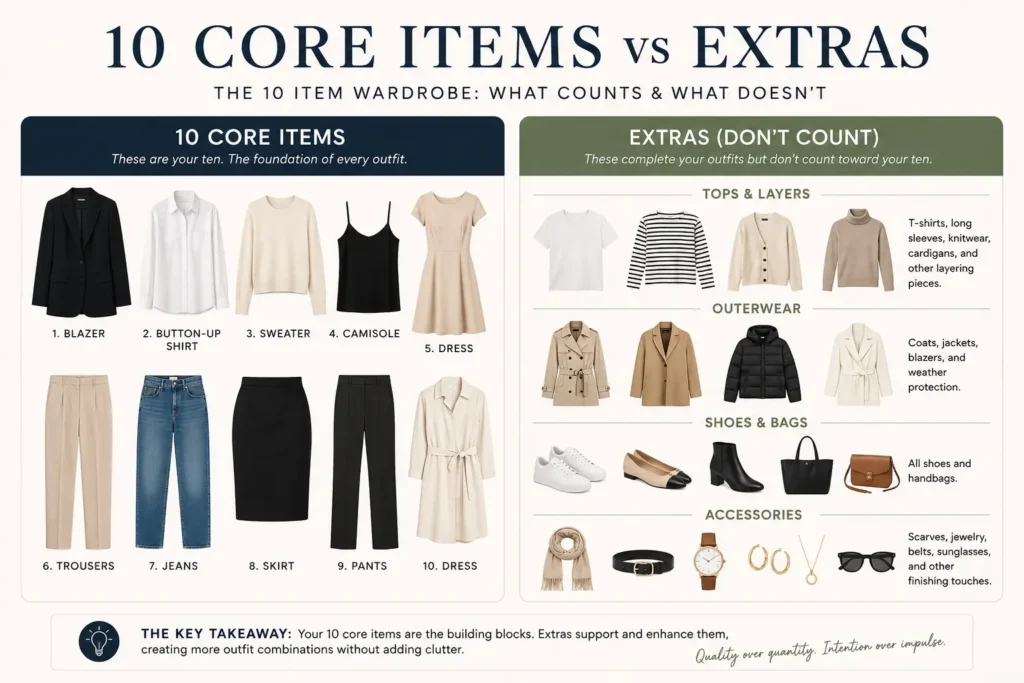
The single biggest source of confusion about the 10 item wardrobe is what actually counts. Once you understand the distinction between core items and extras, the whole system clicks into place.
Your 10 Core Items
Your ten core items are the workhorses of your wardrobe: the tops, bottoms, and dresses you build outfits around, worn in regular rotation throughout the season.
In Scott’s original framing, a sample women’s set might be one pair of slacks, two pairs of jeans, three dresses, and four blouses. These are the pieces you’ll reach for again and again, so they deserve the most thought and the best quality you can afford.
What Counts as an “Extra”?
Extras are the supporting cast. They round out your outfits but don’t count toward your ten. This typically includes t-shirts, sweaters and knitwear, outerwear like a coat or blazer, special-occasion pieces, and accessories.
The reason they’re separate is practical: a cardigan or a trench coat layers over almost anything, so counting them would defeat the purpose. They’re constants, not choices.
What About Shoes and Accessories?
Shoes, bags, scarves, and jewelry generally fall into the extras category rather than your core ten. Scott’s own approach is famously clever here: she counts a few pairs of shoes as a single “item,” and does the same with accessories.
The takeaway is that you shouldn’t agonize over whether your loafers count. The ten is about your core clothing. Your shoes and handbag are simply the finishing touches that make an outfit feel complete.
What Counts vs What Doesn’t: The Complete Breakdown
Because this trips up almost everyone, here’s the full breakdown in one place.
| Counts toward your 10 | Does NOT count (extras) |
| Trousers and slacks | T-shirts and basic tees |
| Jeans | Sweaters and cardigans |
| Dresses | Outerwear (coat, trench, blazer) |
| Blouses and shirts | Shoes and boots |
| Skirts | Bags, scarves, jewelry |
| A little black dress | Special-occasion wear |
| Core tops and bottoms | Activewear and loungewear |
A helpful way to think about it: your ten are the pieces you actively choose between when planning an outfit. The extras are the layers and accessories that quietly support them.
The 10 Item Wardrobe List: A Ready-to-Use Example
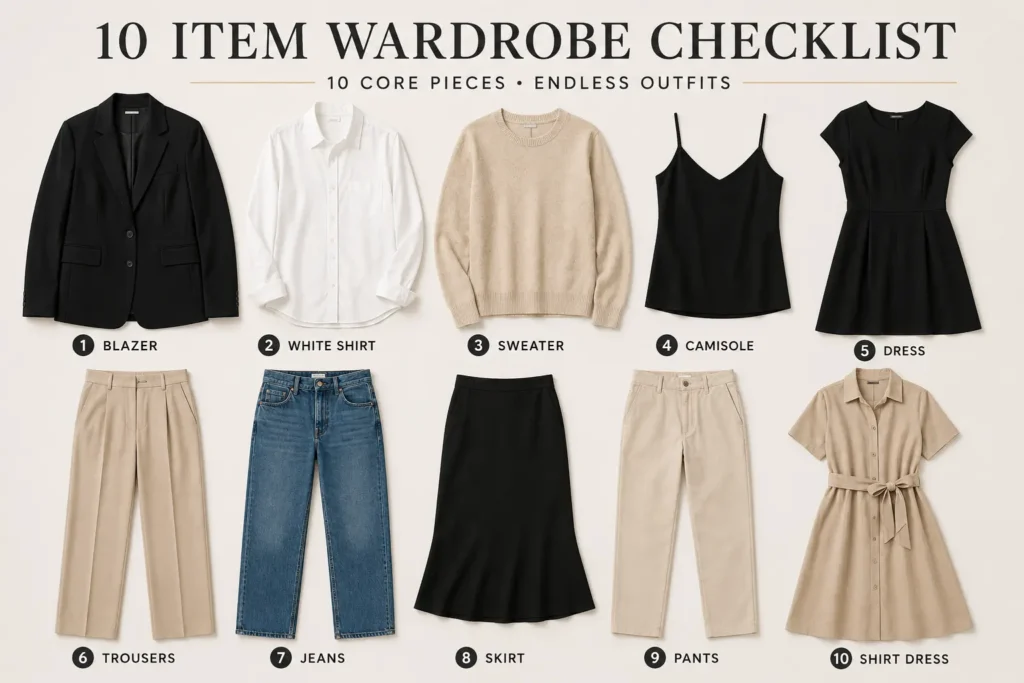
Here’s what most guides skip: an actual list you can copy. Use this as a template, then swap pieces to fit your climate, lifestyle, and color palette. This sample keeps to exactly ten versatile core pieces.
- Tailored trousers (black or a neutral)
- Dark wash jeans
- A second pair of jeans or casual trousers
- Crisp white shirt
- Silk or fine-knit blouse
- Everyday blouse or shirt in a main color
- Little black dress (LBD)
- Casual day dress
- Work-appropriate dress or skirt
- Versatile knit top or fine sweater
Then round it out with your extras: a trench coat, a blazer, a warm coat, a couple of t-shirts, a cardigan, and your shoes and accessories. Notice how heavily the list leans on neutrals and classic shapes.
That’s intentional. When your core pieces share a palette and pair easily, ten items generate far more outfits than the number suggests. Following the classic French formula, most of these are timeless staples rather than trend pieces you’ll tire of by next season.
10 Item Wardrobe Examples for Every Season
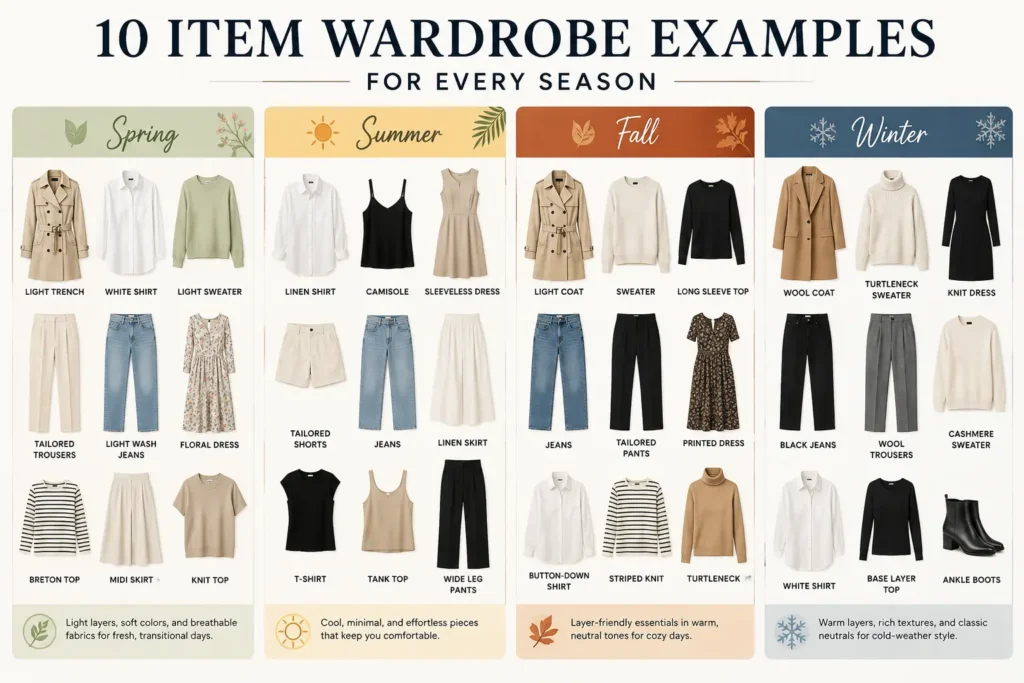
Because your ten should shift with the weather, here are four seasonal examples showing how the core rotates through the year. These 10 item wardrobe examples focus on the pieces that change most from season to season.
Spring 10 Item Wardrobe
Spring calls for lighter layers and transitional pieces: a trench coat as your hero layer, a couple of fine knits, breathable blouses, and a dress or two you can layer a cardigan over. Swap heavy boots for loafers and add clean white sneakers. For a fuller transitional list, see the spring capsule wardrobe guide.
Summer 10 Item Wardrobe
Summer is where ten items feels almost generous, since lighter fabrics simplify everything. Prioritize breathable tops, a couple of easy dresses, linen trousers or a skirt, and sandals. You’ll likely retire your heavy outerwear entirely. The summer capsule wardrobe guide has a complete warm-weather version.
Fall 10 Item Wardrobe
Fall is the classic layering season and arguably the most fun. Bring back sweaters, lean on a versatile jacket, add ankle boots, and introduce richer, deeper tones. A single scarf can transform a look here. Build it out with the fall capsule wardrobe guide.
Winter 10 Item Wardrobe
Winter asks the most from a small wardrobe, because warm layers and outerwear do the heavy lifting. Choose one excellent coat, a couple of merino or wool knits, warm boots, and core pieces that layer invisibly underneath. See the winter capsule wardrobe guide for cold-climate strategies.
How to Build Your 10 Item Wardrobe in 5 Steps
Ready to try it? Here’s the simplest path from a crowded closet to a working ten. Take it gently. This is meant to make your life easier, not add pressure.
Step 1: Empty your closet and declutter. Take everything out and hold each piece up to five honest questions: Does this fit me? Is it my true style? Do I love it? Do I wear it? Is it in good condition? If a piece fails, thank it and let it go. If you’d like a structured version of this, work through the capsule wardrobe checklist.
Step 2: Store your off-season pieces. Anything you can’t wear this season is just visual clutter. Pack away those wool sweaters or sundresses so your closet only shows what’s relevant right now. The visual calm is half the benefit.
Step 3: Choose your 10 core items. Start with your favorites and most-worn basics, then fill the gaps. The easiest way to guarantee everything mixes is to choose within a single color palette, so every top works with every bottom. A couple of neutrals plus one or two colors you love is usually all it takes.
Step 4: Add your extras. Layer in your t-shirts, sweaters, outerwear, shoes, and accessories. These give you range without inflating your core. A blazer and a trench coat alone can take the same ten pieces from weekend casual to polished in seconds. Layer in your t-shirts, sweaters, outerwear, shoes, and accessories. These give you range without inflating your core. A blazer and a trench coat alone can take the same ten pieces from weekend casual to polished in seconds.
Step 5: Keep the mindset, not just the number. The fashion police won’t arrest you for owning eleven or fifteen pieces. The real goal is a wardrobe that’s a reasonable, joyful size. If you push the number too hard, you lose the ease that made it appealing. The mindset is what carries the ten item wardrobe from a one-time declutter into a lasting habit.
See It Work: Outfit Combinations From 10 Items
The most common worry is, “Won’t I get bored?” In practice, no, because a well-chosen ten multiplies fast once you add your extras. Here’s a taste using the sample list above:
- White shirt + tailored trousers + blazer + loafers
- Dark jeans + silk blouse + trench + ankle boots
- Little black dress + cardigan + white sneakers
- Casual day dress + denim jacket + sandals
- Knit top + trousers + coat + boots
- White shirt + jeans + scarf + flats
- Work dress + blazer + heels
- Blouse + second jeans + sweater layered on top
- LBD + white shirt worn underneath + boots (a favorite French layering trick)
- Day dress + trench + loafers for effortless polish
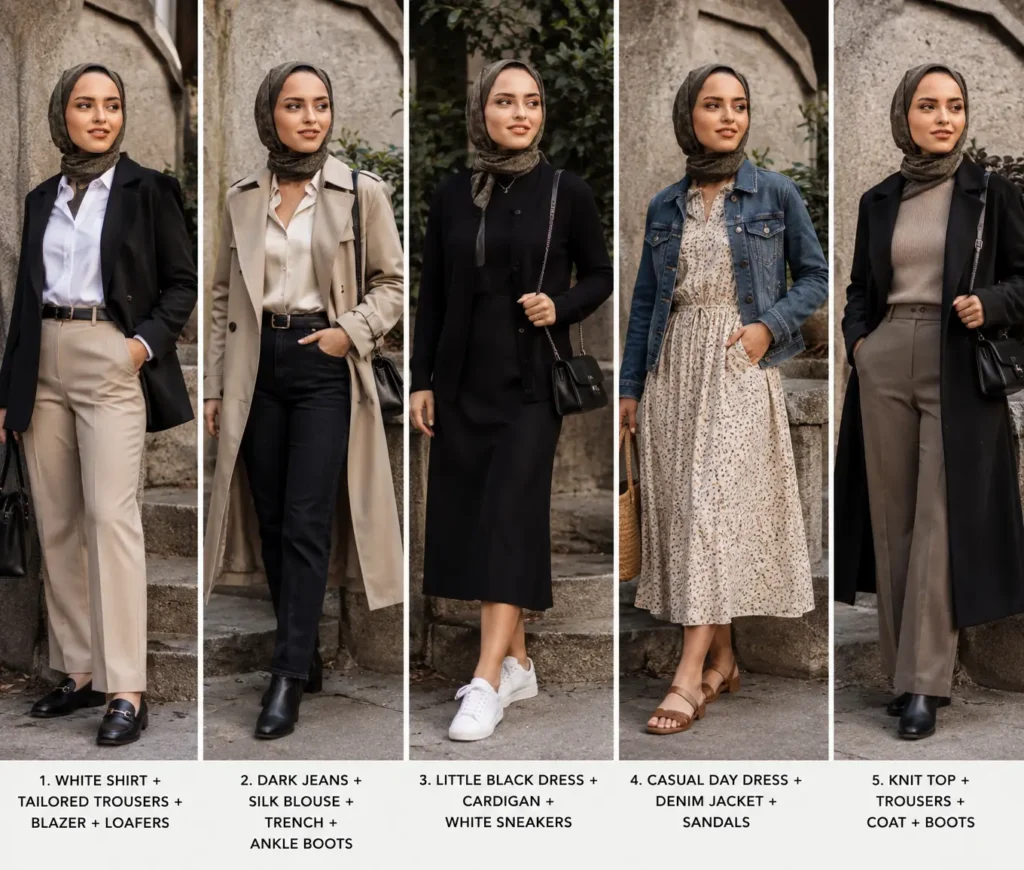
That’s ten distinct looks pulled from a handful of pieces, and we’ve barely started combining. Stretch across all ten cores plus your extras and the outfit count runs well into the dozens. Scarcity, it turns out, is what makes you creative.
10 Item Wardrobe vs Capsule Wardrobe vs Project 333
These three terms get used interchangeably, so here’s how they actually differ.
| Approach | Number of pieces | Time frame | Best for |
| 10 item wardrobe | 10 core + extras | Seasonal | The tightest, simplest core |
| Capsule wardrobe | Around 30 to 40 | Seasonal or ongoing | Flexible mix-and-match variety |
| Project 333 | 33 (all inclusive) | 3 months | A structured challenge with rules |
The 10 item capsule wardrobe is the most pared-down of the three, focusing only on core clothing while letting extras float freely. A standard capsule wardrobe is broader and includes everything in the count. Project 333, created by Courtney Carver, sets a firm 33-item limit including accessories and shoes for exactly three months. If you’re weighing the mindsets, this deeper look at a capsule wardrobe versus a minimalist wardrobe helps clarify which suits you. Many people move between them, using a ten item core as their foundation and expanding when life calls for it.
The Benefits of a 10 Item Wardrobe
People stick with this long after the first season because the rewards reach well beyond the closet. When you dress with a focused ten, you tend to:
- Reduce decision fatigue. Fewer choices in the morning frees mental energy for the things that actually matter. Many people describe it as functioning like a personal uniform.
- Save money. When you stop impulse buying to fill boredom, your spending drops. Investing in fewer, better pieces often costs less over time thanks to a lower cost per wear.
- Own higher quality. A smaller wardrobe justifies spending more on each piece, so everything you own is something you genuinely love and that lasts.
- Get ready faster. With a curated core, you can pull together an outfit in seconds and rarely run late deciding what to wear.
- Define your true style. Limiting your options forces you to notice what you actually love, which sharpens your personal style over time.
- Shop more sustainably. Buying less and choosing timeless pieces over fast fashion is one of the kindest choices you can make for the planet.
Common 10 Item Wardrobe Mistakes to Avoid
A few predictable stumbles trip up beginners. Sidestep these and the whole thing gets easier.
- Obsessing over the exact number. Ten is a guide, not a rulebook. Landing at twelve or fifteen is still a win. The intention matters more than the math.
- Skipping a color palette. This is the big one. If your pieces don’t share a palette, they won’t mix, and ten items will feel limiting instead of freeing.
- Choosing low-quality basics. The 10 item wardrobe lives or dies on quality. Thin, poorly made pieces wear out fast and undermine the whole point.
- Counting aspirational “someday” pieces. The dress you hope to fit into or the blouse you never quite wear only wastes a slot. Build around your real life.
- Forgetting to store off-season clothes. Leaving your winter coats in view during summer creates the exact visual clutter you’re trying to escape.
Free Printable 10 Item Wardrobe Checklist
Want to make this effortless? Grab the free printable 10-item-wardrobe-checklist. It gives you space to write in your ten core items, list your extras, and check everything off as you build your capsule. Keep it on your phone while you shop your closet, and you’ll never lose track of your ten. Print it, fill it in, and start with total clarity.
Ready to Simplify Your Closet?
The 10 item wardrobe works because it’s small enough to feel calm and powerful enough to change how you see everything you own. You don’t need to buy anything new or get it perfect on the first try. You simply choose ten pieces you love, support them with a few good extras, and let the ease unfold. Most people are surprised to find they never miss the crowded closet at all.
Start by settling your colors with the capsule wardrobe color palette guide, then follow the how to build a capsule wardrobe method to assemble your ten. Your simplest, calmest mornings are just a decluttered closet away.
Frequently Asked Questions
What is the 10 item wardrobe?
The 10 item wardrobe is a minimalist approach where you build your outfits around ten versatile core clothing pieces worn in rotation across a season. Extras like t-shirts, sweaters, outerwear, shoes, and accessories don’t count toward the ten. It was popularized by Jennifer L. Scott and is inspired by the way stylish French women dress.
Do shoes count in a 10 item wardrobe?
No, shoes generally don’t count toward your ten. They fall into the “extras” category along with outerwear and accessories. Jennifer Scott famously counts several pairs of shoes as a single item, so you don’t need to agonize over them. The ten refers to your core clothing pieces.
Who created the 10 item wardrobe?
The concept was popularized by Jennifer L. Scott through her book Lessons from Madame Chic, her blog The Daily Connoisseur, and a popular TEDx talk. She based it on the French approach to dressing that she observed while living in Paris, where women wear a few quality pieces in constant rotation.
Is a 10 item wardrobe realistic?
Yes, for most people it’s more realistic than it sounds, because the ten only covers core clothing. With extras like sweaters, outerwear, and accessories layered in, ten core pieces produce dozens of outfits. If your lifestyle needs a little more, a twelve or fifteen item version still delivers the same ease.
What’s the difference between a 10 item wardrobe and a capsule wardrobe?
A 10 item wardrobe is a tighter, more focused version of a capsule wardrobe. A capsule typically includes around 30 to 40 pieces counting everything, while the ten item version counts only your core clothing and treats extras separately. Think of the 10 item capsule wardrobe as the minimalist heart of a larger capsule.
How do I change my 10 items for each season?
You don’t rebuild from scratch. You rotate. Keep your palette and core shapes consistent, then swap seasonal pieces: lighter fabrics and dresses in spring and summer, heavier knits and outerwear in fall and winter. Store the off-season pieces out of sight so your closet only shows what’s wearable now.
Emma studied fashion but could never get her own closet under control. Capsule wardrobes finally fixed that. Now she writes about what actually worked for her, in the hope it saves you a few frustrating mornings.