Getting dressed modestly shouldn’t take twenty minutes and three outfit changes. Yet that’s what happens when your closet is full of pieces that almost work: the dress that needs a layer, the skirt with a slit that’s too high, the top that’s fine until you raise your arms.
Most capsule wardrobe guides make this worse. They assume everyone dresses the same way, so their “essentials” are sleeveless tops, short shift dresses, and cropped trousers. If you wear long sleeves all year, skip trousers, cover your hair, or simply prefer looser fits, half that list needs fixing before you can wear it.
A modest capsule wardrobe solves this by flipping the order. You set your coverage rules first, then build a small, mix-and-match wardrobe where every piece already meets them. It works whether you dress modestly for faith, culture, work, or personal comfort.
In this guide, you’ll learn how to:
- Write a personal modesty spec and test any piece in 60 seconds
- Work out exactly how many pieces you need, instead of guessing
- Choose a colour palette that includes your hijab or scarves
- Pick a skirt-based, trouser-friendly, or abaya-based style path
- Build a 30-piece capsule with a full checklist and outfit grid
- Stay cool in long sleeves and build it all on a real budget
Quick answer: A modest capsule wardrobe is a small collection of interchangeable clothes, usually 25 to 35 pieces, where every item meets your personal coverage standards. To build one: (1) write your modesty spec, (2) choose your piece count, (3) audit your closet, (4) set a colour palette that includes your scarves, and (5) pick the core pieces for your style path.
New to the concept itself? Start with our explainer on what a capsule wardrobe is, then come back here for the modest version.
What Makes a Capsule Wardrobe “Modest”?
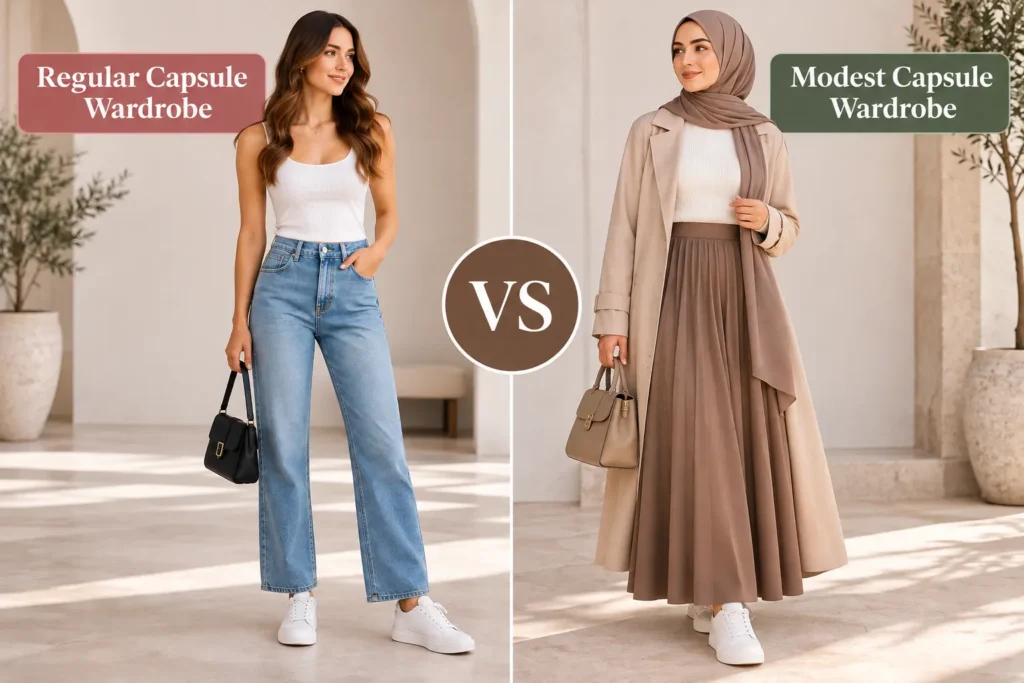
A capsule becomes modest when every piece meets your coverage standard without extra fixes. There is no single global rule. What counts as modest depends on your faith, community, workplace, and comfort.
Coverage Standards Differ
The table below shows common approaches. Practices vary widely within every tradition, so treat it as a starting point, not a rulebook.
| Approach | Neckline | Sleeves | Hem | Trousers? | Other notes |
|---|---|---|---|---|---|
| Hijab-wearing Muslim women | High or covered | Usually to the wrist | Usually to the ankle | Often yes, loose cut | Hair covered; loose, non-clingy silhouettes |
| Skirts-only Christian communities | Modest, no low cuts | Often elbow or longer | Knee or below, often midi to maxi | Usually no | Varies a lot by church |
| Orthodox Jewish (tznius) | Collarbone covered | Elbows covered | Below the knee, including when sitting | Usually no | Married women often cover hair |
| Garment-friendly (LDS) | Covers the garment | Covers the garment sleeve | Covers the garment hem | Yes | The garment sets the minimum coverage |
| Personal preference | Your call | Your call | Your call | Your call | Comfort, workplace, or climate may drive it |
Whatever your standard, the method in this guide stays the same. Only the item list changes.
Why Generic Capsule Lists Don’t Work for Modest Dressers
Standard capsule lists are built around pieces many modest dressers can’t wear alone: sleeveless tops, short shift dresses, slip dresses, cropped trousers, and fitted knits. Each one needs a layer, an alteration, or a swap.
That breaks the core promise of a capsule, which is fewer pieces and faster mornings. A modest capsule starts with your rules, so every piece works the moment you put it on.
Step 1: Write Your Personal Modesty Spec
Your modesty spec is a short written list of your coverage rules. It turns “is this modest enough?” into a quick yes or no while you shop or sort. For the general build process behind these steps, see our guide on how to build a capsule wardrobe.
The 5-Point Coverage Checklist
Write one line for each point. Keep it on your phone.
- Neckline: How high? For example, “no lower than the collarbone.”
- Sleeves: Minimum length? Cap, elbow, three-quarter, or wrist.
- Hem: Minimum length, standing and sitting? Knee, midi, or ankle.
- Opacity: No visible skin or underwear in daylight.
- Fit: How close to the body? Skims, relaxed, or loose.
The 60-Second Movement Test
A piece can pass on a hanger and fail on your body. Try every new or doubtful item with these moves:
- Sit on a low chair. Check the hem and any slit.
- Bend forward as if picking something up. Check the neckline and back.
- Raise both arms. Check the sleeves, waist gap, and hem lift.
- Stand in sunlight or by a window. Check for see-through fabric.
If it fails one move, it goes in the “fix” pile, not the capsule.
Step 2: Find Your Number
The right size for a modest capsule is the smallest number that gets you to laundry day without stress. Guides quote anywhere from 7 to 45 pieces, which is why a formula beats a magic number.
The Piece-Count Formula
Work out how many outfits you need between washes, then add a few occasion pieces:
Core outfits = (Days between laundry × Outfits per day) + Occasion pieces
For example: you do laundry every 7 days, change once a day, and need 2 occasion pieces. That means 9 outfits. Around 25 to 30 well-matched pieces will cover that with room to spare.
Modest capsules often need slightly more pieces than standard ones because layering tops and slips do quiet work in the background.
Starter, Standard or Full Capsule
| Category | Starter (15) | Standard (30) | Full (40) |
|---|---|---|---|
| Tops | 5 | 8 | 11 |
| Bottoms | 3 | 6 | 8 |
| Dresses/abayas | 2 | 4 | 6 |
| Layering pieces | 2 | 6 | 7 |
| Outerwear | 1 | 2 | 3 |
| Shoes | 2 | 4 | 5 |
Scarves, hijabs, and accessories sit outside these counts. Start with the starter or standard size. Only grow when you notice a real, repeated gap.
Step 3: Audit Your Closet: Keep, Fix, or Let Go
You don’t need to start from zero. Most people already own half a modest capsule; it’s just hidden among pieces that don’t work.
Sorting Your Current Clothes
Pull everything out and sort it into three piles using your modesty spec:
| Pile | What goes here | Next step |
|---|---|---|
| Keep | Passes all 5 coverage points and the movement test, fits well, and you wear it | Back in the closet |
| Fix | Almost works: a slit too high, sleeves too short, slightly sheer | Alter, layer or line it within 30 days |
| Let go | Fails your spec, doesn’t fit, or hasn’t been worn in a year | Donate, resell or swap |
Be honest with the “fix” pile. If a piece has sat there for a month, it belongs in “let go”.
Simple Modest Alterations
A good tailor can turn a near-miss into a capsule staple, often for less than a replacement. These are the most useful fixes:
- Close a slit: A few stitches stop a skirt or dress slit at knee height.
- Lengthen a hem: Let down the existing hem, or add a matching band or ruffle at the bottom.
- Add sleeves: Sew in sheer or matching sleeves on a sleeveless dress.
- Raise a neckline: Add a modesty panel or a snap-in insert.
- Line a sheer piece: A simple lining makes a light skirt or blouse wearable on its own.
Step 4: Build a Palette That Includes Your Scarves
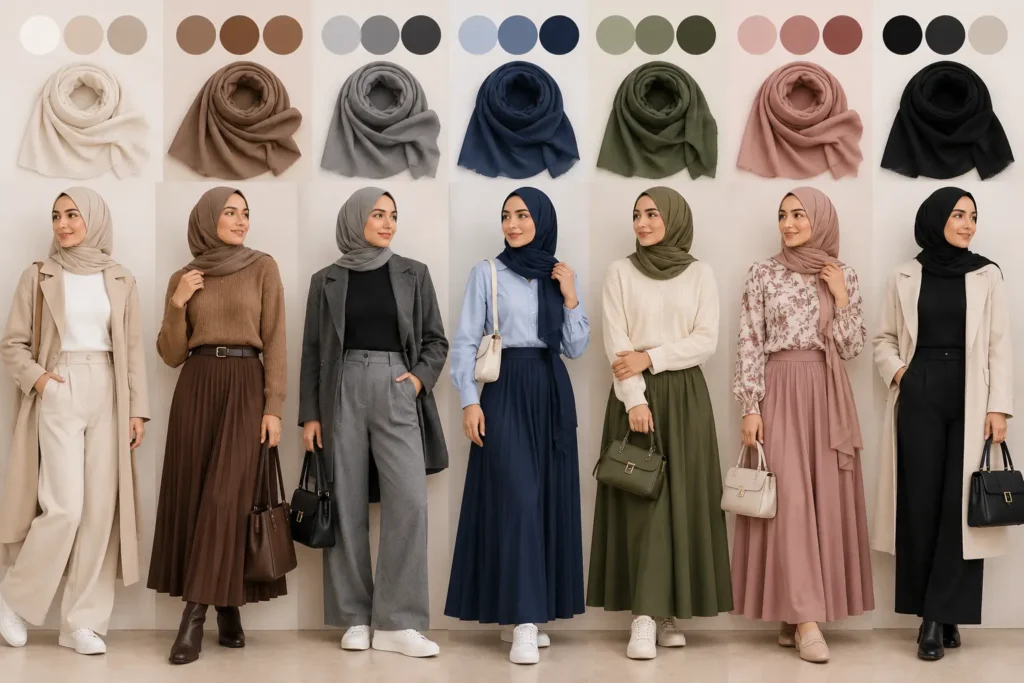
A tight colour palette is what lets 30 pieces act like 70 outfits. For modest dressers who wear a hijab or headscarf, the scarf is part of nearly every outfit, so it belongs in the palette from the start. For more palette ideas, see our full capsule wardrobe colour palette guide.
Base, Accent and Statement Colours
- Base (2 colours): Your workhorse neutrals for bottoms, outerwear and shoes. Examples: black and grey, navy and cream, or chocolate and camel.
- Accent (2–3 colours): Softer shades for tops and dresses that flatter your skin tone. Examples: olive, dusty rose, sage or soft blue.
- Statement (1 colour): One richer shade for a dress, scarf or cardigan. Examples: emerald, burgundy or mustard.
Rule of thumb: every top should work with at least 3 bottoms, and every bottom with at least 4 tops.
How Many Hijabs or Headscarves You Need
Six scarves cover most capsules if you split them into three tiers:
| Tier | Count | Role | Example |
|---|---|---|---|
| Tonal | 3 | Matches your base colours for a seamless, longer line | Black, taupe, navy |
| Contrast | 2 | Lifts a neutral outfit or frames your face | Ivory, dusty rose |
| 1 | Adds pattern while the clothes stay plain | Small floral in your accent shades |
Keep prints on the scarf, not the clothes. Plain garments plus one printed scarf give you variety without breaking the palette.
Step 5: Pick Your Style Path
Your style path decides which bottoms and one-piece items anchor the capsule. Pick the one closest to your spec; you can borrow pieces from the others.
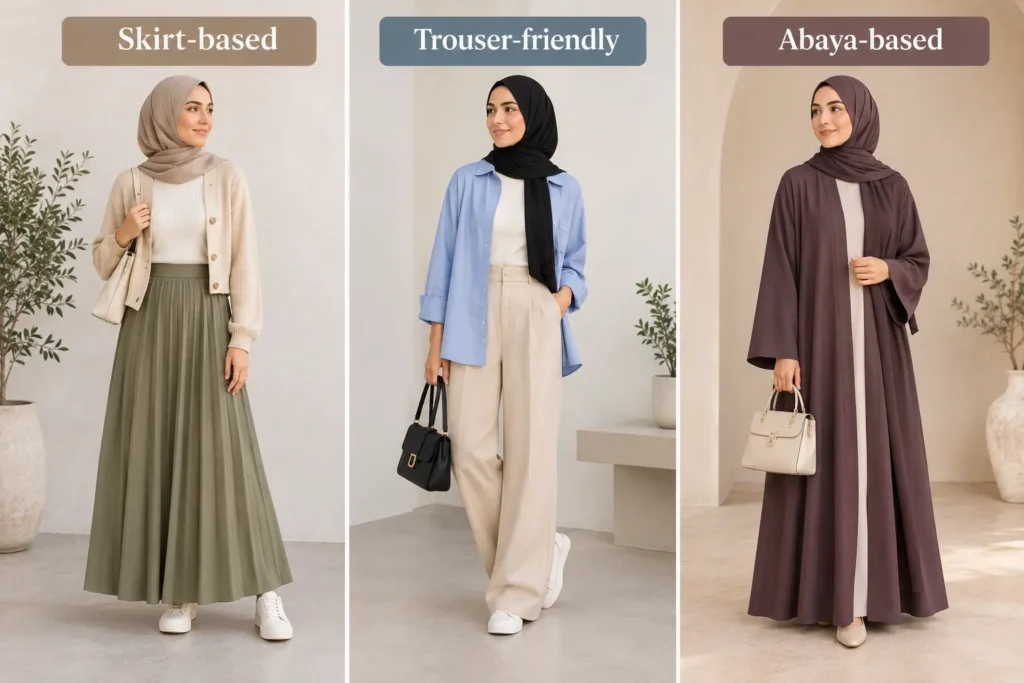
| Skirt-based | Trouser-friendly | Abaya / dress-based | |
|---|---|---|---|
| Anchors | Midi and maxi skirts | Wide-leg trousers + tunics | Abayas and maxi dresses |
| Bottoms in a 30-piece capsule | 5–6 skirts | 2–3 skirts + 3 trousers | 2–3 skirts or trousers under abayas |
| Key layer | Layering tees under dresses | Longline blazer or tunic | Long cardigan or kimono |
| Best for | Skirts-only communities, tznius | Office, travel, active days | Hijab wearers who prefer one-piece outfits |
| Watch out for | High slits, see-through knits | Short tops that don’t cover the hip | Too many similar abayas |
Skirt-Based Capsule
Build around four skirt shapes: A-line midi, flowy maxi, denim, and below-the-knee pencil. Pair them with tops that tuck or sit at the hip. Add one or two layering dresses for days you don’t want to think.
Trouser-Friendly Capsule
Choose wide-leg or straight trousers with a high rise. Pair them with tunics, longline blouses or blazers that cover the hip. One denim skirt and one maxi skirt keep options open for formal days.
Abaya or Dress-Based Capsule
Two everyday abayas or maxi dresses in base colours do most of the work. Change the look with layers, belts, and your scarf tiers. Keep slips and layering tees underneath for comfort and opacity.
Fit Notes for Petite, Tall and Plus-Size Bodies
- Petite: Measure from your waist to your ankle and compare it with the listed skirt length. Choose petite-length maxis, and keep midis just below the knee to avoid a short-legged look. More tips in our petite capsule wardrobe guide.
- Tall: Check sleeve and hem lengths in inches before buying. Look for “tall” ranges, and favour maxi skirts with a deep hem you can let down.
- Plus-size: Choose fabrics that skim rather than cling, like ponte, crepe and heavier jersey. A-line skirts and open long cardigans create a long, clean line. See our plus-size capsule wardrobe for sizing-friendly picks.
Modest Capsule Wardrobe Checklist: 30 Essential Pieces
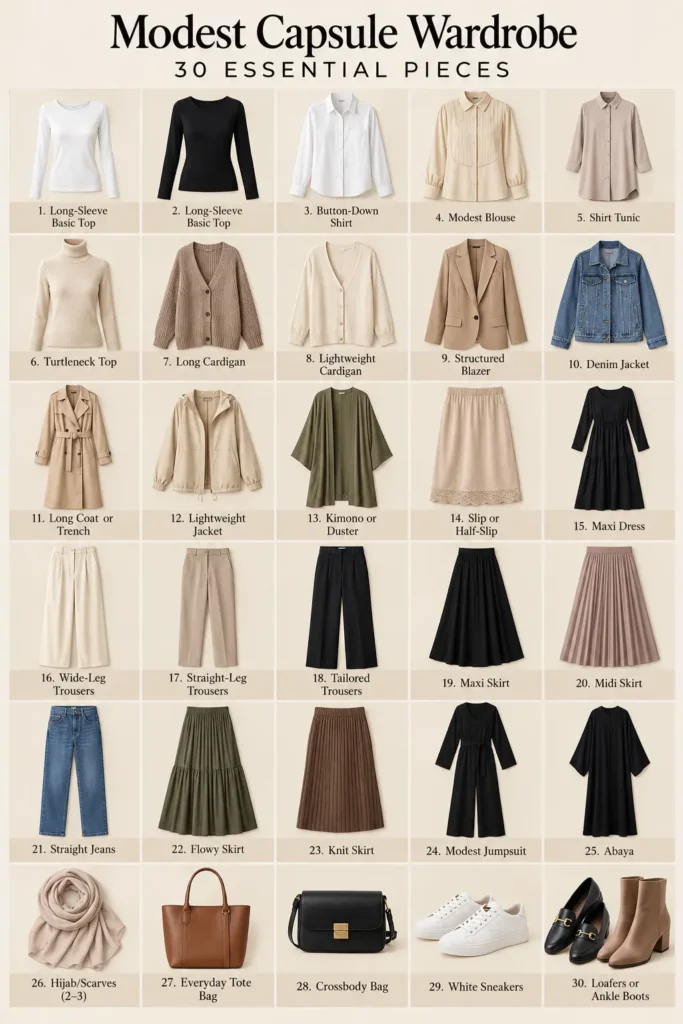
These 30 pieces form a complete standard capsule. Each item carries a path tag (All, Skirt, Trouser, or Abaya) and a one-line modest tip. Swap items to match your spec; keep the counts. For a general, non-modest version, see our main capsule wardrobe checklist.
Tops (8)
Tops do the most daily work in a modest capsule, so choose them for coverage first and style second. Stick to your base and accent colours so every top pairs with at least three bottoms.
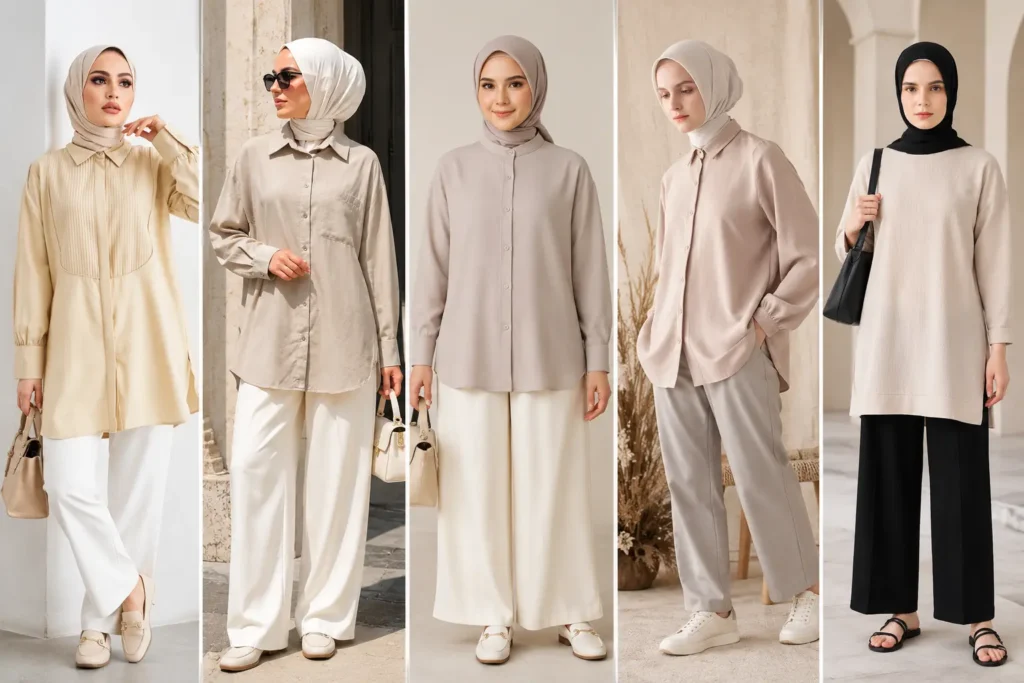
- 2 long-sleeve tees (white and black) (All paths): The backbone of casual outfits. Choose a heavier cotton so the white one isn’t see-through, and check that the hem covers your waistband when you raise your arms.
- 2 layering tops or tanks (neutral) (All paths): These sit under sleeveless dresses, low necklines, and sheer blouses. Pick a snug crew or boat neck that won’t gape when you bend.
- 1 button-down shirt (All paths): Wear it alone, open over a dress, or under a sweater. Size up slightly so the buttons don’t pull open across the chest.
- 1 blouse (All paths): Your dressier top for work and events. Look for a lined or double-layer front so it doesn’t need an extra layer.
- 1 turtleneck or mock-neck (All paths): A fine knit adds warmth and coverage under dresses and jumpers without bulk.
- 1 tunic (Trouser path): Essential if you wear trousers. It should reach at least mid-thigh to cover the hip.
Bottoms (6)
Bottoms set the shape of your capsule. Skirts-only dressers keep the four skirts; trouser-friendly dressers can swap one or two skirts for trousers.
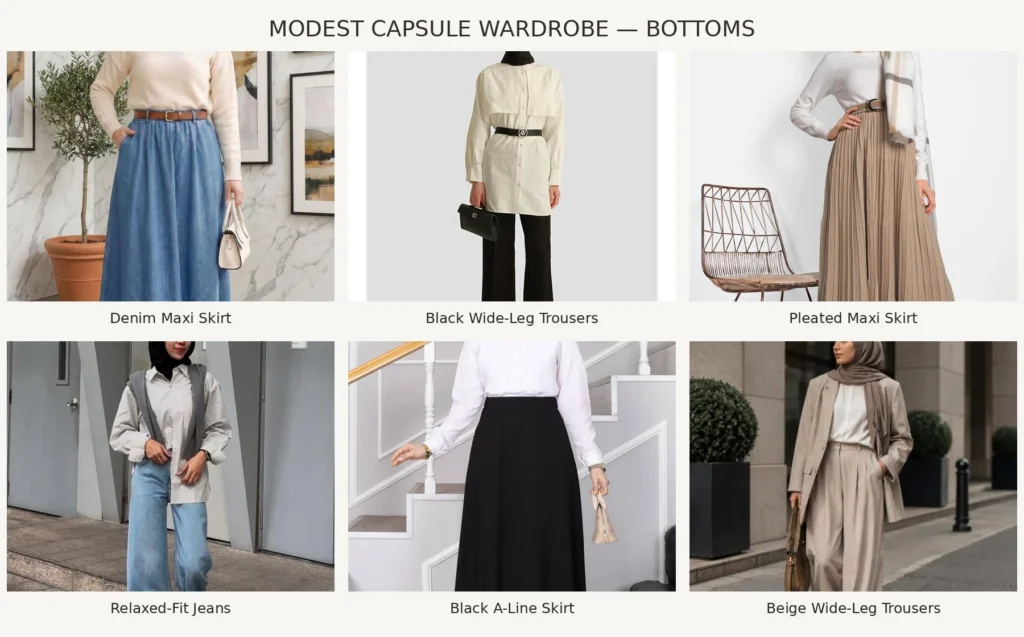
- A-line midi skirt (Skirt path): The most versatile skirt you can own. It works with tees, blouses and knits. Do the sit test to make sure the hem stays below the knee.
- Flowy or knit maxi skirt (Skirt and Abaya paths): Comfortable, elegant and easy to dress up or down. Check the slit height and hold it up to the light for opacity.
- Denim skirt (Skirt path): Your casual weekend staple. Choose one with a back slit that stops below the knee.
- Below-the-knee pencil skirt (Skirt path): Polished enough for the office. It needs a walking slit, so close it with a few stitches if it rises too high.
- Wide-leg trousers (Trouser path, optional): A high rise and loose leg keep them comfortable and cling-free.
- Tailored trousers (Trouser path, optional): For work and smart-casual days. Pair them with tops long enough to cover the seat.
Dresses and Abayas (4)
Dresses and abayas are one-step outfits, which makes them the fastest pieces in any modest capsule.
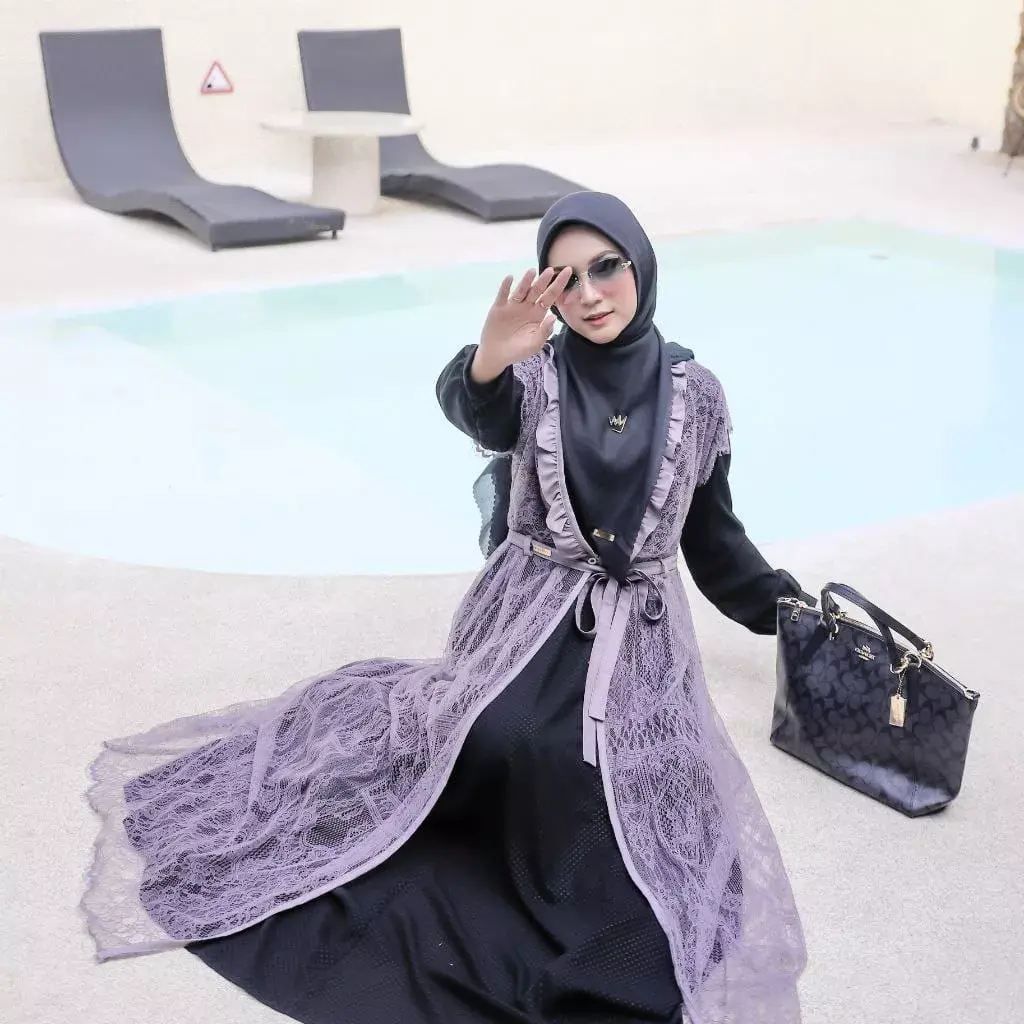
- Long-sleeve midi or maxi dress (All paths): Pick a solid base colour so it works with every layer and scarf you own.
- Sleeveless layering dress (Skirt and Abaya paths): Wear it over a tee in summer and a turtleneck in winter. One dress, two seasons.
- Modest black dress (All paths): Covers weddings, dinners, and formal events. Add a slip if the fabric is light.
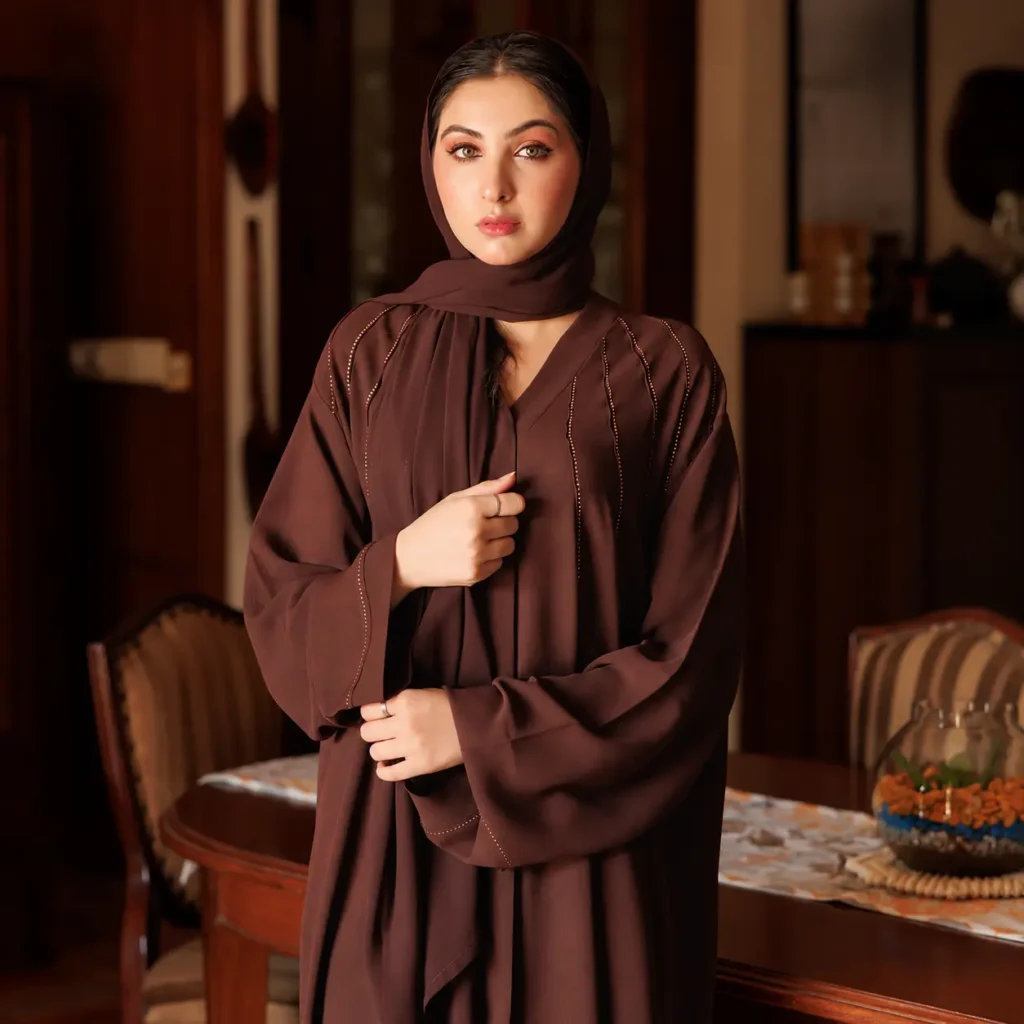
- Everyday abaya or shirt dress (Abaya path): Choose a breathable, wrinkle-resistant fabric you can wear straight from the bag.
Layering Pieces (6)
Layering pieces are the secret weapon of modest dressing. They add coverage, change the look of an outfit, and let one dress work across seasons.
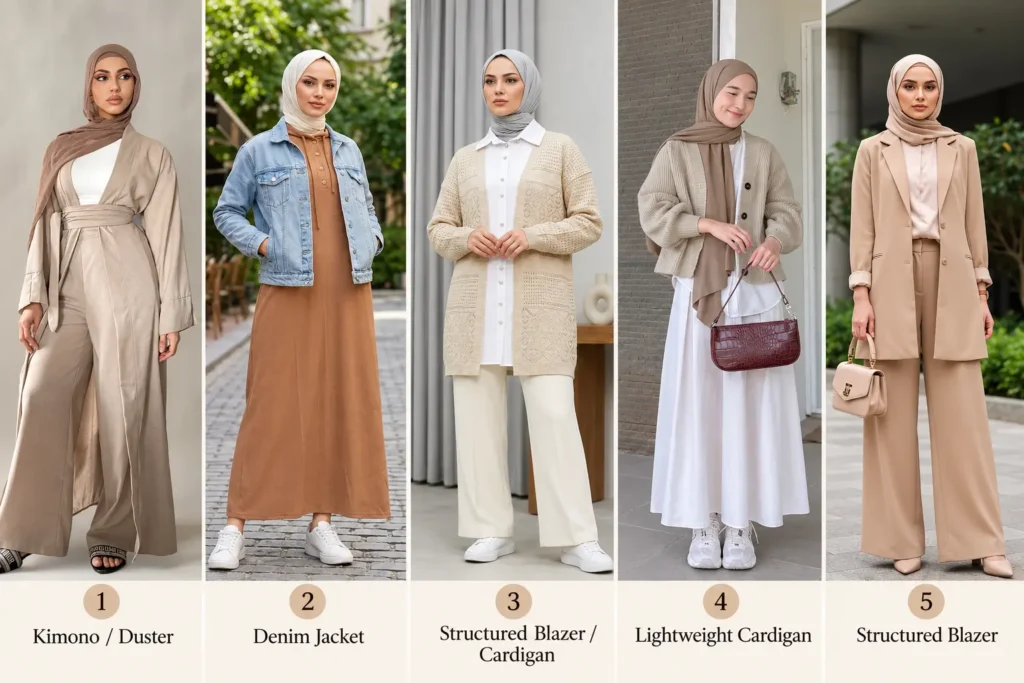
- Long cardigan (All paths): Hip length or longer adds coverage and creates a long, clean line.
- Lightweight cardigan (All paths): Covers short sleeves in summer and air-conditioned rooms.
- Structured blazer (All paths): Instantly makes an outfit office-ready. Longline cuts also cover the hip.
- Denim jacket (All paths): Turns a dressy maxi dress into a casual weekend look.
- Slip or half-slip (All paths): Fixes sheer skirts and dresses in seconds. Easy to forget, hard to live without.
- Kimono or duster (All paths): Adds arm coverage over short sleeves without adding heat.
Outerwear (2)
Two outer layers handle most climates. Buy them in your darkest base colour so they match everything underneath.
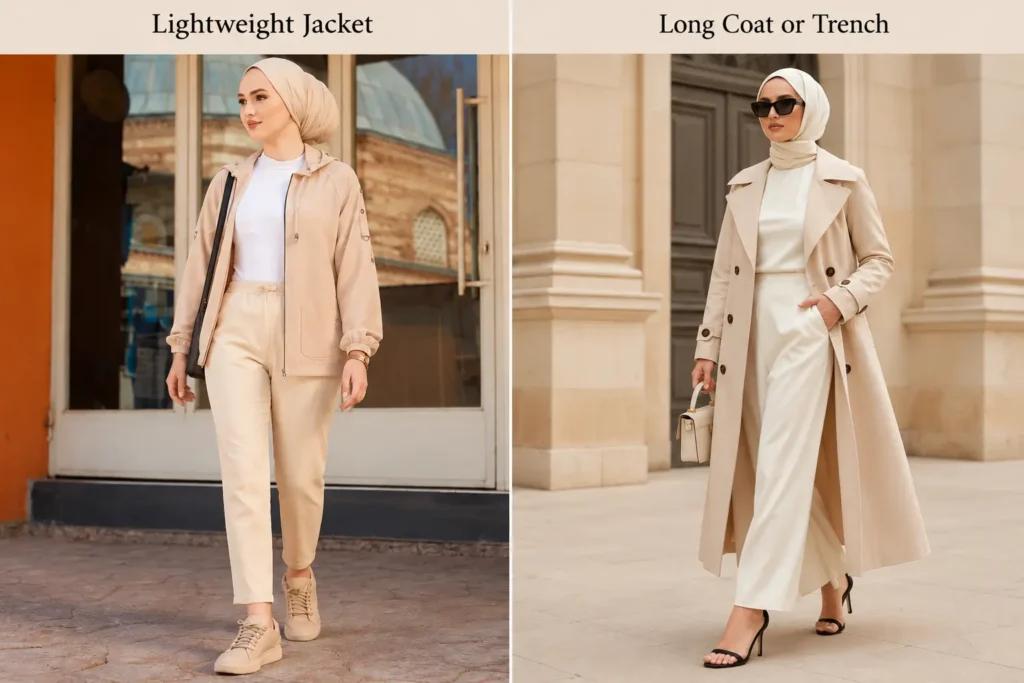
- Long coat or trench (All paths): A knee-length or longer coat covers midi skirts and keeps the outfit’s line unbroken.
- Lightweight jacket (All paths): For spring and autumn. Make sure it covers your longest layering top.
Shoes (4)
Four pairs of shoes cover casual, work, and dressy days. Comfort matters, because you’ll wear each pair often.
- Flats or loafers (All paths): Work with every hem length, from midi skirts to trousers.
- White sneakers (All paths): Make maxi skirts and abayas feel relaxed and modern.
- Ankle or knee-high boots (All paths): Knee-highs add extra coverage under midi skirts in winter.
- Sandals (All paths): Choose neutral colours and minimal straps for summer.
Hijabs, Scarves and Accessories
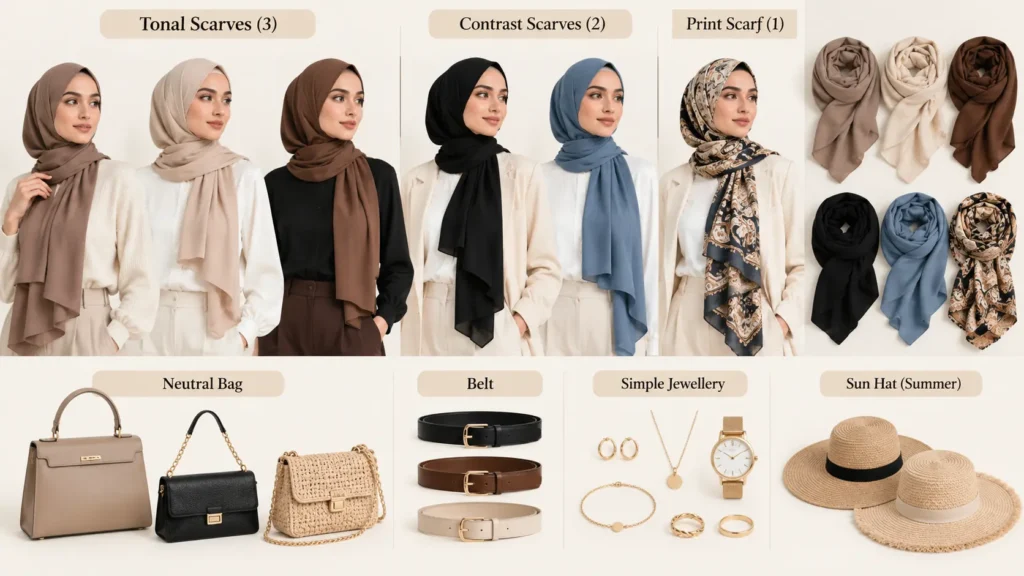
- Scarves: 3 tonal, 2 contrast, 1 print (see Step 4).
- Accessories: a neutral bag, a belt, simple jewellery and a sun hat for summer.
The Outfit Grid
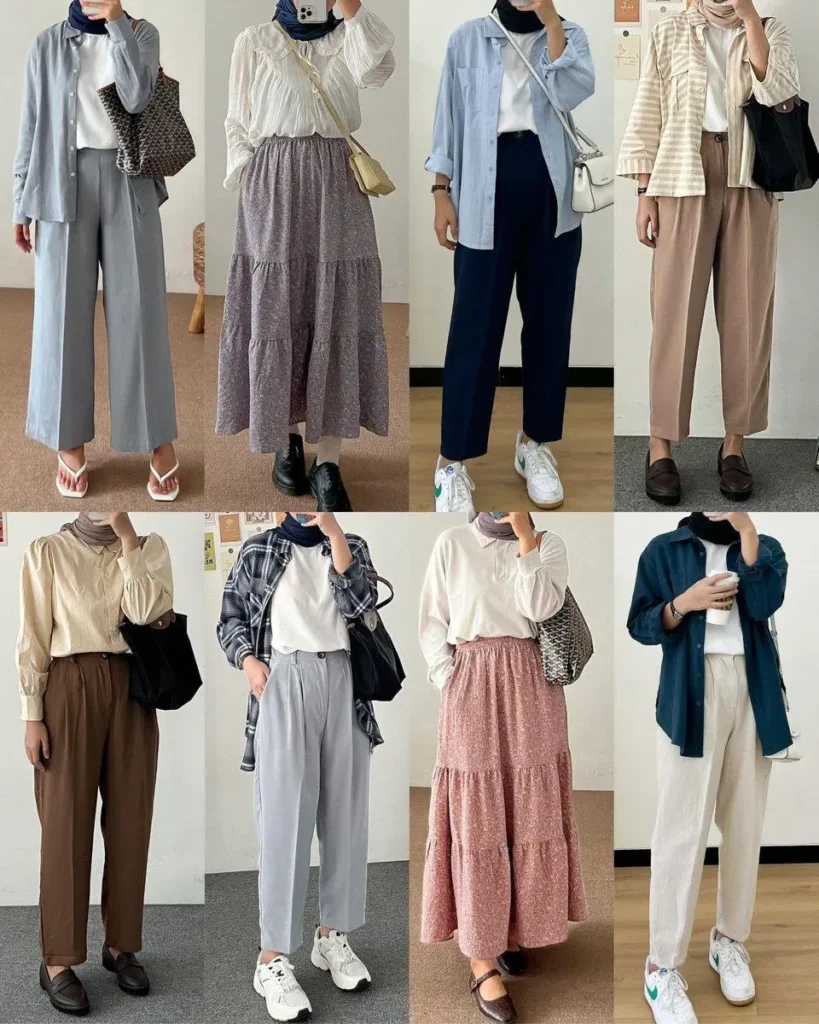
The math is simple. If 8 tops each work with 6 bottoms, that is 48 combinations. Add 4 dresses worn with 6 different layers, and you get 24 more. That makes over 70 base outfits, before you change shoes or scarves.
Here is a slice of the grid, showing how four tops and four bottoms cover a whole week:
| A-line midi | Maxi skirt | Denim skirt | Wide-leg trousers | |
|---|---|---|---|---|
| White tee | Errands | Weekend | Casual | Travel |
| Button-down | Office | Church or event | Smart casual | Office |
| Turtleneck | Winter office | Winter dinner | Winter casual | Winter travel |
| Tunic | Not ideal | Relaxed day | Not ideal | Everyday |
The Modest Layering System (Without the Bulk)
Layering is how a modest capsule stretches, but too many layers make outfits heavy and hot. Think in three layers, and only use the ones a piece needs.
Foundation Layer
These pieces sit closest to the skin and solve coverage quietly:
- Layering tees and tanks: Fill in low necklines, short sleeves and sleeveless dresses.
- Slips and half-slips: Make light skirts and dresses opaque.
- Shorts or leggings under skirts: Add confidence on windy days, stairs and while sitting on the floor.
Choose thin, smooth fabrics in skin-tone or base colours so they disappear under clothes.
Mid and Outer Layers
The mid layer adds coverage and style: cardigans, blazers, kimonos and vests. The outer layer handles weather: coats and jackets.
Use the one-silhouette rule: if one layer is loose, keep the other more structured. A flowy maxi skirt pairs well with a fitted cardigan. A loose tunic looks sharper under a structured blazer. Two loose layers together read as bulky and add heat.
Fabrics That Cover Without Overheating
The right fabric does two jobs: it stays opaque, and it lets your skin breathe. Getting both right is what makes long sleeves wearable in July.
Opacity and Fabric Weight
Fabric weight is often listed as GSM (grams per square metre). As a rough guide, very light tees and knits are the most likely to show through, especially in white and pale colours. Mid-weight and heavier knits usually stay opaque.
When there is no GSM on the label, use the hold-it-to-the-light test. Put your hand inside the garment and hold it up to a window. If you can clearly see your hand’s outline, plan to line it, layer it, or skip it.
Hot-Climate vs Cold-Climate Fabrics
| Climate | Best fabrics | Why | Watch out for |
|---|---|---|---|
| Hot and humid | Linen, cotton lawn, Tencel (lyocell), rayon challis | Breathe well and dry fast | Light linen and lawn can be sheer; add a slip |
| Hot and dry | Loose linen, cotton voile, lightweight wool | Shade the skin and let air move | Voile is very thin; line skirts |
| Mild | Cotton jersey, crepe, viscose blends | Drape without clinging | Thin jersey can cling when you move |
| Cold | Wool, merino, ponte knit, cashmere | Warm and structured | Bulky knits under fitted coats |
In the heat, looser cuts matter as much as the fabric. Air moving between cloth and skin keeps you cooler than a thin, tight top. Our summer capsule wardrobe has more warm-weather pieces you can adapt.
Capsule Slots Most Guides Forget
A capsule fails when real life asks for something it doesn’t hold. Reserve a few slots for these situations.
Work and Office
A structured blazer, tailored trousers or a pencil skirt, and a blouse cover most offices. Add a longline cardigan for air-conditioned rooms. For a deeper office plan, see our work capsule wardrobe.
Worship and Religious Occasions
Church services, Jummah, Shabbat, Eid and weddings often call for a slightly dressier look. One or two occasion pieces are enough: a long-sleeve maxi dress in a rich fabric, or a dressy abaya. Change the look each time with a different scarf, jewellery, or layer.
Modest Activewear and Swim
Most capsule guides leave out activewear, but modest dressers need it planned. Useful pieces include:
- Athletic skirts with built-in leggings
- Long-sleeve, loose-fit workout tops
- A sports hijab, if you wear one
- A swim dress or full-coverage swimsuit
Our athleisure capsule wardrobe covers comfortable pieces that double as weekend wear.
Pregnancy and Nursing-Friendly Pieces
Wrap dresses, empire-waist maxis, stretch-waist skirts and long open cardigans can carry you through pregnancy. For nursing, look for side-zip or button-front dresses and layering tops with a hidden opening. See our maternity capsule wardrobe and nursing capsule wardrobe guides for full lists.
Building a Modest Capsule on a Real Budget
You can build a full modest capsule in about three months without a big one-time spend. Buy in phases, start with the pieces you’ll wear most, and use what you already own.
A 3-Phase Buying Plan
The amounts below are a sample for someone buying mid-range and thrifted pieces in the US. Your totals will drop for every piece you already own.
| Phase | Timing | What to buy | Sample budget |
|---|---|---|---|
| 1. Foundation | Month 1 | Layering tops, slips, 2 long-sleeve tees, 1 skirt or trouser in your base colour | $150–250 |
| 2. Core | Month 2 | Remaining bottoms, 2 dresses or abayas, long cardigan, everyday shoes | $200–350 |
| 3. Finish | Month 3 | Blazer, coat, occasion piece, scarves to complete your tiers | $100–200 |
Cost-Per-Wear Example
Cost per wear is the price divided by the number of times you wear it. It shows why a slightly pricier staple can be the cheaper choice:
- A $90 maxi skirt worn 80 times costs about $1.13 per wear.
- A $25 trend skirt worn 6 times costs about $4.17 per wear.
Spend more on the pieces you wear weekly, like skirts, trousers and shoes. Save on trend colours and occasion pieces.
Finding Modest Pieces in Mainstream and Thrift Stores
- Use search filters: Try “maxi”, “long sleeve”, “ankle length”, “midi skirt” and “lined”.
- Check the listed length: Most product pages list length in inches. Compare it with your own waist-to-ankle or shoulder-to-ankle measurement.
- Read the fabric content: It tells you more about opacity and heat than the photo does.
- Thrift by category, not by rack: Go straight to skirts and dresses, and check for slits and sheerness on the spot.
- Buy from shops with easy returns: Then do the movement test at home.
5 Mistakes That Break a Modest Capsule
- Copying a generic list. Half of it won’t meet your spec. Start from your rules instead.
- Skipping the sunlight test. Sheer fabric is the most common reason modest pieces sit unworn.
- Buying too many prints. Prints rarely mix. Keep patterns on scarves and accessories.
- Forgetting the foundation layer. Without slips and layering tops, half your dresses become unwearable.
- Ignoring your climate. A capsule built for a cold city fails in a humid summer, so plan fabrics by season.
Final Thoughts
A modest capsule wardrobe works when it starts from your rules, not someone else’s list. Write your modesty spec, pick your number, keep what already works, and fill the gaps in phases. The result is a closet where every piece fits your values and every morning is easier.
Once your core 30 pieces are in place, you can extend them into a year-round capsule wardrobe by swapping only a few fabrics and layers each season.
FAQ
What are the essential pieces of a modest capsule wardrobe?
The core is long-sleeve tees, layering tops, a blouse, midi and maxi skirts or wide-leg trousers, a long-sleeve dress, a long cardigan, a blazer, a coat and four pairs of shoes. Hijab wearers add about six scarves in tonal, contrast and print tiers.
Can a modest capsule wardrobe include jeans or trousers?
Yes, if your standard allows them. Choose wide-leg or straight cuts with a high rise, and pair them with tops or tunics that cover the hip. Skirts-only dressers can swap trousers for a denim skirt.
How many hijabs should a capsule wardrobe have?
Around six covers most needs: three tonal scarves that match your base colours, two contrast scarves, and one print. Add more only if you wear a hijab for sport or formal events.
Is an abaya a capsule wardrobe piece?
Yes. Two everyday abayas in base colours can replace several dresses. Layers, belts and scarves change the look, and they keep the capsule small.
How do I stay cool dressing modestly in summer?
Wear loose cuts in breathable fabrics like linen, cotton lawn and Tencel. Add a thin slip instead of a second full layer, and choose light colours that reflect the sun.
How much does a modest capsule wardrobe cost?
Built from scratch with mid-range and thrifted pieces, a 30-piece capsule can cost roughly $450–800 in the US. Most people spend far less, because they already own many of the pieces.

Emma studied fashion but could never get her own closet under control. Capsule wardrobes finally fixed that. Now she writes about what actually worked for her, in the hope it saves you a few frustrating mornings.