Most people think dressing for the whole year means owning more: a summer wardrobe, a winter wardrobe, a spring and fall in between. It’s actually the opposite.
The secret to a capsule wardrobe year round isn’t buying for every season; it’s owning a small core of versatile pieces that quietly handle all of them. Once that clicked for me, getting dressed went from a daily negotiation to a thirty-second decision.
Below is my full method for how to build a capsule wardrobe that works all year: how it works, what to put in it, and how to make it survive whatever your climate throws at you.
You’ll get the definition, a full year round capsule wardrobe list you can copy, a climate-based approach for making it work anywhere, real outfit formulas, and a free checklist at the end.
What Is a Year-Round Capsule Wardrobe?
A capsule wardrobe is just a small, intentional collection of versatile pieces that all mix and match, so nearly everything goes with everything else.
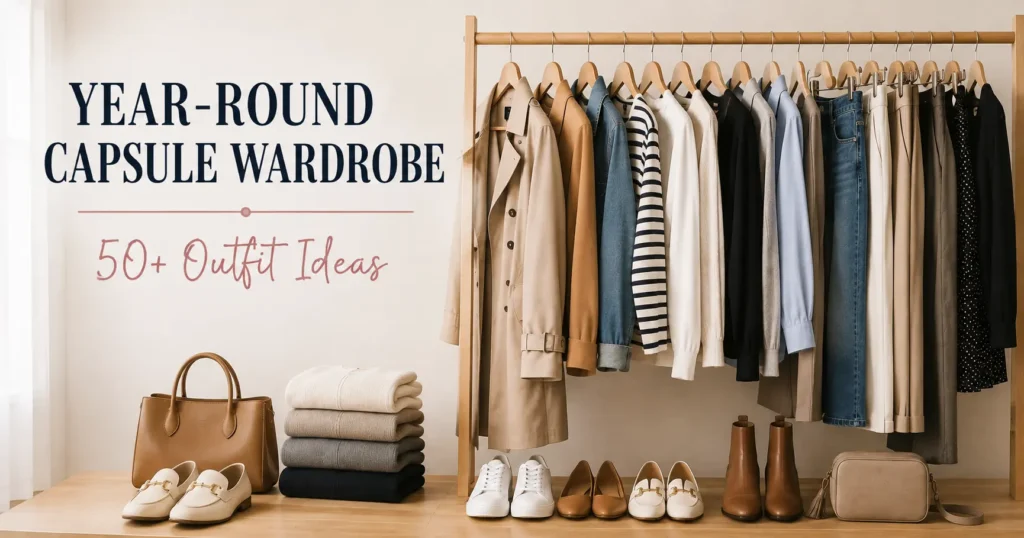
A year round capsule wardrobe takes that one step further: instead of swapping your whole closet out four times a year, you keep one cohesive set of timeless, transitional pieces you wear all twelve months, then layer a handful of seasonal add-ons on top.
The idea isn’t new, by the way. The capsule wardrobe concept is usually traced back to Susie Faux, a London boutique owner in the 1970s, and it hit the mainstream when Donna Karan released her “7 Easy Pieces” collection in 1985.
So if you’ve ever felt like slow fashion and minimalism were trendy inventions, they’ve actually got deep roots.
Year-round vs. seasonal vs. Project 333 vs. 10×10
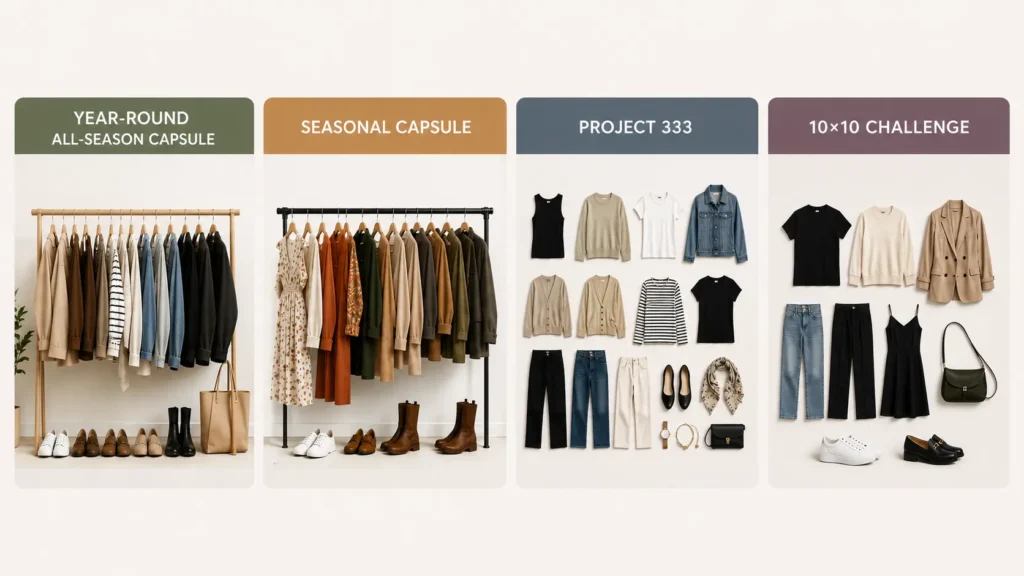
It helps to know where a capsule wardrobe year round approach sits next to the other systems you’ve probably seen:
- Seasonal capsule: a new set of roughly 30 to 40 pieces built for each season. More variety, but more shopping, more storage, and more decisions.
- Project 333: dress with 33 items (clothes, shoes, accessories, jewelry) for 3 months. A great reset challenge, but still seasonal by design.
- 10×10 challenge: pick 10 pieces, make 10 outfits over 10 days. Perfect for testing your basics, not a full wardrobe.
- Year-round / all-season capsule: one core wardrobe worn continuously, adjusted with small seasonal kits. Less to store, more to actually enjoy.
If your goal is fewer decisions and a closet that finally feels calm, the all year round capsule wardrobe wins. That’s what we’re building here.
Why One Wardrobe Can Work All Year

Here’s the objection I hear constantly: “That’s fine for you in a mild climate, but I live somewhere with real winters and brutal summers.” I get it.
I’ve lived in both. And I promise it still works, because a true year-round capsule rests on three simple levers.
- Versatile fabrics. Cotton, linen, wool, cashmere, and denim behave differently across temperatures. A fine merino sweater layers under a coat in January and stands alone on a cool spring evening. Choosing the right materials does half the seasonal work for you.
- Layering. This is the secret that makes one wardrobe stretch. A slip dress is a summer piece on its own, then a fall outfit over a fitted white tee, then a winter look with a chunky knit on top and boots below. Same dress, three seasons.
- Redefining “essential.” Most of us drastically overestimate what we need. You probably don’t need five coats. One genuinely warm coat plus a couple of lighter jackets covers far more than you’d think. When you question every “must-have,” your core list shrinks fast.
The core + seasonal kit model
The framework that ties it together: build one core of pieces you wear year-round, then keep small, climate-specific seasonal kits you pull from as needed. Your core lives in the closet all the time.
Your kits (a bin of winter accessories, a bin of summer staples) get stored away until the weather calls for them. Your everyday closet stays small and cohesive; your seasonal gear is there when you need it.
This is the piece almost no other guide spells out, and it’s exactly why a year-round approach doesn’t leave you freezing in December.
Step 1: Audit Your Closet First
Before you buy a single thing, shop your own closet. You almost certainly already own the backbone of your capsule.
Pull everything out. Everything. Then sort into four honest piles: love and wear, doesn’t fit or flatter, duplicates, and haven’t touched in a year. Be ruthless with that last one. If you haven’t worn it in twelve months (and it’s not a genuine occasion piece), it’s not earning its hanger.
What’s left in your “love and wear” pile is your starting core. Donate, sell, or consign the rest, and box up anything you’re not ready to part with so you can reassess in a few months without the clutter.
Decluttering first means you build around what already works, instead of buying duplicates of things you forgot you had.
Step 2: Choose Your Color Palette
A cohesive color palette is what makes a small wardrobe feel bottomless, because when your colors coordinate, nearly every top works with nearly every bottom.
Keep it simple: pick two neutral base colors (think black, navy, gray, camel, cream, or white) and three or four accent colors that flatter you and make you happy. Your neutrals do the heavy lifting and mix effortlessly; your accents add personality.
I like to keep accents flexible so they can shift a little with the seasons or with what I’m drawn to that year, without blowing up the whole system. If you want to nail shades that genuinely suit you, a quick seasonal color analysis is worth the afternoon.
Step 3: The Core Year-Round Item List
Here’s a proven starting template: a roughly 50 piece year round capsule wardrobe covering clothes, shoes, and accessories. Treat it as a flexible guide, not gospel.
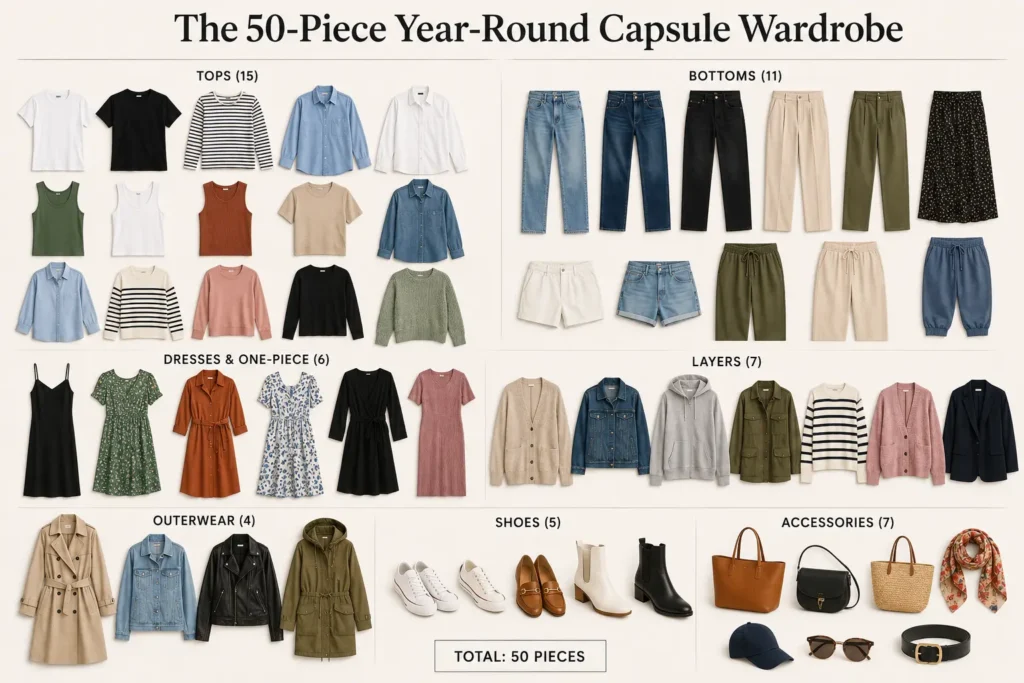
If you’re a dress person, swap some tops for dresses. If you never wear heels, don’t own any. The counts are a launch pad; your life sets the final number.
A quick note on what’s not counted here (the same way every honest capsule guide excludes them): underwear, socks, sleepwear, loungewear, activewear, and swimwear sit outside the capsule.
Tops (about 10)
- Basic tees: 2 to 3, in white and a neutral, your everyday workhorses
- Striped tee: one, the effortless French-girl staple
- Camisole or tank: one, layers under everything in warm months
- Button-up shirt: one crisp white, dresses up or down instantly
- Blouse: one, for when you want a little polish
- Light knit / fine sweater: 1 to 2, layers beautifully
- Chunky knit sweater: one, cozy on its own or over a slip dress
- Turtleneck: one, a cold-weather layering hero
Bottoms (about 6)
- Jeans: 2 to 3 pairs in cuts you actually love (a straight-leg and a wide-leg cover a lot)
- Tailored trousers: one pair, instant put-together
- Skirt: one versatile midi
- Shorts or denim cutoffs: one, for the hottest stretch
Dresses (about 3)
- Little black dress (LBD): one, endlessly dress-up-able
- Day dress: one easy, throw-on-and-go style
- Slip dress: one, the ultimate layering piece across three seasons
Layers (about 4)
- Cardigan: one, easy warmth you can shed
- Blazer: one, elevates jeans and a tee in seconds
- Denim jacket: one, spring and fall staple
- Leather (or vegan leather) jacket: one, adds instant edge
Outerwear (about 3)
- One genuinely warm winter coat, a wool coat or parka
- Trench coat, the transitional-weather MVP
- A lighter jacket for in-between days
Shoes (about 6)
- White sneakers: one clean, go-with-everything pair
- Flats or loafers: one
- Ankle boots or Chelsea boots: one
- Sandals: one, for summer
- A dressier heel or clog: one, for occasions
- An everyday second sneaker or comfortable walker: one
Bags and accessories (about 6)
- Tote bag: one, for work and errands
- Crossbody bag: one, for hands-free days
- A belt: one quality neutral
- Everyday jewelry: a couple of pieces you never take off (hoops, a fine necklace)
- A scarf and a hat that work with your palette
That lands you right around 50 pieces, a comfortable, real-life number that never leaves you scrambling but still fits the minimalist spirit.
Step 4: Seasonal Add-On Kits by Climate
This is where a year-round wardrobe actually earns its name. The core above works nearly everywhere; you just adjust the seasonal kit to match where you live. If you want to go deeper on any single season, I have full guides to building a spring, summer, fall, and winter capsule too.
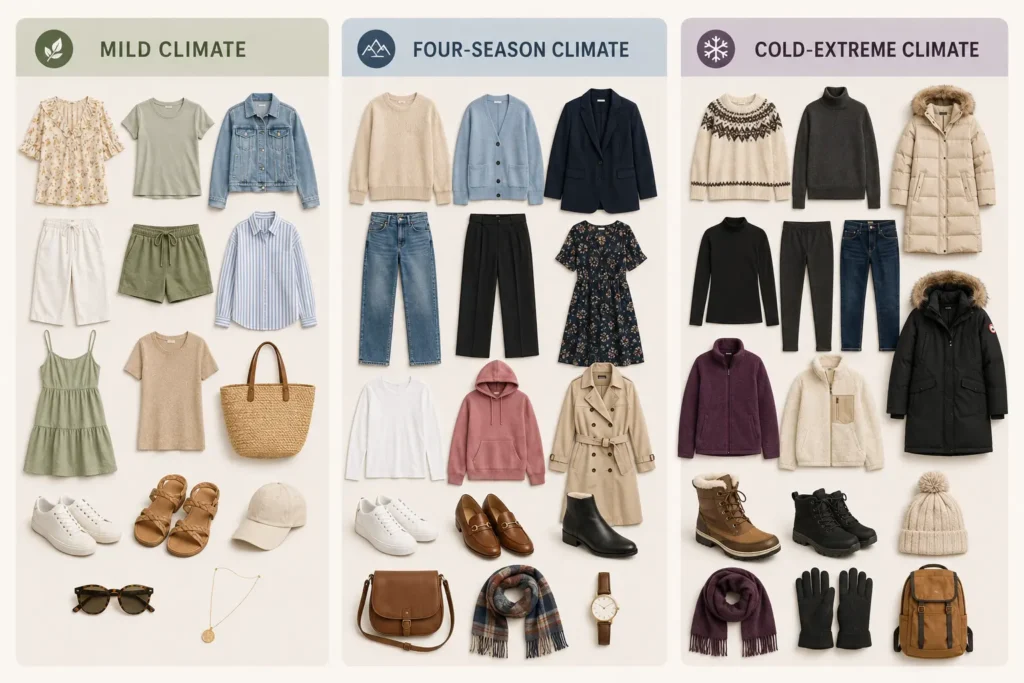
Mild climate (think coastal California)
Barely any kit needed. Your core plus a light jacket, sandals, and maybe one warm layer will carry you all year. Lucky you.
Temperate / four-season climate
Add a summer kit (extra sandals, a few breezy tops, sun hat) and a winter kit (a couple of heavier sweaters, warm socks, gloves, a scarf). Rotate them in and out as the seasons turn. Total footprint stays small.
Cold/extreme climate
You’ll add more, and that’s completely fine. A year-round capsule bends to reality. Your winter kit grows to include an insulated parka, waterproof snow boots, thermal base layers, and a serious hat-gloves-scarf set. Come summer, you’ll want a fuller warm-weather kit of lightweight dresses, shorts, and sandals.
The trick that keeps it all sane: store each kit in a labeled bin (one for winter, one for summer) tucked away when it’s out of season. Your daily closet stays lean and cohesive; the extreme-weather gear waits in the wings until you need it.
Here’s roughly how the counts stack up:
| Climate | Core pieces | Seasonal kit | Rough total |
| Mild | ~50 | ~3 to 5 | ~53 to 55 |
| Temperate | ~50 | ~10 to 14 | ~60 to 64 |
| Cold/extreme | ~50 | ~15 to 20 | ~65 to 70 |
Year-Round Capsule Wardrobe Outfit Formulas
A list of clothes isn’t much use if you can’t picture the outfits. So here are repeatable formulas you can lean on when your brain is empty at 7 a.m. Save the ones you love as your go-to uniforms.
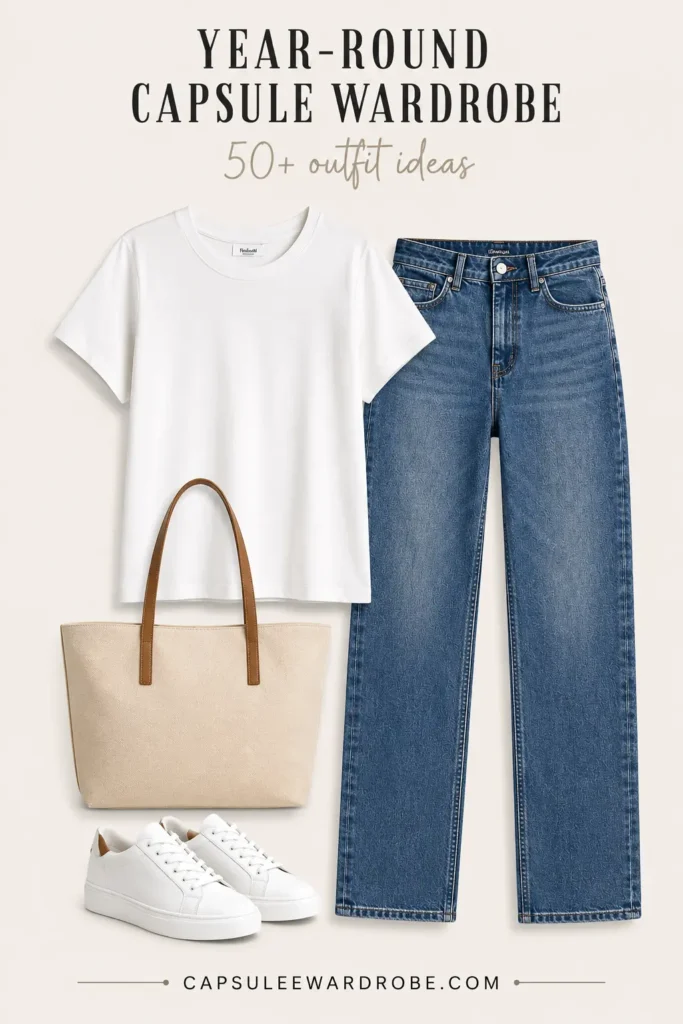
- White tee + straight-leg jeans + white sneakers + tote (the everyday classic)
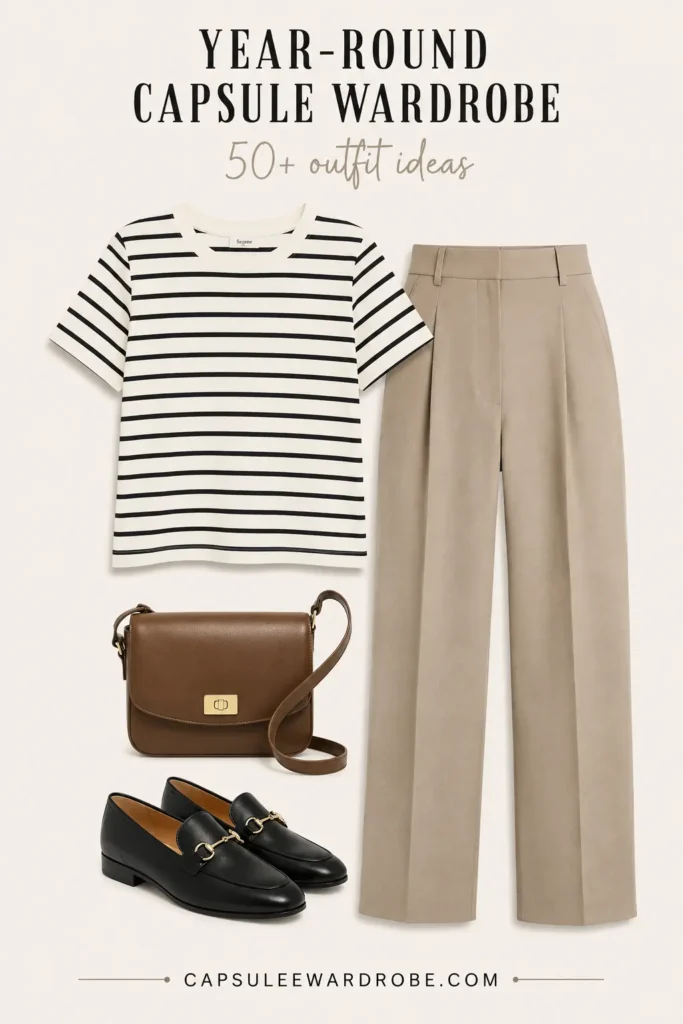
- Striped tee + tailored trousers + loafers + crossbody (smart-casual, no effort)
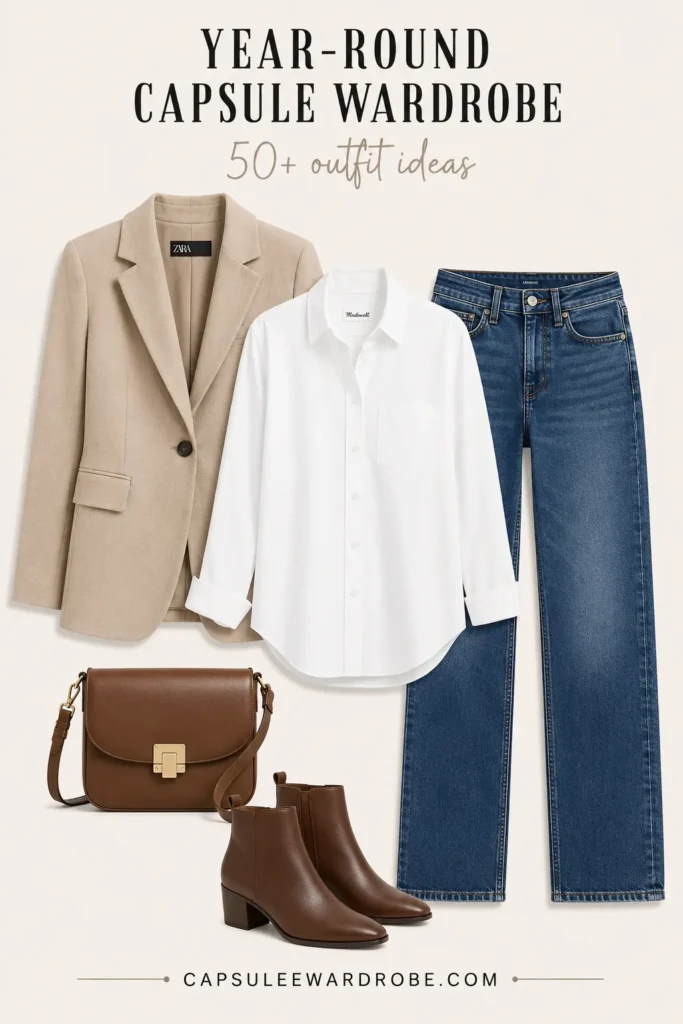
- Button-up shirt + jeans + blazer + ankle boots (the “I have a meeting” look)
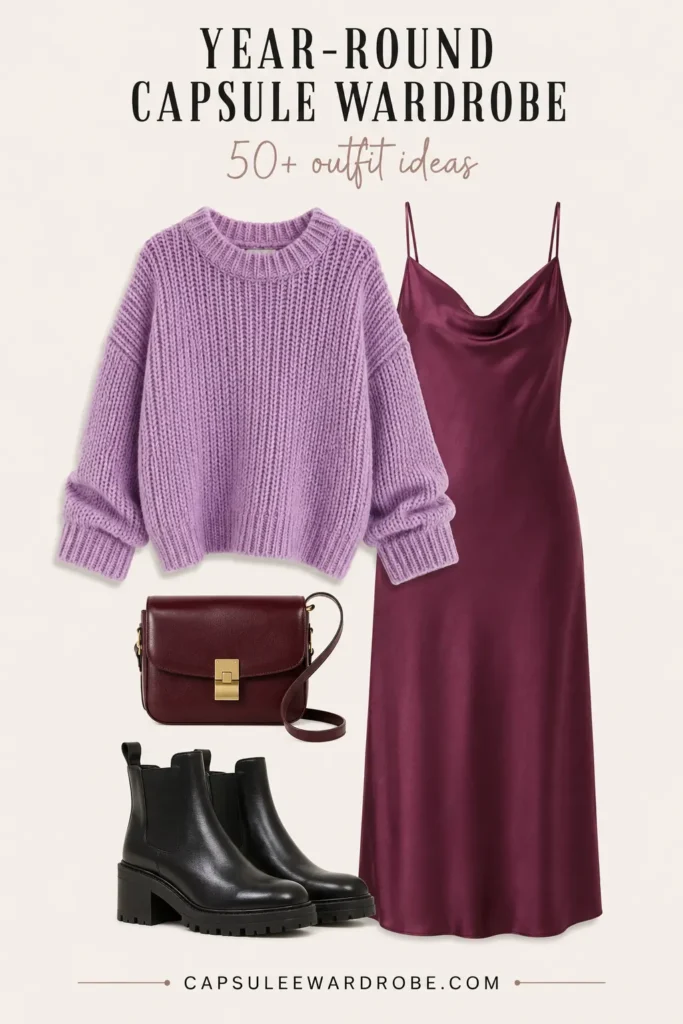
- Slip dress + chunky knit + boots (instant fall)
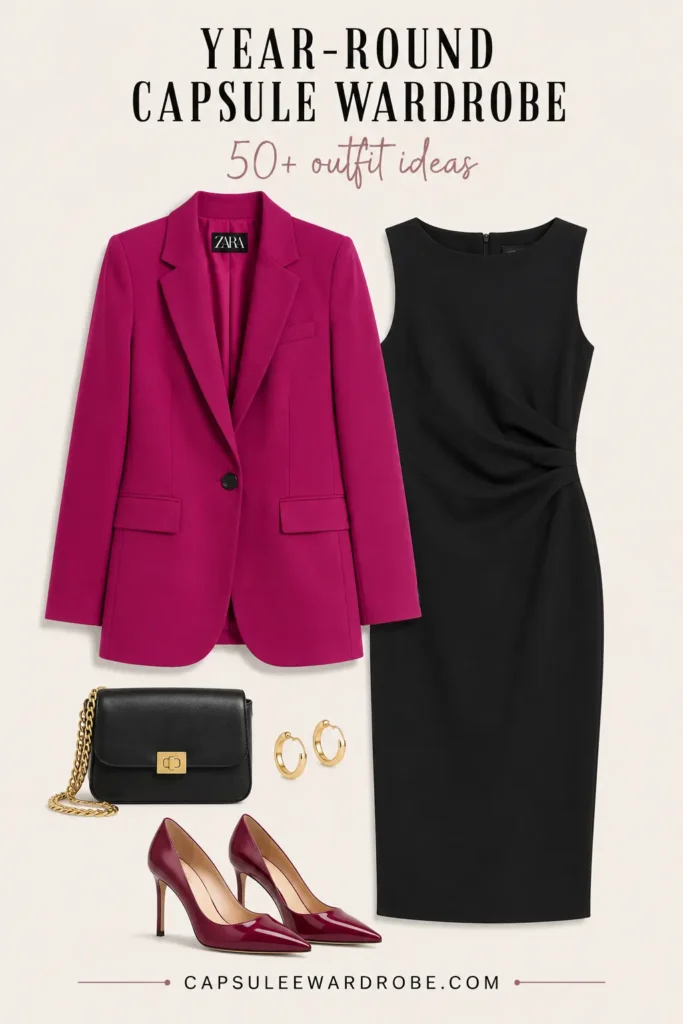
- LBD + blazer + heels (date night or an event, sorted)
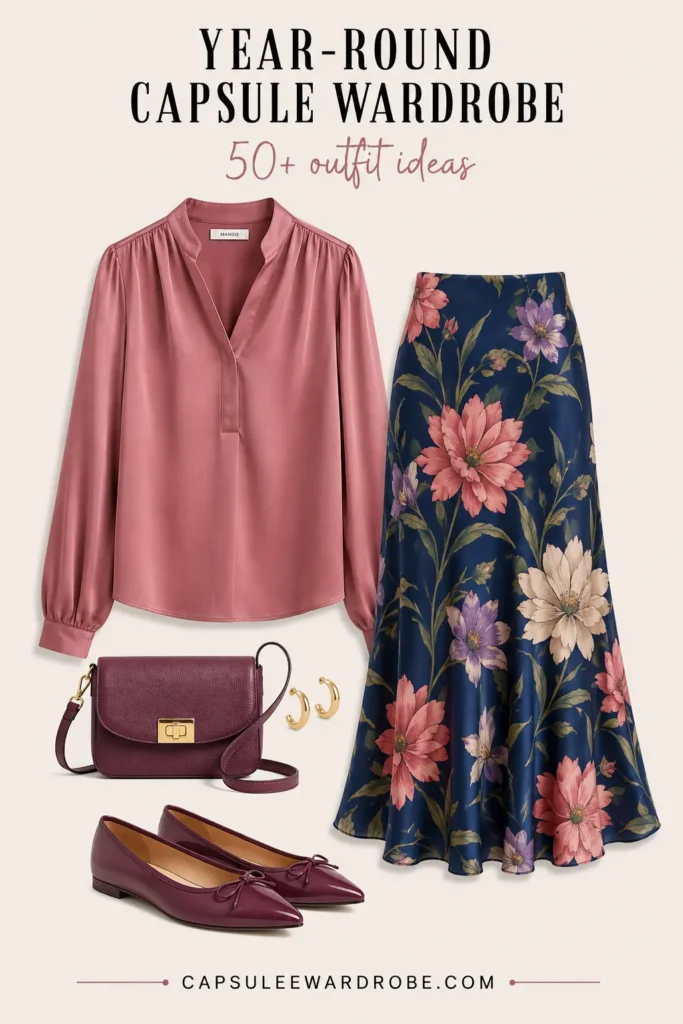
- Blouse + midi skirt + flats (polished and feminine)
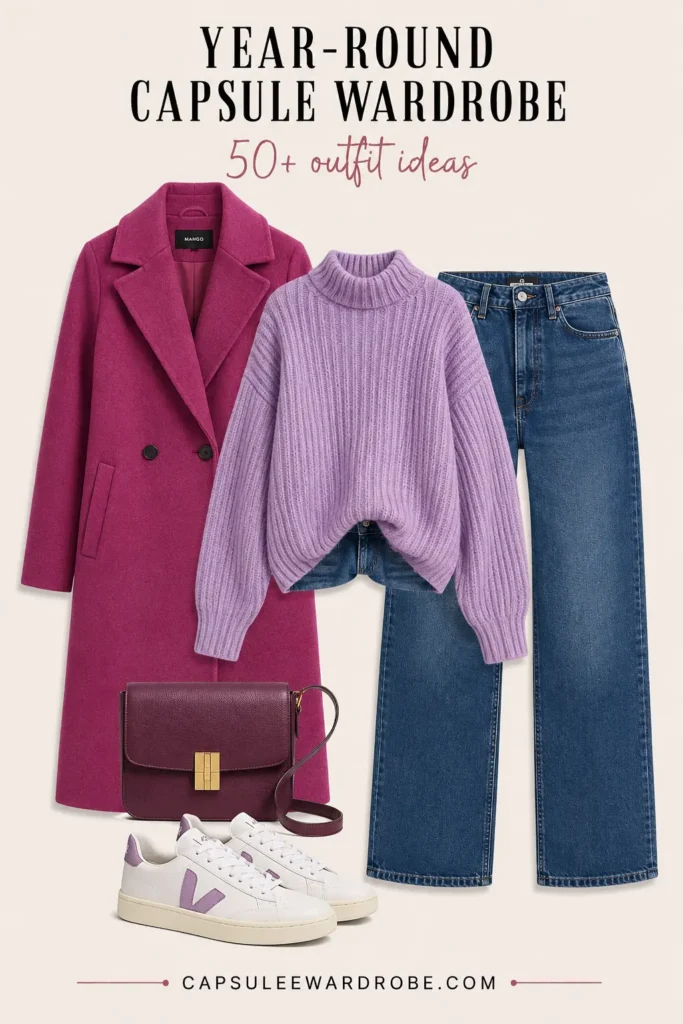
- Chunky sweater + jeans + sneakers + wool coat (cozy winter armor)
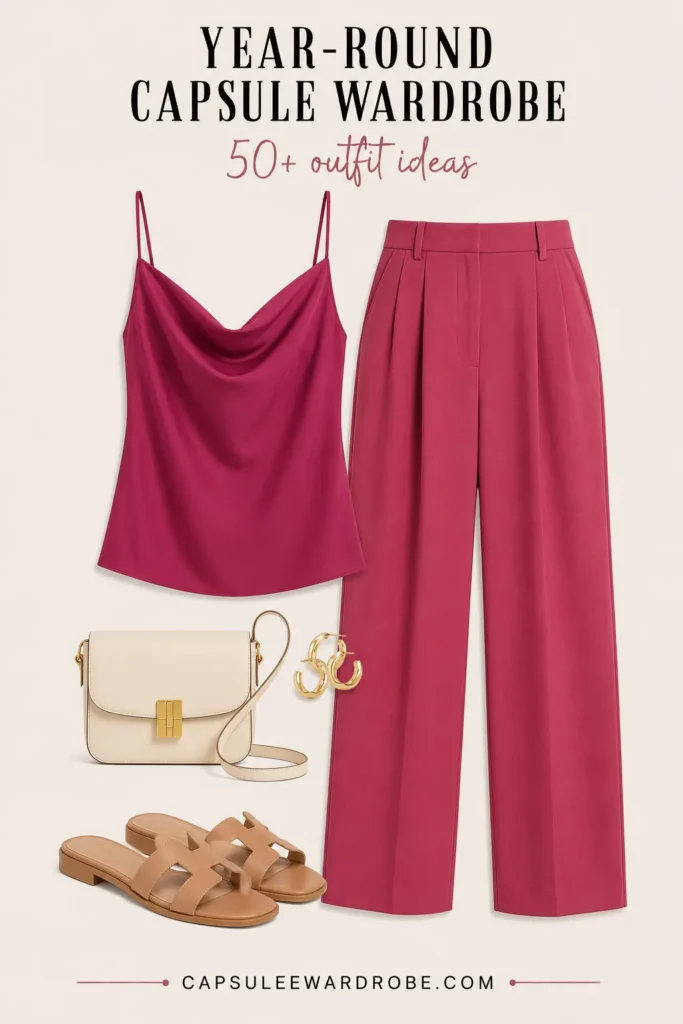
- Camisole + trousers + sandals (the hottest summer day)
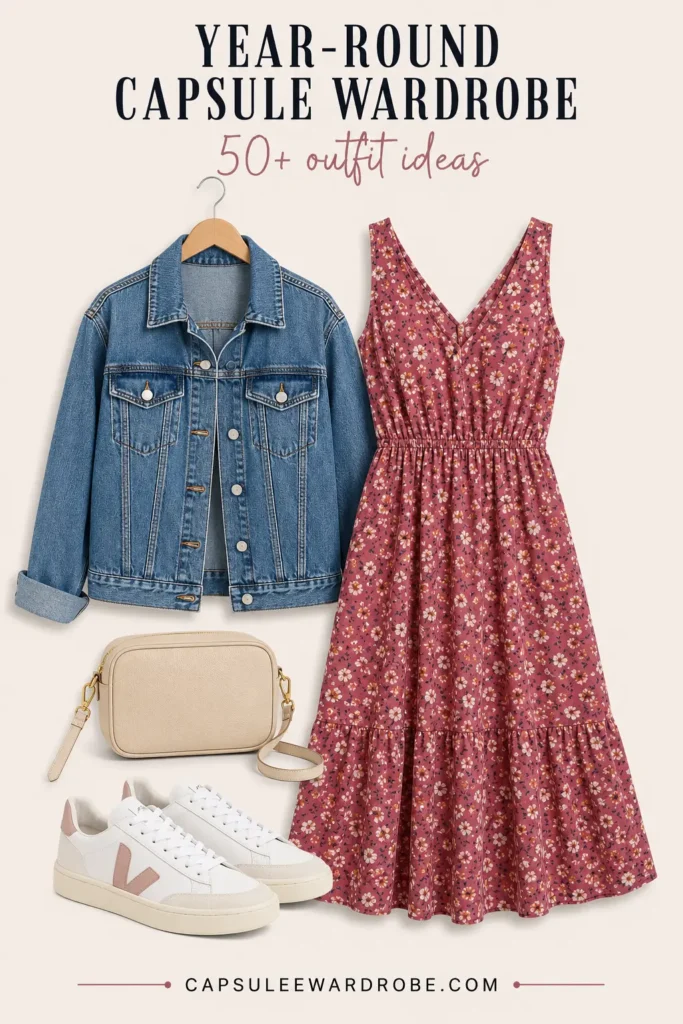
- Day dress + denim jacket + sneakers (weekend errands)
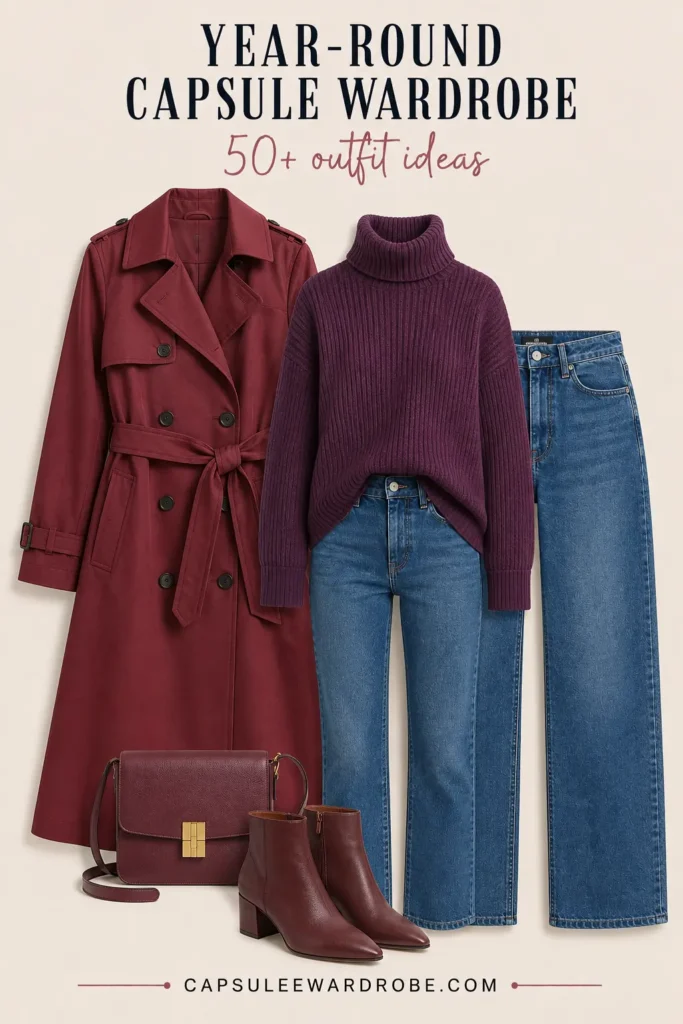
- Turtleneck + jeans + trench + boots (transitional-weather perfection)

One piece, four seasons
Watch a single slip dress flex all year, which is the whole point of an all-season capsule:
- Summer: slip dress + sandals + crossbody
- Spring: slip dress over a fitted white tee + sneakers
- Fall: slip dress + chunky knit on top + ankle boots
- Winter: slip dress + turtleneck underneath + wool coat + boots
How Many Pieces in a Year-Round Capsule Wardrobe?
The honest answer: there’s no magic number, but most people land somewhere between 35 and 50 core pieces, plus a seasonal kit sized to their climate.
The template above sits right around 50, which I find is the sweet spot, small enough to stay cohesive, roomy enough that you’re never rewearing the same three things while everything else is in the wash.
Please don’t get hung up on hitting an exact count. Anyone who tells you a real wardrobe must be precisely 33 or 40 items is selling you a rule, not a solution.
The right number is the smallest one that lets you get dressed confidently for your actual life. Start with this template, live in it for a season, and adjust.
Budget and Where to Shop
One of the quiet joys of a capsule is that it saves you serious money over time. You stop the impulse buys and buy fewer, better things. But you don’t need to spend a fortune up front.
Invest here: your coat, your boots, and your everyday denim. These get the most wear, so cost-per-wear makes quality worth it. A well-made wool coat you wear for ten winters is cheaper than three cheap ones you replace.
Save here: tees, tanks, trend-leaning accessories, and pieces that take heavy wear anyway. There’s no shame in a great Target or Uniqlo tee.
Budget tiers to shop:
- Accessible: Target, Old Navy, Uniqlo, Gap, Quince, J.Crew Factory
- Mid-range: Madewell, J.Crew, Everlane, Aritzia, Loft, COS
- Investment: Cuyana, Sezane, Common Projects (and save designer splurges for pieces you’ll keep for a decade)
And don’t sleep on secondhand. Poshmark, ThredUp, Depop, and local consignment shops are gold mines for exactly these timeless, classic pieces, better for your wallet and for the planet. Building a capsule slowly, over a few paychecks, is completely fine. It’s a wardrobe, not a race.
Adapt It to Your Body and Lifestyle
A template is only useful if it bends to you.

Petite: look for cropped or higher-waisted cuts and pointed-toe shoes to lengthen the leg line; a monochrome outfit in one color also makes you look taller.
Tall: longline coats, wide-leg trousers, and midi lengths that were designed with you in mind; don’t be afraid of volume.
Plus-size and curvy: the same capsule logic applies: versatile, well-fitting basics in a cohesive palette. Prioritize fit and fabric with a little structure or stretch, and tailor key pieces so they sit exactly right. (This is a group most capsule guides ignore entirely, and you deserve one that doesn’t.)
By dress code: if you work in an office, weight your capsule toward trousers, blouses, and blazers. If you’re work-from-home or a busy parent, lean into elevated-casual: nice tees, comfortable denim, and an easy day dress. A teacher who sits on the floor all day can sub dressy ankle pants for jeans and never miss a beat. Build the capsule around how you actually spend your days, not how you wish you did.
Maintaining Your Capsule Over Time
A year-round capsule isn’t “set it and forget it,” but it’s close. A few habits keep it humming:
Refresh, don’t overhaul. When a basic wears out (and your white tee will eventually give up), replace that one piece rather than rethinking everything. A simple one-in, one-out rule keeps the numbers stable: something new comes in only when something old goes out.
Leave room for a little fun. You don’t have to be a purist. Fold in a trend piece or two each season if it makes you happy; just keep them a small, deliberate minority, so your timeless core stays the star. Boredom is normal, but patience is the whole skill.
Care for what you own. Wash cold, hang or fold properly, and treat your investment pieces gently. The better you care for quality basics, the longer this whole system pays you back.
Your Free Year-Round Capsule Wardrobe Checklist
Ready to build yours? Grab the free year-round-capsule-wardrobe-checklist, a printable version of this whole list, plus a seasonal outfit calendar so you always know what to wear.
It’s the perfect companion for a beginner year round capsule wardrobe checklist run-through: keep it in your closet, check off what you own, and shop only the gaps.
The Bottom Line
A year round capsule wardrobe isn’t about owning less for the sake of it. It’s about owning the right things: a cohesive, versatile core you genuinely love, plus a small seasonal kit that adapts to wherever you live.
Build it around your body, your climate, and your real life, and getting dressed stops being a daily negotiation. Start with the template, grab the checklist, and give yourself one season to feel the difference. I don’t think you’ll look back.
Frequently Asked Questions
Does a year-round capsule wardrobe really work in cold climates?
Yes. You keep the same versatile core all year and add a small, stored winter kit (a warm coat, insulated boots, and cold-weather accessories) when temperatures drop. Layering does the rest. The core stays constant; only the kit changes.
How is a year-round capsule different from a seasonal one?
A seasonal capsule is rebuilt every few months. A year-round capsule is one cohesive wardrobe you wear continuously, adjusting with small seasonal add-ons instead of starting over. Less shopping, less storage, fewer decisions.
How many pieces should a year-round capsule wardrobe have?
Most people do well with around 35 to 50 core pieces plus a climate-appropriate seasonal kit. The 50-piece template in this guide is a reliable starting point you can trim or expand.
How much does it cost to build one?
It varies, but you’ll almost always spend less over time than you do now, because you stop impulse buying. Invest in a few high-wear pieces (coat, boots, denim), save on the rest, and shop secondhand to build it affordably over several months.
How often should I update my capsule?
Only when something wears out, or your life genuinely changes. Use a one-in, one-out rule so the wardrobe stays lean instead of creeping back to chaos.
Can I include trendy pieces?
Absolutely. Keep them a small, intentional minority alongside your timeless basics so your capsule stays cohesive and doesn’t date quickly.
Does the piece count include shoes, accessories, and activewear?
Shoes and accessories are included in the count. Underwear, sleepwear, loungewear, activewear, and swimwear are kept separate, since they serve specific needs outside your everyday mix-and-match capsule.

Emma studied fashion but could never get her own closet under control. Capsule wardrobes finally fixed that. Now she writes about what actually worked for her, in the hope it saves you a few frustrating mornings.