A new season is right around the corner, which makes it the perfect time to try something that sounds a little scary and turns out to be surprisingly freeing.
Whether you’ve been curious about Project 333 for a while or you’re hearing about it for the very first time, I’m here to help you get started, one simple step at a time.
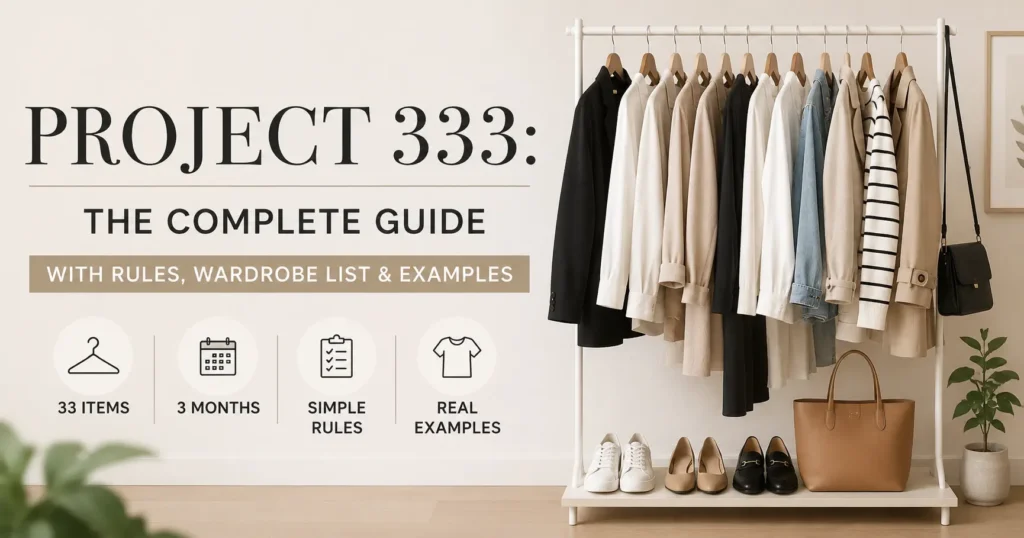
Here’s the whole idea: you choose 33 items to wear for 3 months, then tuck everything else away out of sight. That’s it. And if your mind is already whispering “I could never get down to 33,” or “my weather changes too much,” or “but I actually like shopping,” you’re in good company.
Almost everyone thinks those exact thoughts before they begin. The funny thing? Doing Project 333 is so much easier than thinking about doing it.
This isn’t a project in suffering, and it’s definitely not an all-or-nothing commitment. Think of it as an experiment, not an emergency.
Over the next few minutes, I’ll guide you through the exact rules, give you a ready-to-use 33-item wardrobe list, share seasonal examples, and hand you a free printable checklist so you can start today, without the overwhelm.
What Is Project 333?
Project 333 is a minimalist fashion challenge created by Courtney Carver, founder of the simple-living site Be More With Less, back in 2010. The rules are refreshingly simple: dress with only 33 items, including clothing, accessories, jewelry, and shoes, for three months. Everything else gets packed away and stored out of sight until the season ends.
Think of it as a capsule wardrobe with a clear number attached. A capsule wardrobe is any small, intentional collection of pieces that mix and match easily. Project 333 takes that idea and turns it into a defined, time-boxed experiment: 33 pieces, 90 days, then reassess.
If you’ve ever wondered how the capsule wardrobe Project 333 approach differs from a general minimalist wardrobe, that’s the heart of it. The capsule is the philosophy; Project 333 is the specific game you play with it.
What makes the challenge so approachable is that it isn’t permanent. Carver has always framed it as an experiment, not an emergency. You’re not throwing anything away on day one.
You’re simply testing what “enough” feels like, which removes almost all of the fear that stops people from starting.
The Project 333 Rules
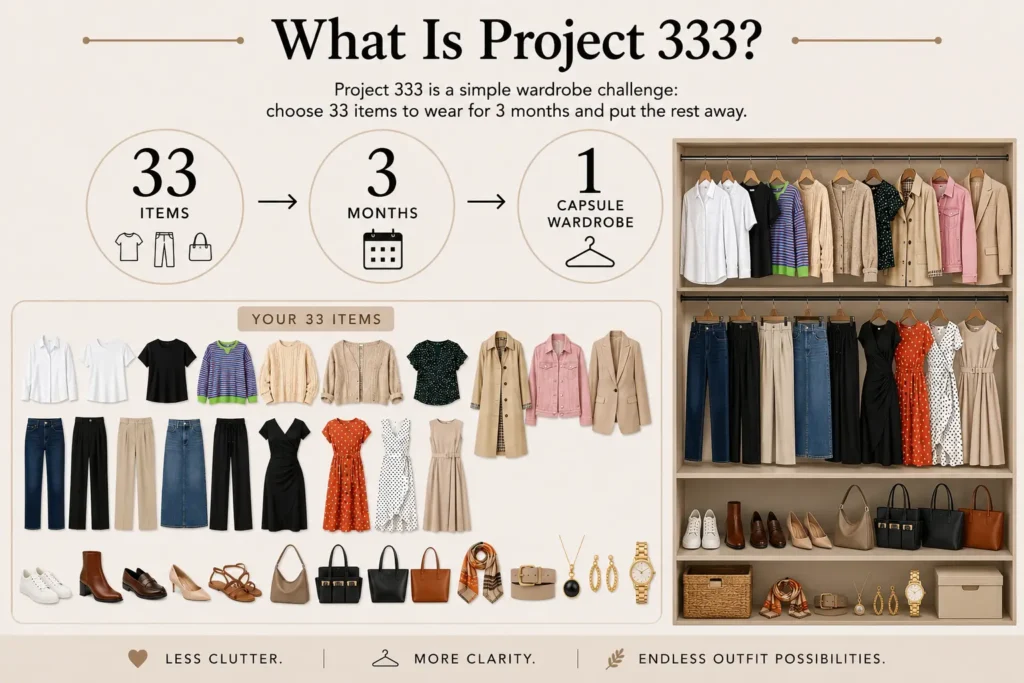
The official Project 333 rules are easy to grasp, but a few details trip people up. Here’s the plain-language version.
How long does it last?
Three months. The challenge is designed to run seasonally, so a natural rhythm is to start at the beginning of each new season and reassess when it ends.
That said, there’s nothing magical about the calendar. You can begin any day you like, and it’s never too late to jump in.
What counts as your 33 items?
Your 33 items include clothing, outerwear, shoes, accessories, and jewelry that you wear day to day. If you put it on to leave the house and it’s visible, it almost certainly counts.
What doesn’t count?
This is where people feel relief. The following are not counted in your 33: underwear, sleepwear, in-home loungewear, and workout clothing.
Carver’s one gentle caveat is that your workout clothes actually have to work out, meaning you can’t count leggings as activewear and then wear them to brunch every day. A wedding ring or a sentimental piece of jewelry you never take off is also exempt.
The number itself is deliberately a little arbitrary. Carver has said that if 33 genuinely doesn’t work for your life, a Project 335 or 340 is perfectly valid.
The point of the 333 rule for clothes isn’t rigid restriction. It’s testing your own limits to understand what “enough” really means for you.
What Counts vs What Doesn’t: The Complete Breakdown
Because this is the single most common source of confusion, here’s the full breakdown in one place.
| Counts toward your 33 | Does NOT count |
| Tops, shirts, blouses | Underwear and bras |
| Trousers, jeans, skirts | Sleepwear and pajamas |
| Dresses | In-home loungewear |
| Sweaters and cardigans | Workout clothing (that actually works out) |
| Coats and jackets (outerwear) | A wedding ring or never-removed sentimental jewelry |
| Shoes and boots | Purely functional items (e.g., a raincoat in some versions) |
| Bags and purses | |
| Scarves, belts, hats | |
| Jewelry you rotate |
A helpful way to think about it: the 33 are the pieces you actively choose between when building an outfit. The exemptions are the essentials that run on autopilot.
The Project 333 Wardrobe List: A Ready-to-Use Example
Here’s what almost no other guide gives you: an actual, complete Project 333 wardrobe list you can copy. Use this as a template, then swap pieces to match your climate, lifestyle, and color palette. This sample 333 project wardrobe adds up to exactly 33 items.
Tops (9)
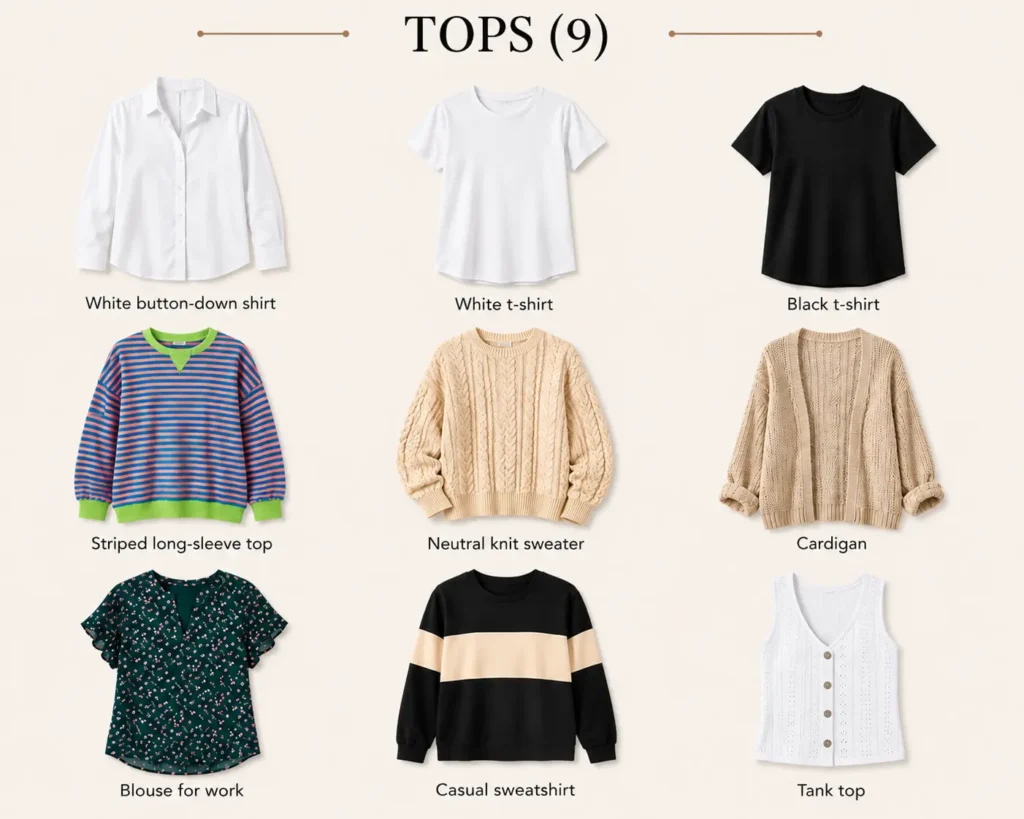
- White button-down shirt
- White t-shirt
- Black t-shirt
- Striped long-sleeve top
- Neutral knit sweater
- Cardigan
- Blouse for work
- Casual sweatshirt
- Tank top
Bottoms (5)
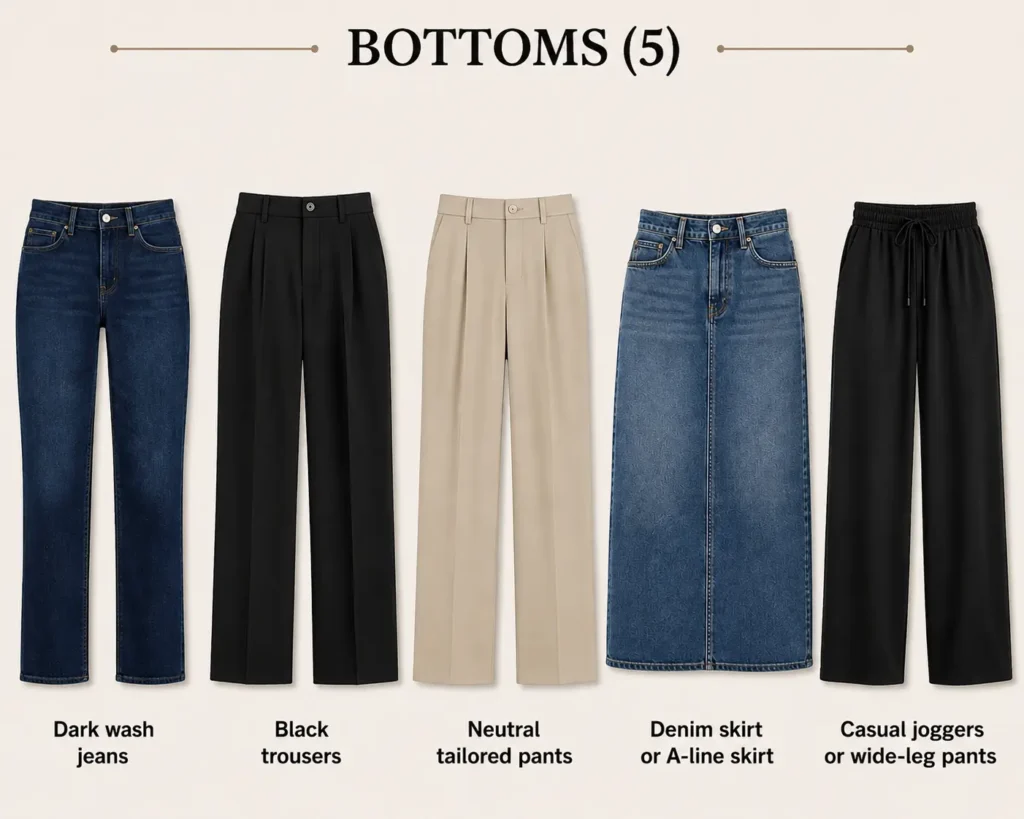
- Dark wash jeans
- Black trousers
- Neutral tailored pants
- Denim skirt or A-line skirt
- Casual joggers or wide-leg pants
Dresses (4)
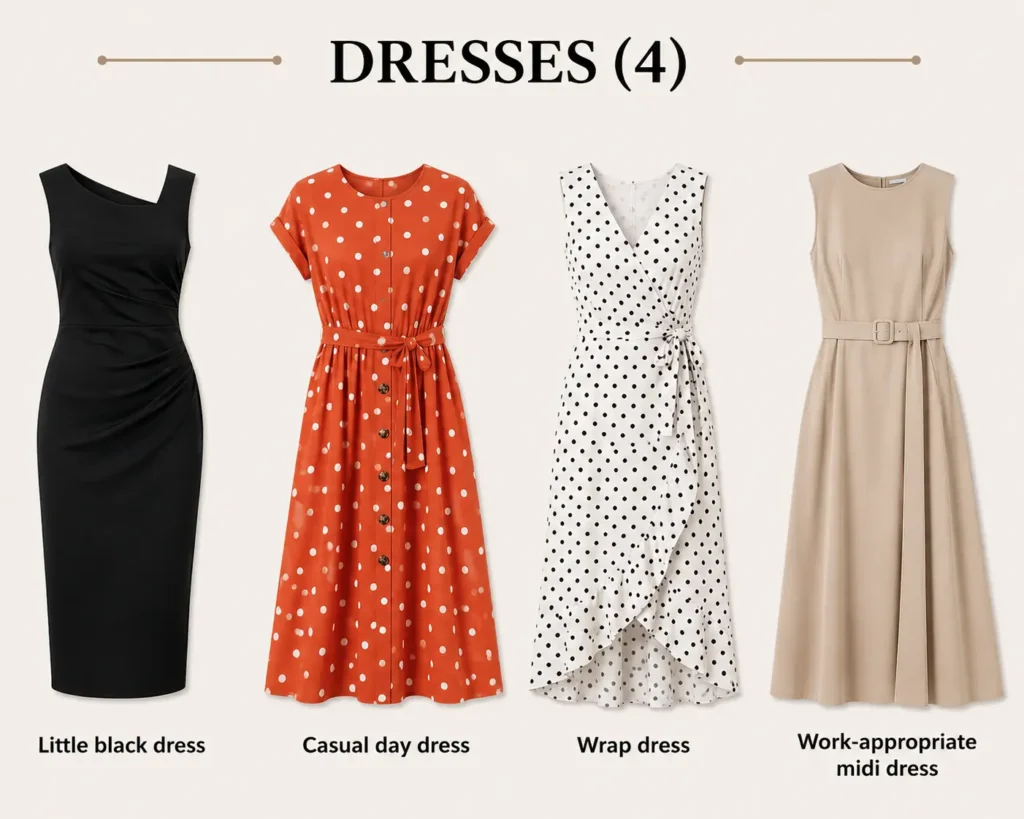
- Little black dress
- Casual day dress
- Wrap dress
- Work-appropriate midi dress
Outerwear (4)
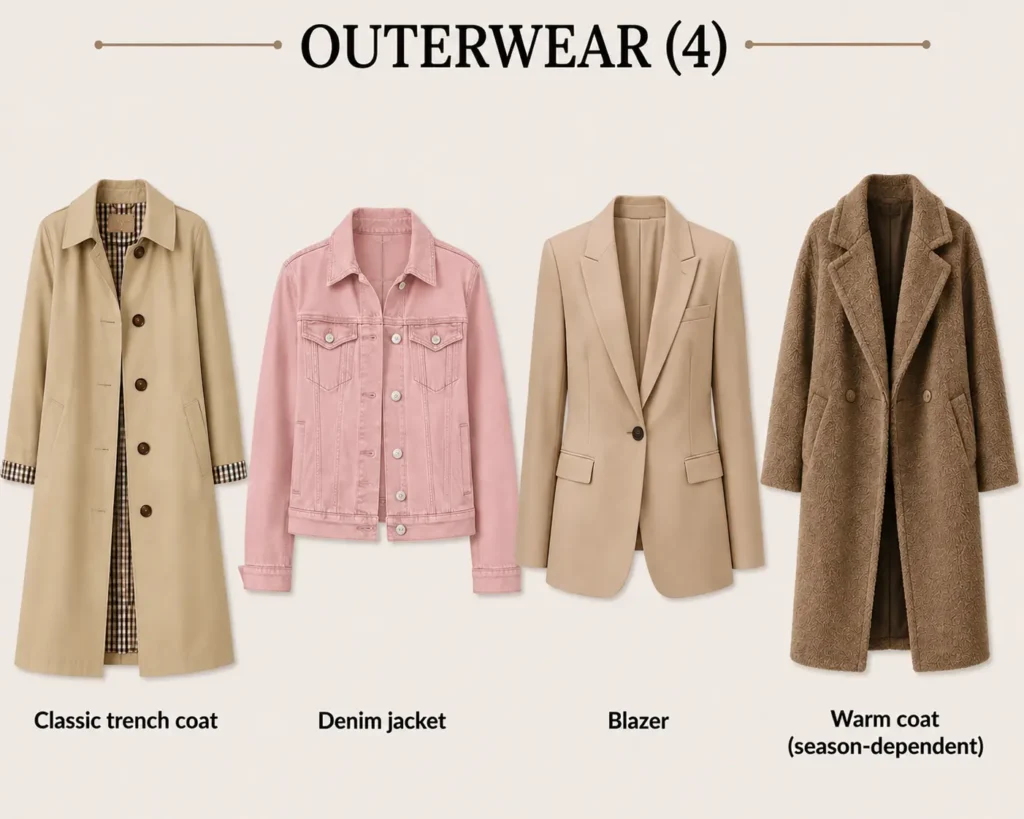
- Classic trench coat
- Denim jacket
- Blazer
- Warm coat (season-dependent)
Shoes (5)
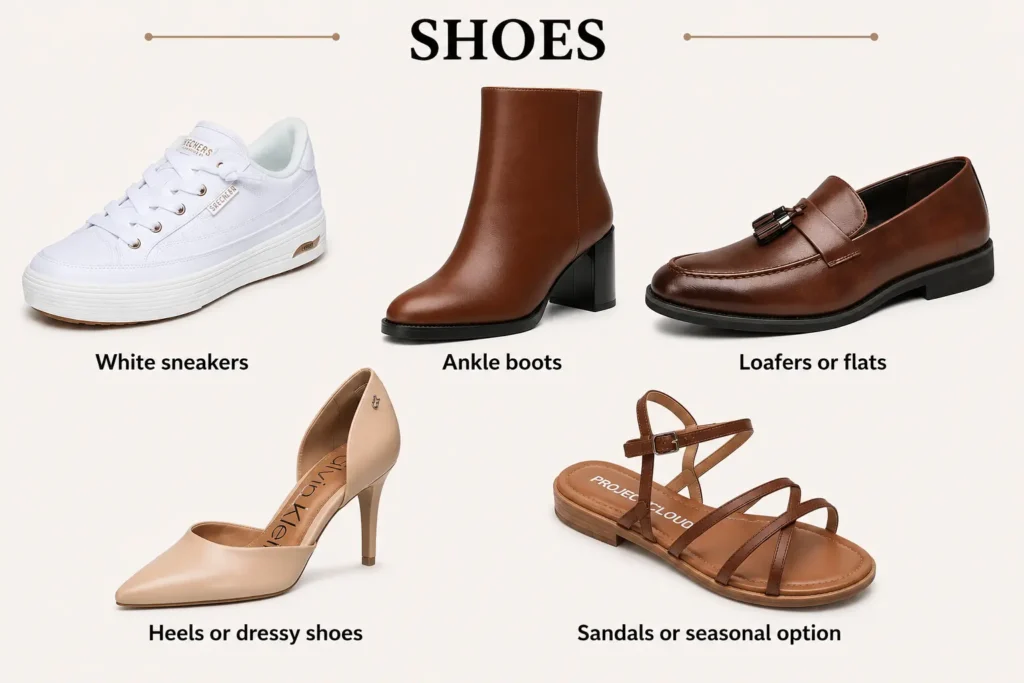
- White sneakers
- Ankle boots
- Loafers or flats
- Heels or dressy shoes
- Sandals or seasonal option
Accessories (6)
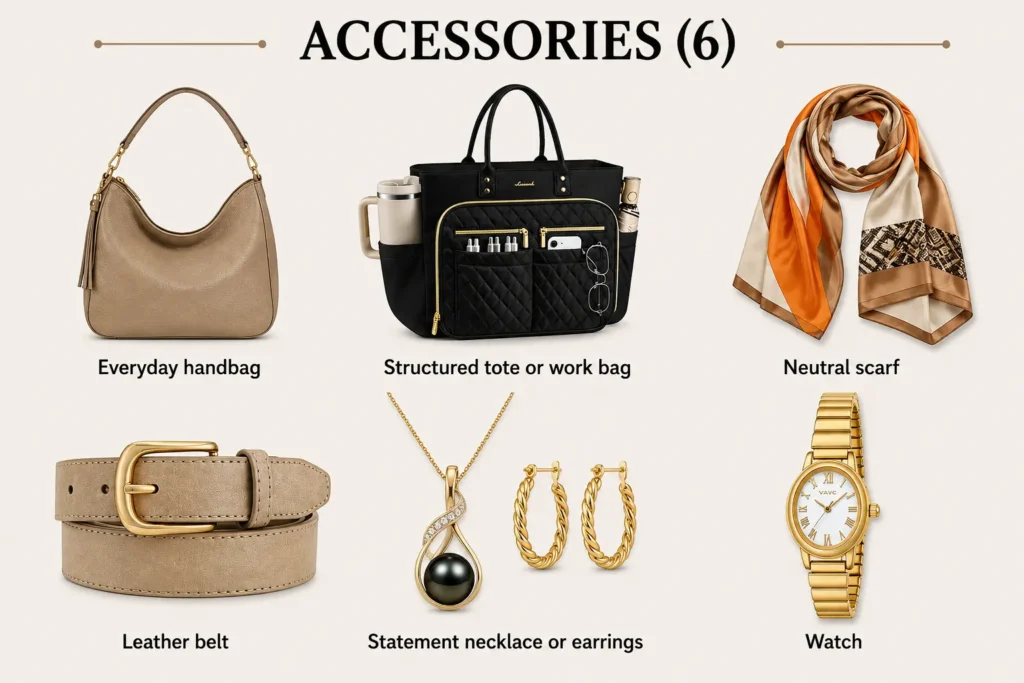
- Everyday handbag
- Structured tote or work bag
- Neutral scarf
- Leather belt
- Statement necklace or earrings
- Watch
total 33
That’s a full, mixable Project 333 capsule wardrobe. Notice how heavily it leans on neutrals: that’s intentional. When your pieces share a palette, a smaller number produces far more outfits, which is the entire secret to making 33 feel like plenty.
Project 333 Examples for Every Season
Because the challenge rotates every three months, your list should shift with the weather. Here are four lighter Project 333 examples, one per season, showing how the same core wardrobe adapts. These 333 project examples focus on the pieces that change most.
Spring Project 333 Example
Spring leans into lighter layers and transitional pieces. Think a trench coat, a couple of lightweight knits, a denim jacket, breathable blouses, and one or two dresses you can layer a cardigan over. Swap heavy boots for loafers and add a pair of clean white sneakers. For a full breakdown of transitional pieces, see the spring capsule wardrobe guide.
Summer Project 333 Example
Summer is where 33 items feels almost generous, because lighter fabrics take up less mental space. Prioritize breathable tops, a few dresses, shorts or linen trousers, sandals, and one light layer for over-air-conditioned rooms. You’ll likely retire your heavy outerwear entirely. The summer capsule wardrobe guide has a complete warm-weather list.
Fall Project 333 Example
Fall is the classic layering season and arguably the most fun for Project 333. Bring back sweaters, add a versatile jacket, lean on boots, and introduce richer, deeper tones. A single scarf can transform an outfit here. Build it out with the fall capsule wardrobe guide.
Winter Project 333 Example
Winter asks the most from a small wardrobe, since outerwear and warm layers eat into your count. The trick is choosing one excellent coat, a couple of heavy knits, warm boots, and thermal-friendly basics that layer invisibly. See the winter capsule wardrobe guide for cold-climate strategies.
How to Start Project 333 in 5 Steps
Ready to try it? Here’s the simplest path from a packed closet to a working 33-item wardrobe. Remember Carver’s framing throughout: this is an experiment, not an emergency.
Step 1: Pick your start date and season. Don’t overthink this. The best day to start is the one you’ll actually commit to. Align it with the current season so your 33 items match the weather.
Step 2: Empty your closet and sort. Take everything out and make three piles: favorites you reach for constantly, maybes you’re unsure about, and pieces to donate. Seeing it all at once is clarifying. This is also the moment to run a proper capsule wardrobe checklist so nothing essential slips through.
Step 3: Choose your 33. Start with your favorites and your most-worn basics, then fill gaps. The easiest way to guarantee everything mixes is to choose within a single color palette, so every top works with every bottom. Two or three neutrals plus a couple of accent colors is usually all it takes.
Step 4: Box up the rest and store it. Pack everything that didn’t make the cut into a box, tape it shut, and put it somewhere out of sight. Out of sight genuinely matters. The visual quiet is half the benefit.
Step 5: Wear it, then reassess after three months. Live in your 33. Take notes on what you reach for and what you miss. When the season ends, unbox your stored items with fresh eyes and build your next round. Most people find they don’t miss the boxed-up pieces at all, which makes the next round of choices even easier.
See It Work: Outfit Combinations From 33 Items
The most common worry is, “Won’t I get bored wearing the same 33 things?” In practice, no, because a well-chosen set multiplies. Here’s a taste of how many looks the sample list above produces:
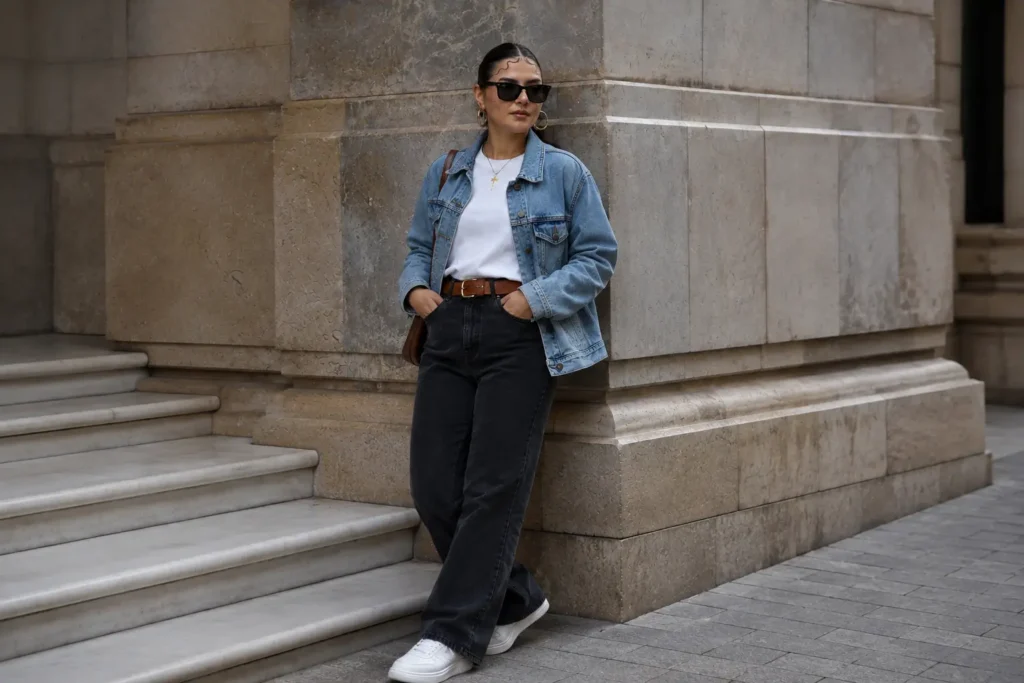
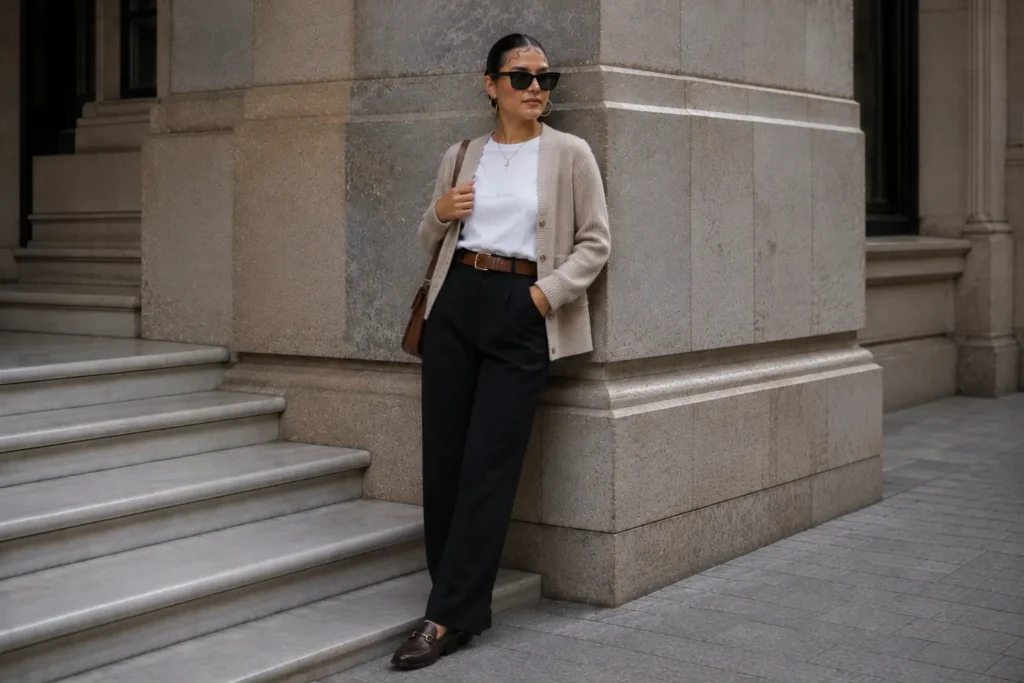
- White tee + dark jeans + white sneakers + denim jacket
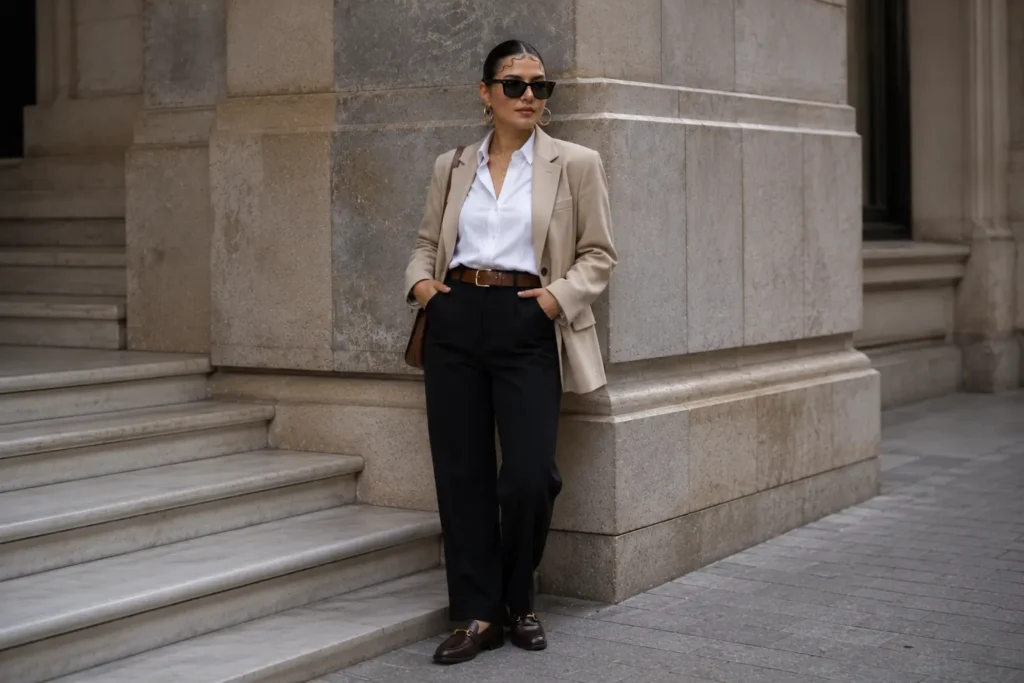
- Black trousers + white button-down + blazer + loafers
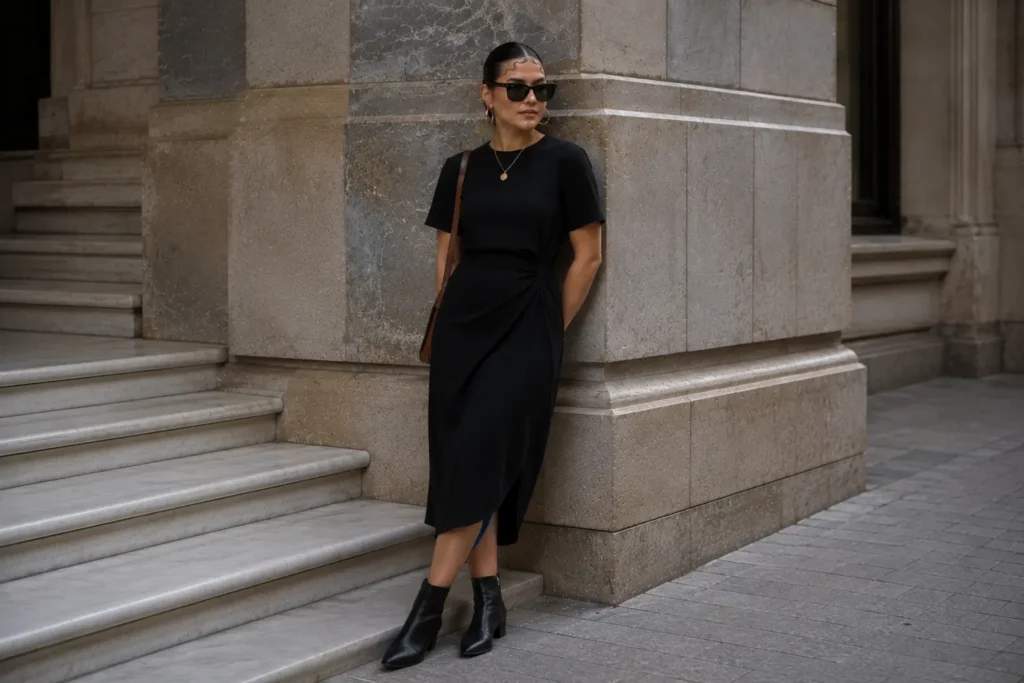
- Little black dress + ankle boots + statement necklace
- Striped top + tailored pants + trench + flats
- Knit sweater + denim skirt + boots + scarf
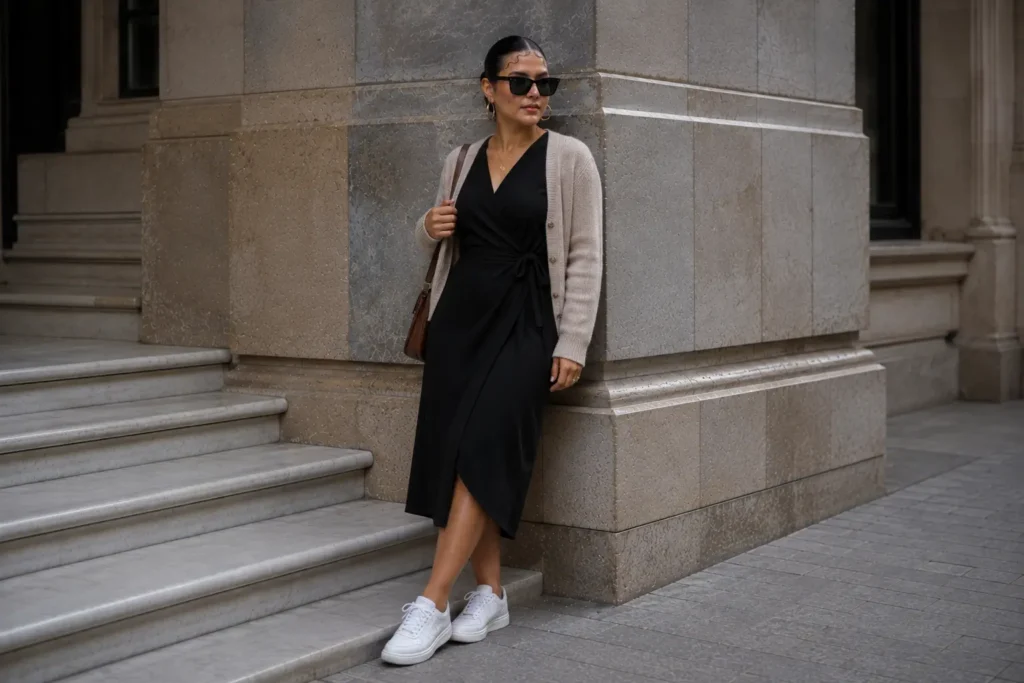
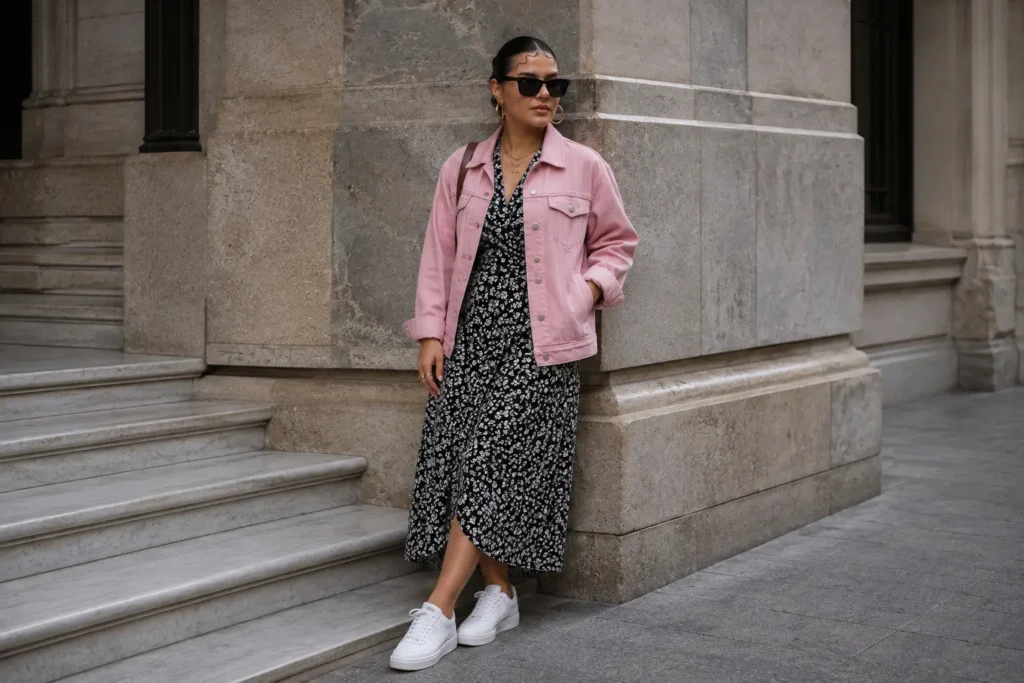
- Wrap dress + cardigan + sneakers
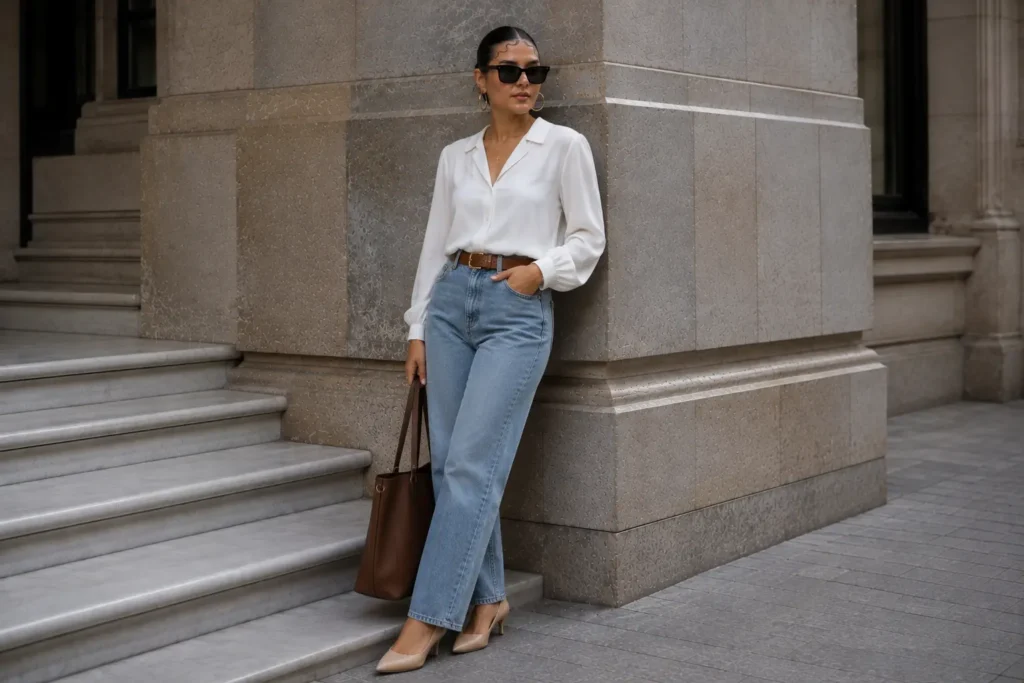
- Blouse + jeans + heels + tote
- Sweatshirt + joggers + sneakers for a rest day
- Midi dress + blazer + heels for work
- Tank + wide-leg pants + sandals + watch
- Cardigan + white tee + trousers + loafers
- Day dress + denim jacket + white sneakers
That’s twelve distinct outfits pulled from a fraction of the list, without a single repeat feeling forced. Stretch across all 33 items and the combinations run well into the dozens. Scarcity, it turns out, is what sparks creativity.
The Benefits of Project 333
People stay with this challenge long after the first three months because the payoff reaches far beyond the closet. When you dress with less, you tend to:
- Save money, because you stop making impulse purchases to fill boredom. The average person wears a small fraction of what they own, so buying less rarely means wearing less.
- Reduce decision fatigue, freeing up mental energy for choices that actually matter. Fewer morning decisions are a small change with an outsized calming effect.
- Get ready faster and rarely run late deciding what to wear.
- Rediscover your personal style, because limiting your options forces you to notice what you truly love wearing.
- Shop more sustainably, since consuming less is one of the most eco-friendly choices you can make. Choosing timeless pieces over trends keeps clothes in rotation for years.
Carver often points out that the challenge was never really about clothing at all. The closet is just where it starts. The real prize is the mental space that opens up once getting dressed stops draining you.
Who Project 333 Is Best For
One of the quiet strengths of this challenge is how well it adapts to different lives. It genuinely suits almost anyone, but a few people tend to fall in love with it fast.
If you experience decision fatigue or anxiety around getting dressed, the reduced number of choices is a direct remedy. Fewer options means less overthinking and quicker, calmer mornings.
If you enjoy the idea of a personal “uniform” but still want a little creative freedom, Project 333 hits that balance perfectly.
It’s also a natural fit for anyone trying to curb overconsumption or an impulse-shopping habit, because the challenge builds in a three-month pause that resets your relationship with buying.
People with demanding jobs often assume they can’t do it, yet the opposite is usually true. If you wear a uniform or scrubs to work, you can count all of your matching uniforms as a single item, which frees up plenty of slots for the rest of your wardrobe.
And if your role calls for polished, professional outfits, a focused work capsule wardrobe fits neatly inside your 33.
Parents, frequent travelers, and anyone craving a simpler daily routine tend to benefit the most, precisely because their mental load is already high.
In fact, the same thinking behind a travel capsule wardrobe, packing light with pieces that all coordinate, is exactly the muscle Project 333 builds. Removing even a handful of daily decisions has a noticeable ripple effect.
The only people who might want to adapt the rules are those in climates with extreme seasonal swings. If that’s you, the fix is simple: keep a small, easily accessible box of weather extras, or bump your number up slightly. The challenge is meant to serve your life, not fight it.
Project 333 vs a Regular Capsule Wardrobe
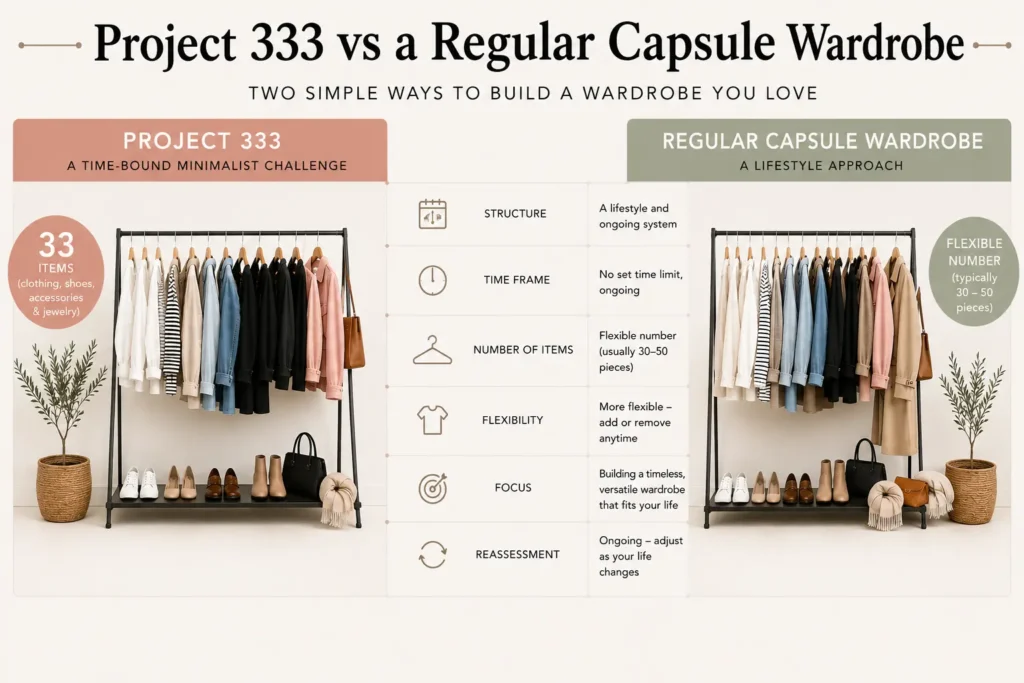
Because the two terms get used interchangeably, it’s worth drawing a clear line between them. A capsule wardrobe is the broad concept: a curated set of clothes that coordinate well and can be mixed into many outfits. There’s no fixed number of pieces and no set time limit. You simply keep a tight, intentional collection.
Project 333 is a specific, rule-based version of that idea. It pins down the number (33), the duration (3 months), and adds the crucial step of physically storing everything else out of sight. That storage step is what makes Project 333 feel different in practice.
A regular capsule wardrobe lives entirely in your closet, so the temptation to reach for an old favorite never fully disappears. With Project 333, the boxed-away clothes are genuinely gone for the season, which sharpens the experiment and speeds up the mental reset.
If you’re brand new to dressing with less, Project 333 is often the easier on-ramp, because the clear rules remove guesswork. If you’ve already lived with a capsule for a while, you might prefer the looser, ongoing structure of a standard capsule wardrobe.
If you’re still weighing the two mindsets, this deeper look at a capsule wardrobe vs a minimalist wardrobe helps clarify which suits you. Many people move fluidly between the two, using a Project 333 round to reset each season and a relaxed capsule the rest of the time. There’s no wrong way to dress with less.
Common Project 333 Mistakes to Avoid
A few predictable stumbles trip up first-timers. Sidestep these, and the challenge gets dramatically easier.
- Obsessing over the exact number. Thirty-three is a guide, not a commandment. If you land at 35, you’re still winning. The intention matters more than the math.
- Skipping a color palette. This is the biggest one. If your pieces don’t share a palette, they won’t mix, and 33 items will feel limiting instead of freeing.
- Keeping uncomfortable shoes or clothes. If it pinches, itches, or doesn’t fit, it wastes a slot. Every one of your 33 should earn its place.
- Counting aspirational “someday” pieces. The dress you’re hoping to fit into or the blazer you never quite wear will sit unused. Build around your real life, not your imagined one.
- Trying to replace everything at once. You don’t need a new wardrobe to start. The most sustainable move is to use what you already own.
Free Printable Project 333 Checklist
Want to make this effortless? Grab the free printable Project 333 checklist. It gives you a category-by-category worksheet: tops, bottoms, dresses, outerwear, shoes, and accessories, with space to write in each of your 33 items and check them off as you build your capsule.
Keep it on your phone while you shop your closet, and you’ll never lose track of your count. Print it, fill it in, and start your challenge with total clarity.
📥 Free download: Get the project-333-checklist — tick off all 33 items as you build your capsule, and keep it on your phone while you shop your closet.
Ready to Dress With Less?
Project 333 works because it’s small enough to feel safe and powerful enough to change how you see your whole closet. You don’t need to buy anything, throw anything away, or get it perfect. You just need to choose 33 things you love, tuck the rest away, and stay curious for three months. Most people are surprised to find the hard part was only ever thinking about it.
Start by settling your colors with the capsule wardrobe color palette guide, then follow the how to build a capsule wardrobe method to assemble your 33. Your calmest, clearest mornings are just one boxed-up closet away.
Frequently Asked Questions
What is the 333 rule for clothes?
The 333 rule means dressing with just 33 items of clothing, accessories, jewelry, and shoes for a period of 3 months. Underwear, sleepwear, loungewear, and genuine workout clothing don’t count toward the total. It’s a minimalist fashion challenge designed to reduce clutter and decision fatigue.
Does jewelry count in Project 333?
Yes, jewelry you actively rotate counts toward your 33 items. The one exception is a wedding ring or a sentimental piece you never take off, which is exempt. If you love accessorizing, simply plan a few of your 33 slots for jewelry.
Can I shop during Project 333?
The spirit of the challenge is to pause impulse shopping, but it isn’t a suffering contest. If something wears out or no longer fits, you’re encouraged to replace it. A useful tactic is to keep a running list of things you want and revisit it once the three months are up, which often reveals how few you actually needed.
Is Project 333 the same as a capsule wardrobe?
They’re closely related but not identical. A capsule wardrobe is any small, coordinated collection of clothes. The capsule wardrobe Project 333 version adds specific rules: exactly 33 items for exactly 3 months, with the rest stored away. Project 333 is essentially a structured, time-boxed way to build and test a capsule.
What if my size changes during the three months?
Life happens, and Carver’s guidance is flexible. If your size fluctuates, it’s fine to keep a couple of pieces in a different size or adjust your 33 as needed. The challenge bends to your body, not the other way around.
Why 33 items specifically?
The number is intentionally a bit arbitrary. It’s small enough to feel like a genuine challenge but large enough to be livable across a full season. If 33 truly doesn’t fit your climate or work life, a slightly higher number still delivers the same benefits, so long as you’re honestly testing your limits.
Emma studied fashion but could never get her own closet under control. Capsule wardrobes finally fixed that. Now she writes about what actually worked for her, in the hope it saves you a few frustrating mornings.