Nine years ago, I owned 174 pieces of clothing and wore roughly 20 of them. I counted. Everything came out of the closet and onto the bed one Saturday morning, and by dinner, I had my answer to why getting dressed felt so hard. I didn’t have a wardrobe. I had a pile of unrelated purchases.
That day, I built my first capsule wardrobe, badly. I copied a Pinterest checklist, bought a blazer I never wore, and decluttered a denim jacket I ended up re-buying six months later.
Since then, I’ve rebuilt my capsule every season, helped hundreds of readers do the same, and slowly worked out a process that starts with what you actually wear instead of what a checklist says you should own.
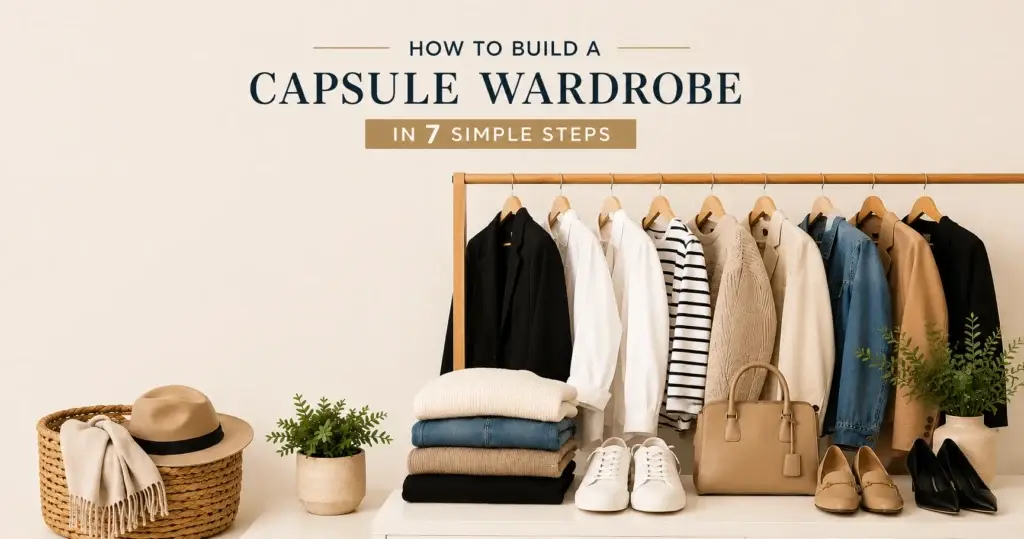
I call it the Wear-First Method. In this article, I’ll walk you through all seven steps, show you my own current 32-piece capsule as a worked example, and give you a free printable checklist and wardrobe planner so you can do the whole thing in one weekend.
📥 DOWNLOAD: capsule-wardrobe-checklist-planner with a printable essentials checklist, declutter tracker, color palette planner, and outfit formula worksheet.
What Is a Capsule Wardrobe? (And Where the Idea Comes From)
A capsule wardrobe is a small, intentional collection of versatile clothes, usually 25 to 50 pieces, that all work together so you can create dozens of outfits from a handful of items. (New to the concept? Start with our complete beginner’s guide to capsule wardrobes, then come back here to build yours.)
The term isn’t new. London boutique owner Susie Faux coined the term “capsule wardrobe” in the 1970s at her shop Wardrobe, describing a core of timeless essentials updated each season with a few statement pieces. Donna Karan brought the idea mainstream in 1985 with her famous “Seven Easy Pieces” collection, an entire working wardrobe built from a bodysuit, skirt, trousers, blazer, and a few interchangeable layers.
More recently, Courtney Carver’s Project 333 challenge (dress with just 33 items, including clothes, shoes, jewelry, and accessories, for 3 months) turned capsule dressing into a minimalist movement, partly as a reaction against fast fashion and the average closet stuffed with barely worn impulse buys.
The focus is not on owning the fewest clothes possible. The focus is on owning the right clothes.
A good capsule wardrobe helps you:
- Get dressed faster (less decision fatigue every morning)
- Reduce closet clutter
- Avoid impulse shopping and save money
- Create more outfit combinations from fewer pieces
- Build a clearer personal style
- Shop more sustainably
The Wear-First Method: Why This Guide Is Different
Most capsule wardrobe guides hand you a shopping list: buy a white shirt, buy a trench coat, buy loafers. I did that in year one, and it’s exactly why I wasted money on a blazer that didn’t suit my work-from-home life.
The Wear-First Method flips the order:
- Find what you already wear. Your real style is hiding in your laundry basket.
- Build the capsule around those proven pieces.
- Only then shop, and only for genuine gaps.
You’ll notice that shopping is Step 6 of 7, not Step 1. That single change is what makes a capsule stick.
Before You Start: Match the Capsule to Your Real Life
A capsule fails when it’s built for an imaginary life. Before touching your closet, answer three questions.
What are my wardrobe proportions?
Look at your normal week. If 80% of your life is casual, with school runs, errands, and working from home, then 80% of your capsule should be casual. When I audited my own week, I needed roughly 25 casual outfits a month and only 2 or 3 dressy ones. My old closet had those proportions reversed.
What’s my climate?
Someone in a hot, humid climate needs breathable linen, organic cotton, and sandals, closer to a summer capsule wardrobe. Someone with real winters needs merino wool, layering pieces, and a proper coat, which looks more like a winter capsule wardrobe. There’s no universal checklist, because the climate decides half your capsule for you.
What does my wardrobe need to do?
List your recurring situations: work, weekends, travel, exercise, dinners out. Your capsule needs to cover all of them, and nothing more.
Step 1: Assess Your Current Wardrobe (The Bed Test)

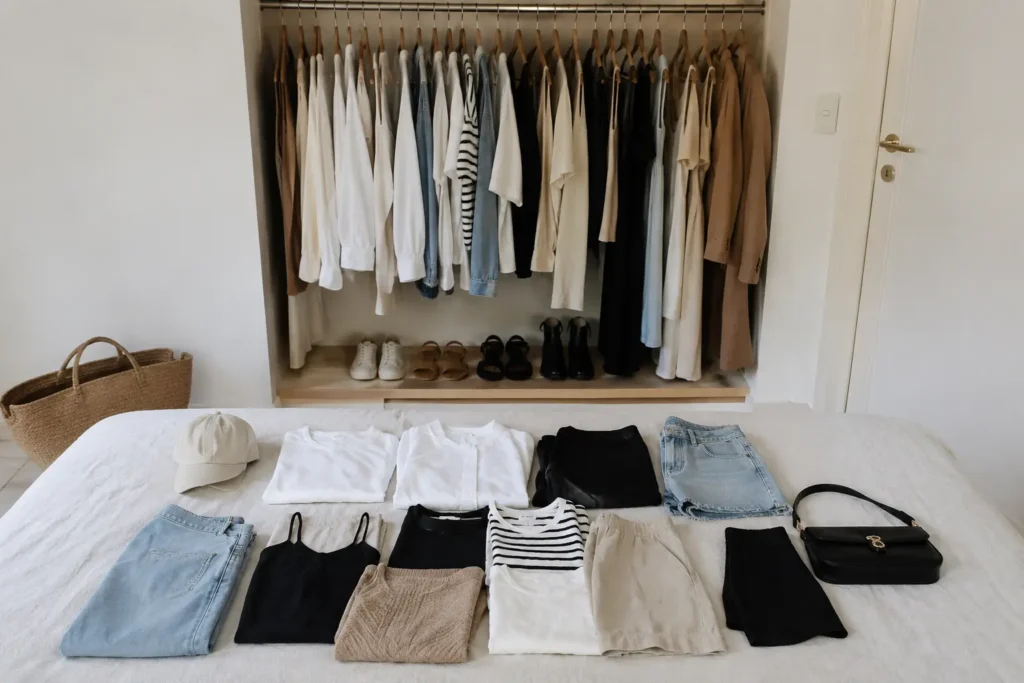
Take everything out of your closet, drawers, and storage boxes, and put it on your bed. Yes, all of it. Putting it on the bed matters because you’ll be motivated to finish before you sleep.
The first time I did this, I found three nearly identical grey sweaters and a dress with the tags still on from two years earlier. Seeing everything in one place is uncomfortable and incredibly clarifying.
Now sort into simple categories: t-shirts, shirts, sweaters, jeans, trousers, jackets, shoes, accessories. Then look for two things:
- Duplicates and dead weight, like the ten black tees and the jackets you never reach for
- Your true favorites, the pieces you wash and wear on repeat
Those favorites are the seeds of your capsule. Don’t focus on what you wish you wore. Focus on what you genuinely wear.
✅ The printable Declutter Tracker in the free planner has columns for Keep, Donate, Sell, and Store so you can log everything as you sort.
Step 2: Define Your Personal Style (Read Your Own Patterns)

Most closets contain clothes bought for different versions of ourselves: the trendy buy, the single-event dress, the sale rack “bargain.” That’s why they feel disconnected.
Instead of taking a style quiz, read the evidence you already have:
- Which outfits do you repeat without thinking?
- Which pieces make you feel confident the moment you put them on?
- What do your favorites have in common? Neutral colors? Relaxed silhouettes? Structured tailoring?
When I did this exercise, the pattern was embarrassingly obvious: straight-leg jeans, white and striped tops, a cardigan, and white sneakers. My “style” wasn’t the edgy pieces I kept buying. It was the quiet uniform I kept wearing.
If you work from home, your capsule may lean on knitwear and elevated basics. If you’re in a professional office, you’ll need blazers, trousers, and polished shoes. Build around your daily life, not around trends.
Step 3: Declutter What You Don’t Need (Without the Regret)
Decluttering is the hardest step because clothes carry guilt. It was expensive. It was a gift. It might fit again someday.
Sort every item into four piles:
Keep. It fits well, suits your current life, and works with other pieces.
Donate. Good condition, but it no longer serves you.
Sell. Higher-quality pieces are worth listing on Vinted, Poshmark, or eBay.
Store. Off-season and sentimental items, boxed out of sight.
For each borderline item, ask: Have I worn this in the last year? Does it fit comfortably? Can I make three outfits with it? Would I buy it again today? Consistent “no” answers mean it goes.
Two hard-won warnings from my own mistakes:
- Don’t declutter to a number in one weekend. Whether you follow Marie Kondo’s KonMari method (“does it spark joy?”) or Project 333’s 33-item limit, extreme one-day purges cause regret. I decluttered a denim jacket in my first purge and bought it back within six months. Use the Store box as a safety net: box borderline items for 3 months, and if you never miss them, let them go.
- The goal is visibility, not emptiness. A decluttered closet shows you what you own, which makes every later step easier.
Step 4: Choose Your Color Palette (The 3 + 2 Rule)
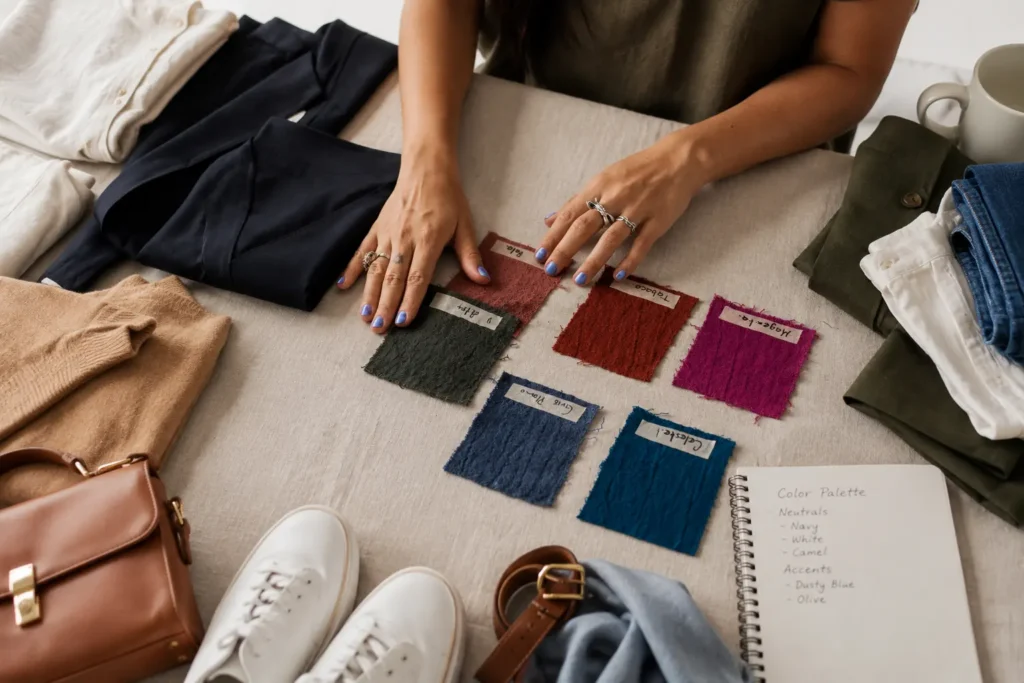
Color coordination is the engine of a capsule wardrobe. When everything shares a palette, almost everything matches, which means more outfits from fewer clothes.
I use a simple 3 + 2 formula:
Pick 3 to 4 foundation neutrals. Black, white, navy, grey, brown, camel, cream, and olive are the classics because they rarely clash. Mine are navy, white, and camel. A quick pairing cheat sheet:
- White works with almost everything
- Navy pairs beautifully with grey, camel, olive, and cream
- Black anchors white, grey, and camel
Add 1 to 2 accent colors. Burgundy, forest green, dusty blue, rust, soft pink. Choose whatever you actually enjoy wearing, not whatever Pantone crowned this year. My accent is dusty blue, because half my favorite tops already were.
Before any new piece enters your wardrobe, run the three-outfit test: can I wear this with at least three things I already own? If not, it stays in the store.
<!– Insert your own graphic here: a simple image of your palette swatches. These perform extremely well on Pinterest. –>
✅ The free planner includes a Color Palette Worksheet with swatch boxes for your 3 foundations and 2 accents.
Step 5: Identify Your Capsule Wardrobe Essentials
With your palette set, choose your essentials, the reliable backbone pieces. Use these category targets as a guide, not a law. This is roughly a 30 to 40 piece seasonal capsule:
| Category | How many | Classic examples |
| Tops | 8–12 | Basic tees, white button-down, simple blouses, long-sleeve basics |
| Bottoms | 4–6 | Dark straight-leg jeans, tailored trousers, chinos, a skirt |
| Layers & outerwear | 4–6 | Blazer, cardigan, crewneck sweater, denim jacket, trench or wool coat |
| Dresses (optional) | 1–3 | One casual, one dressier |
| Shoes | 3–5 | White sneakers, loafers, boots, flats, or sandals |
| Accessories | 4–6 | Tote, crossbody bag, belt, scarf, simple jewelry |
Every piece must pass the versatility test: if it only works in one specific outfit, it doesn’t earn a spot. For a complete item-by-item breakdown of every category, see our full capsule wardrobe checklist. And if you want essentials tailored by gender, we have dedicated guides to the capsule wardrobe for women and the capsule wardrobe for men.
My current 32-piece capsule (worked example)
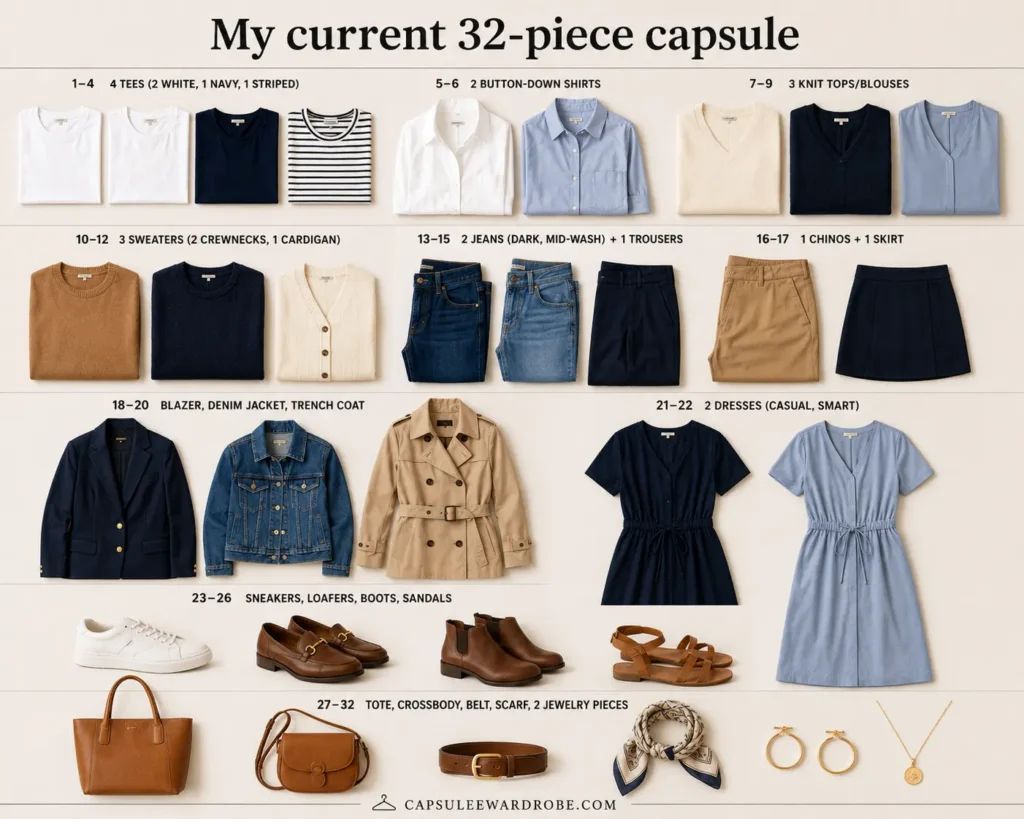
Those 32 pieces give me well over 60 outfit combinations, which brings us to fabric. Since capsule pieces get worn hard, fabric quality matters more than brand names.
I look for merino wool (knits that resist odor and last years), organic cotton and linen (breathable basics), and TENCEL™ lyocell (a soft, sustainable drape for blouses). Natural and durable beats cheap and synthetic when something will be worn 100+ times.
Step 6: Fill Wardrobe Gaps Carefully (Cost Per Wear, Not Price Tag)
Only now, after auditing, decluttering, and choosing your palette, do you shop. By this point, your gaps are obvious and specific. Not “I need clothes,” but “I need one navy blazer and better white sneakers.”
Write a gap list and stick to it. Missing essentials, worn-out replacements, and versatility multipliers. Nothing else.
Judge purchases by cost per wear, not price. The formula is simple:
Cost per wear = price ÷ number of times you’ll wear it
A $150 wool coat worn 200 times costs $0.75 per wear. A $30 trendy top worn twice costs $15 per wear. The coat is twenty times cheaper. This one mental shift ended my sale-rack impulse buying.
Buy slowly. You do not need to complete the capsule in a month. I add pieces over a full season, because wearing the capsule teaches you what’s actually missing. Secondhand is fair game too, and some of my best staples came from thrift stores and resale apps.
Step 7: Build Outfit Combinations (Outfit Formulas)
Here’s the truth most guides skip: a capsule wardrobe isn’t a collection of clothes, it’s a collection of outfits. This step is where the whole system starts paying off.
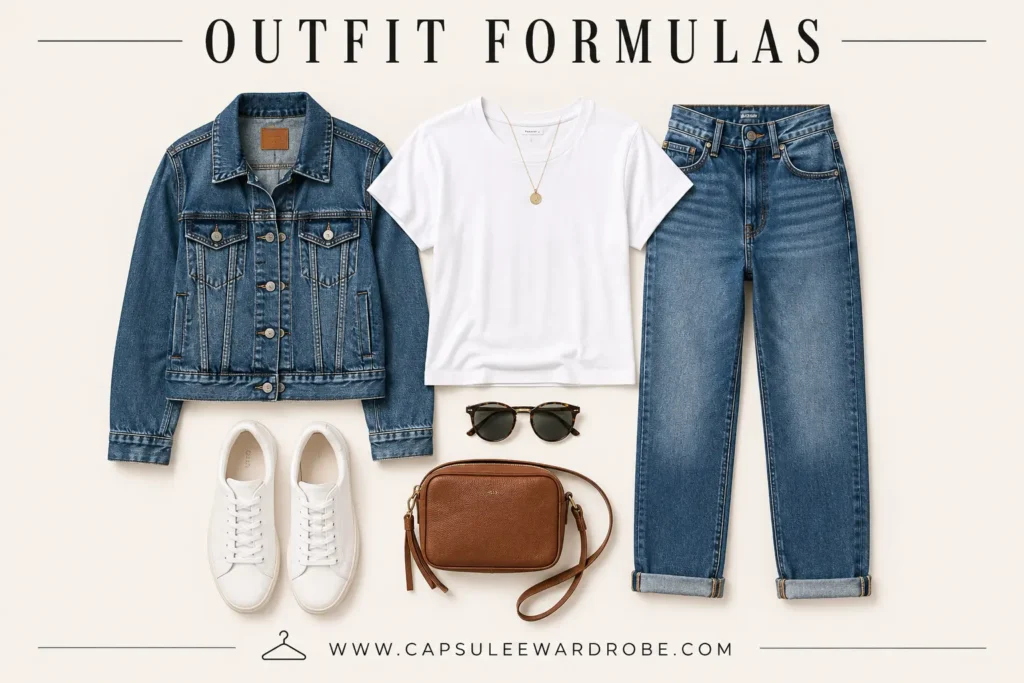
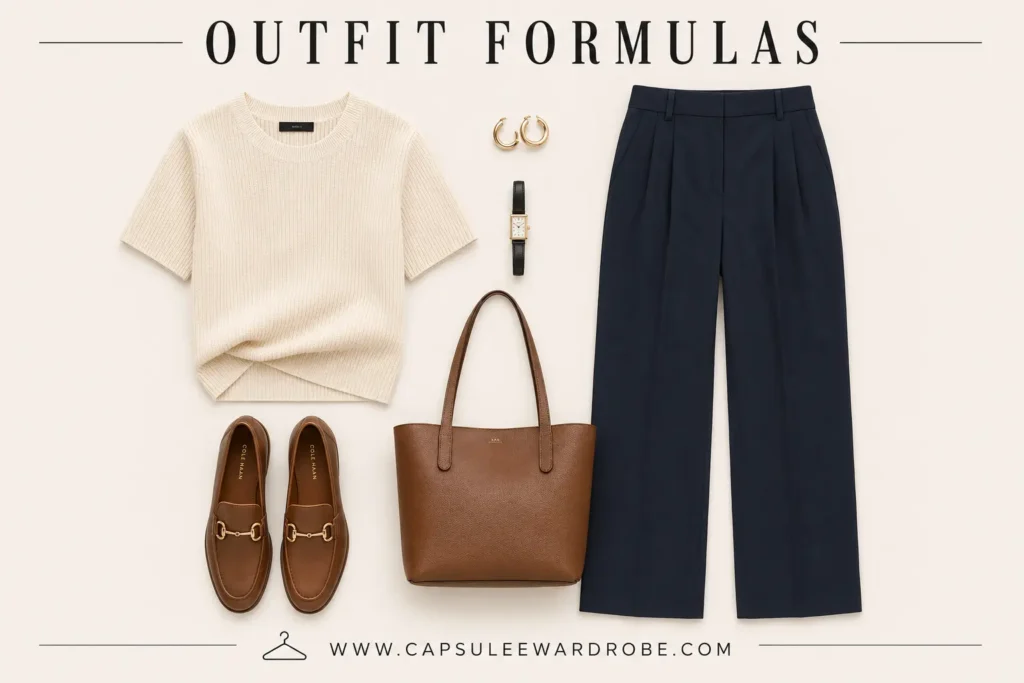
Start with outfit formulas, which are repeatable templates you can run on autopilot:
- Everyday: tee + jeans + sneakers d+enim jacket
- Elevated casual: knit top + trousers + loafers
- Work: blazer + button-down + tailored trousers + flats (our work capsule wardrobe guide expands this into 15 office-ready pieces)
- Weekend: sweater + chinos + boots
- Travel: layers in one palette + your most comfortable shoes (see the full travel capsule wardrobe guide for packing-light formulas)
Take a single core piece and stress-test it. My white button-down works with jeans and sneakers, with trousers and loafers, under the camel sweater, and open over a dress. That’s four outfits from one shirt, and it’s the versatility a shared color palette buys you.
Save what works. Photograph successful outfits and keep them in a phone album (or use the outfit formula sheet in the free planner). On rushed mornings, you’re not creating, you’re choosing from a proven menu. This is how a 32-piece capsule genuinely beats a 174-piece closet: I have more outfits now, not fewer.
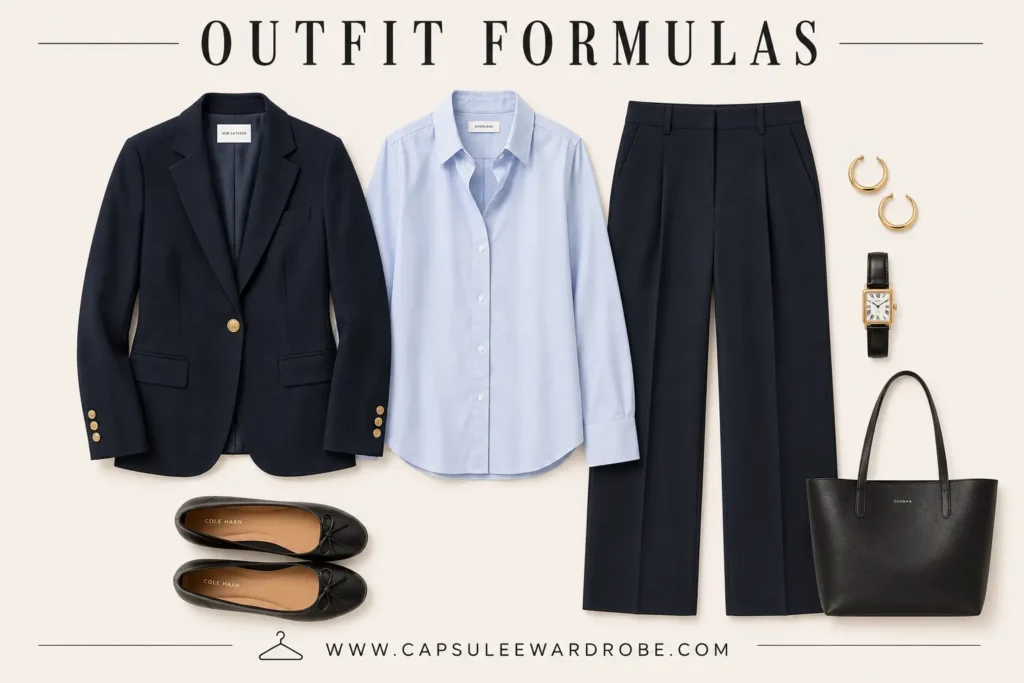
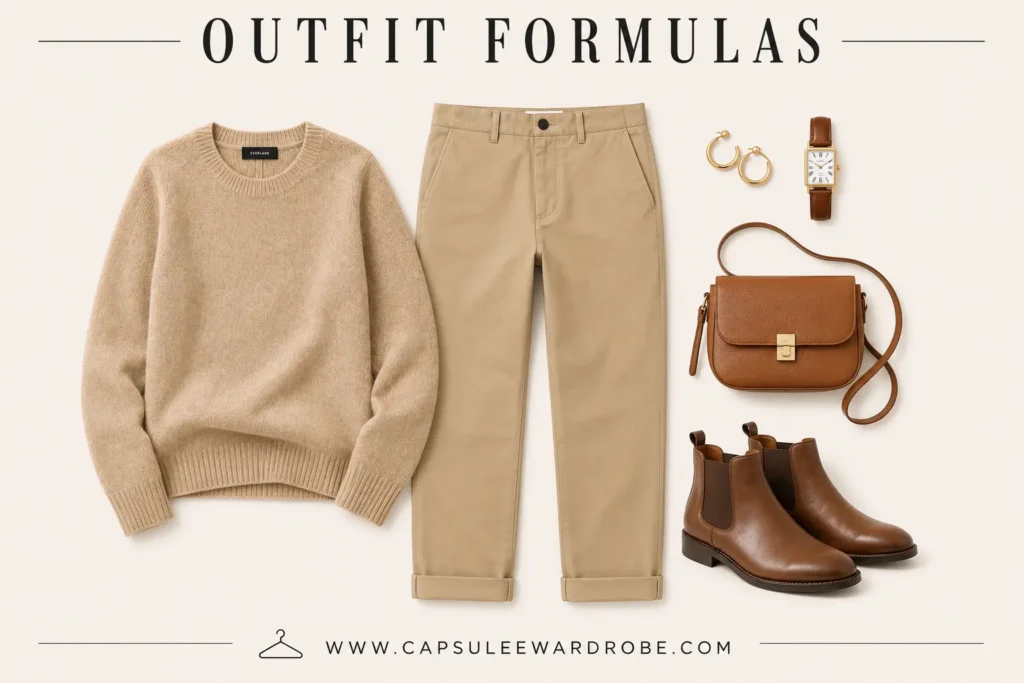
5 Common Capsule Wardrobe Mistakes (I’ve Made Most of Them)
Shopping too soon. Buy from a checklist before auditing your closet. That was my year-one blazer mistake. Audit first, shop last.
Copying someone else’s capsule. If you hate blazers, your capsule doesn’t need one, no matter what the listicles say (though if that pared-back Parisian look genuinely is your style, our French capsule wardrobe guide builds it properly in 25 pieces). And if dresses and bright colors are your style, keep them.
Building on trends. Trends are seasoning, not foundation. Base the capsule on timeless pieces, then add one or two trend items per season if you enjoy them.
A palette that fights itself. When colors compete, outfits get harder, not easier. Fewer, friendlier colors mean more combinations.
Being too restrictive. If your life genuinely needs 50 pieces instead of 33, take 50. The goal is a wardrobe that works, not a number to brag about. Extreme minimalism that leaves you doing laundry twice a week isn’t simplicity.
Maintaining Your Capsule Wardrobe
Building the capsule is a weekend. Keeping it is a system, and a light one.
Seasonal review (4 times a year, about 30 minutes). At each season change, ask: what did I wear most, what sat unused, what needs replacing? Rotate stored seasonal pieces in and out. Our spring and fall capsule wardrobe guides walk through exactly what to swap at each transition.
The one-in-one-out rule. Every new purchase displaces an old piece. This single habit stops the slow creep back to closet chaos.
Care for what you own. Follow care labels, fold knitwear instead of hanging it, repair small damage early, and clean your shoes. Quality pieces cared for properly last for years, which is the quiet sustainability win of capsule dressing.
Let it evolve. New job, new city, new season of life: your capsule should change with you. Mine looks quite different from the one I built nine years ago, and that’s the point.
Adapt the Method to Your Life
The seven steps above work for everyone, but the pieces you choose will differ with your body, age, and season of life. Once you’ve finished this guide, these deep dives apply the same method to specific situations: dressing professionally with a business casual capsule wardrobe, refining timeless style with a capsule wardrobe over 50, choosing flattering essentials for a plus size capsule wardrobe or a petite capsule wardrobe, dressing a growing bump with a maternity capsule wardrobe, building comfortable classroom outfits with a teacher capsule wardrobe, or simplifying your children’s closets with a kids capsule wardrobe.
Start This Weekend
You don’t need to buy anything to start. You need one free morning, your bed, and every piece of clothing you own in one pile.
Print the checklist below, do the Bed Test (Step 1), and build from what you already wear. Six weekends from now, getting dressed will be the easiest part of your day.
📥 DOWNLOAD: capsule-wardrobe-checklist-planner with an essentials checklist, declutter tracker, color palette worksheet, and outfit formula sheet, all printable.
Frequently Asked Questions
How many clothes should be in a capsule wardrobe?
There’s no magic number. Project 333 uses 33 items, including shoes and accessories. The classic “seasonal capsule” is often cited as 37 pieces, and many people are happiest between 30 and 50. My own sits at 32 per season.
Focus on whether your wardrobe covers your real life without clutter, not on hitting a number. Our capsule wardrobe checklist shows what a complete wardrobe covers, category by category.
Can I build a capsule wardrobe without buying new clothes?
Yes, and you should. The Wear-First Method builds the capsule entirely from your most-worn existing pieces first. Shopping only happens at Step 6, and only for genuine gaps. My first capsule required zero purchases.
Do capsule wardrobes save money?
For most people, significantly. You buy fewer items, skip impulse purchases, and judge everything by cost per wear instead of price tag.
Since building my first capsule, I buy roughly half as much clothing per year as I did before, and I like what I own far more.
What’s the 333 method?
Project 333 is Courtney Carver’s minimalist fashion challenge: dress with only 33 items, including clothing, accessories, jewelry, and shoes, for 3 months. Underwear, sleepwear, and workout clothes don’t count. It’s a great forcing function if you want strict rules. My method is looser but borrows its seasonal rhythm.
What colors work best in a capsule wardrobe?
Neutrals: black, white, navy, grey, brown, camel, cream, and olive, because they mix freely. Choose 3 or 4 as your foundation, then add 1 or 2 accent colors you love, such as burgundy, forest green, dusty blue, or rust. The best palette is the one already hiding in your most-worn clothes.
Can a capsule wardrobe include trendy items?
Yes. Build the foundation from timeless pieces, then add one or two trend pieces per season that fit your palette. Trends should decorate the capsule, not define it.
How often should I update my capsule wardrobe?
Seasonally, with a 30-minute review four times a year. Swap stored seasonal items in, retire worn-out pieces, and note gaps. Small regular adjustments beat dramatic overhauls.
What if my style changes?
Then your capsule changes too. A capsule wardrobe is a living system, not a locked box. Mine has evolved through job changes and a move, and the method absorbed every shift: audit, keep what you wear, release what you don’t.

Emma studied fashion but could never get her own closet under control. Capsule wardrobes finally fixed that. Now she writes about what actually worked for her, in the hope it saves you a few frustrating mornings.