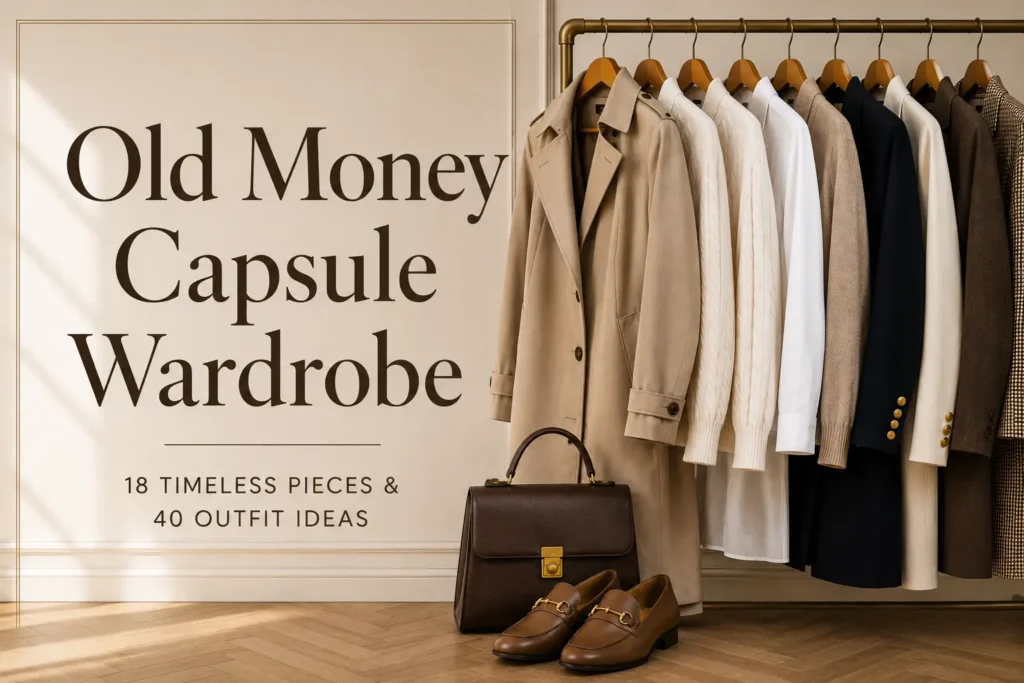
An old money capsule wardrobe is a small, deliberately chosen set of clothes built around quality fabric, clean tailoring, and a tight neutral palette, pieces that look considered rather than new.
It is a timeless capsule wardrobe with a particular accent: the old money aesthetic favors warm neutrals, natural fabric, and traditional tailoring over anything that announces itself.
This guide gives you the exact 18 items, the shoes and accessories that finish them, the 40 outfits they produce, three budget routes to build it, and the styling rules that separate a wardrobe that looks expensive from one that only looks beige.
Most guides on this topic hand you a mood board and a shopping list. This one hands you arithmetic.
Every piece below earns its slot because it pairs with at least four others, and the outfit count at the end is a real count you can verify against the grid, not a number rounded up to sound impressive.
What an Old Money Capsule Wardrobe Actually Is
Strip away the aesthetic language and the idea is simple. A capsule wardrobe is a limited set of garments chosen so that nearly everything works with nearly everything else.
If you are new to the format entirely, it is worth understanding what a capsule wardrobe is before layering a style on top of it, because the mechanics matter more than the mood.
The old money version, which you will also see written as old-money style, applies three additional filters to that basic structure. Each one is what separates old money fashion from generic neutral dressing.
The Four Markers of Old Money Style
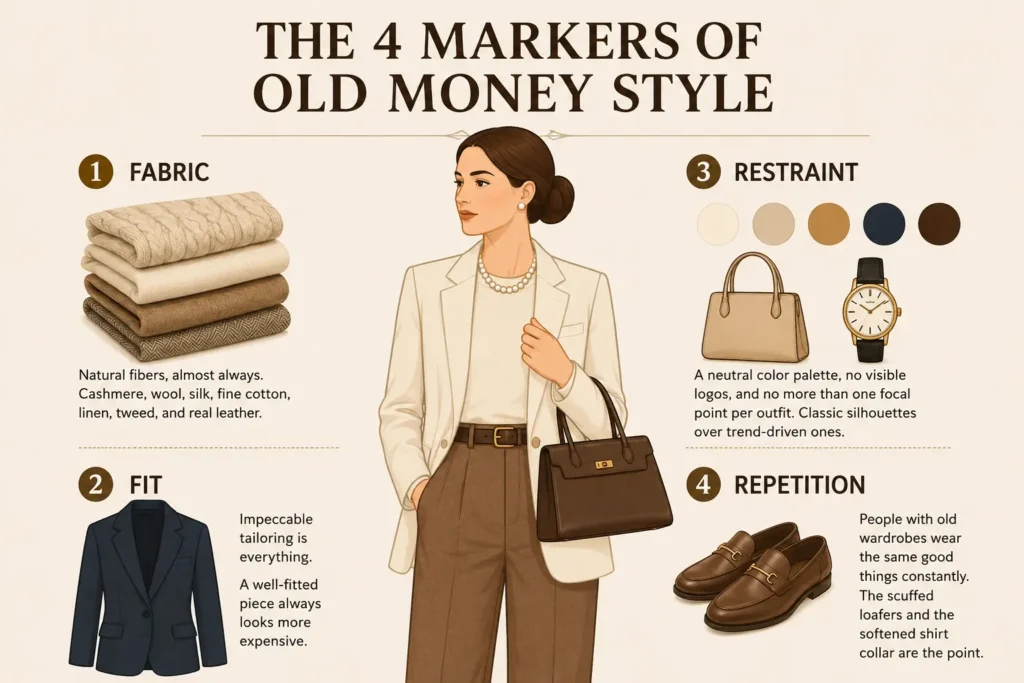
- Fabric. Natural fibers, almost always. Cashmere, wool, silk, fine cotton, linen, tweed, and real leather. These fabrics behave differently from synthetics. They hold a shape, they drape instead of clinging, and they age into something better rather than something sadder.
- Fit. Impeccable tailoring is the whole game. A $90 blazer that fits your shoulders correctly reads as more expensive than a $900 blazer that does not. This is the cheapest upgrade available to you, and most people skip it.
- Restraint. A neutral color palette, no visible logos, and no more than one focal point per outfit. Classic silhouettes over trend-driven ones. If a piece would look dated in a photo from five years ago, it will look dated in five years too.
- Repetition. This is the marker nobody mentions, and it might be the most important. People with genuinely old wardrobes wear the same good things constantly. The scuffed loafers and the slightly softened shirt collar are the point. A wardrobe where everything looks brand new reads as a costume, not as timeless sophistication.
Old Money vs. Quiet Luxury vs. Minimalist
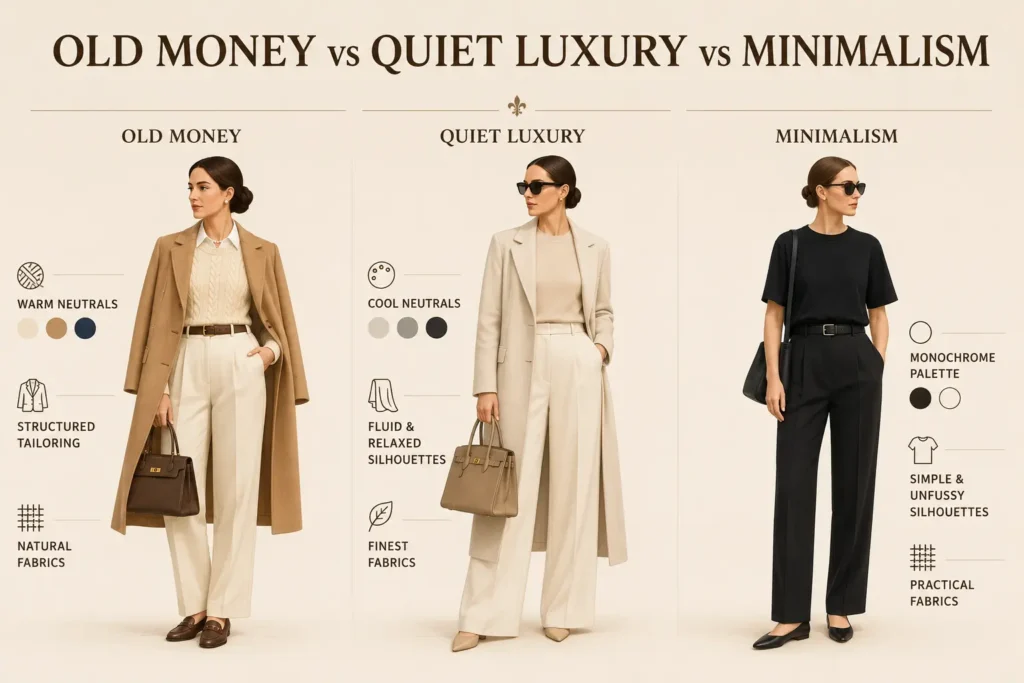
These three terms get used interchangeably, and they should not be.
| Item | Core idea | Palette | Silhouette | Fabric priority |
| Old money | Inherited-looking, slightly traditional | Warm neutrals: camel, cream, navy, chocolate brown | Structured, tailored, waist-defined | Cashmere, wool, tweed, cotton |
| Quiet luxury | Expensive but unmarked, contemporary | Cool neutrals: charcoal, black, white | Fluid, relaxed, sometimes oversized | Silk, fine wool, leather |
| Minimalist | Fewest possible items, function first | Often monochrome | Simple, unfussy | Whatever performs |
Quiet luxury is the broader, more modern category. Old money style sits inside it but adds a traditional, slightly heritage-leaning accent.
A quiet luxury wardrobe and a quiet luxury capsule wardrobe both prize understated elegance, and stealth wealth style is essentially the same instinct pushed further: no logos, no signals, nothing legible at a distance. Where they diverge is warmth and structure.
Minimalism overlaps in method but not in intent. A minimalist cares about the count, an old money dresser cares about the fabric.
If that distinction interests you, the comparison of a capsule wardrobe vs. a minimalist wardrobe unpacks the philosophical difference in more depth.
A useful shorthand: quiet luxury is what you wear to look successful now. Old money is what you wear to look like you were never worried about it.
The 18-Piece Old Money Capsule Wardrobe Checklist
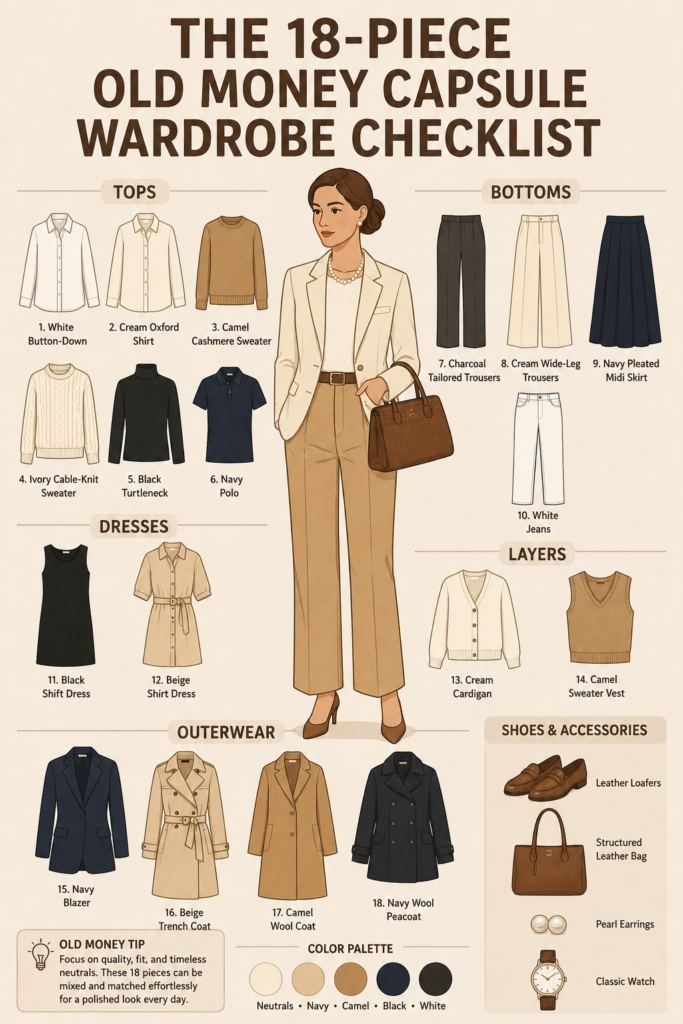
Clothing only. Shoes and accessories follow below, since they replace on different cycles and take a different share of your budget.
These are timeless wardrobe essentials, not a seasonal list. Every piece should still be in rotation in five years. If you would rather shop from a printable version, the general capsule wardrobe checklist gives you a format to adapt.
The quick version: 7 tops, 4 bottoms, 2 dresses, 2 third pieces, 3 coats.
Tops: 7 Pieces
1. White Button-Down (Cotton)
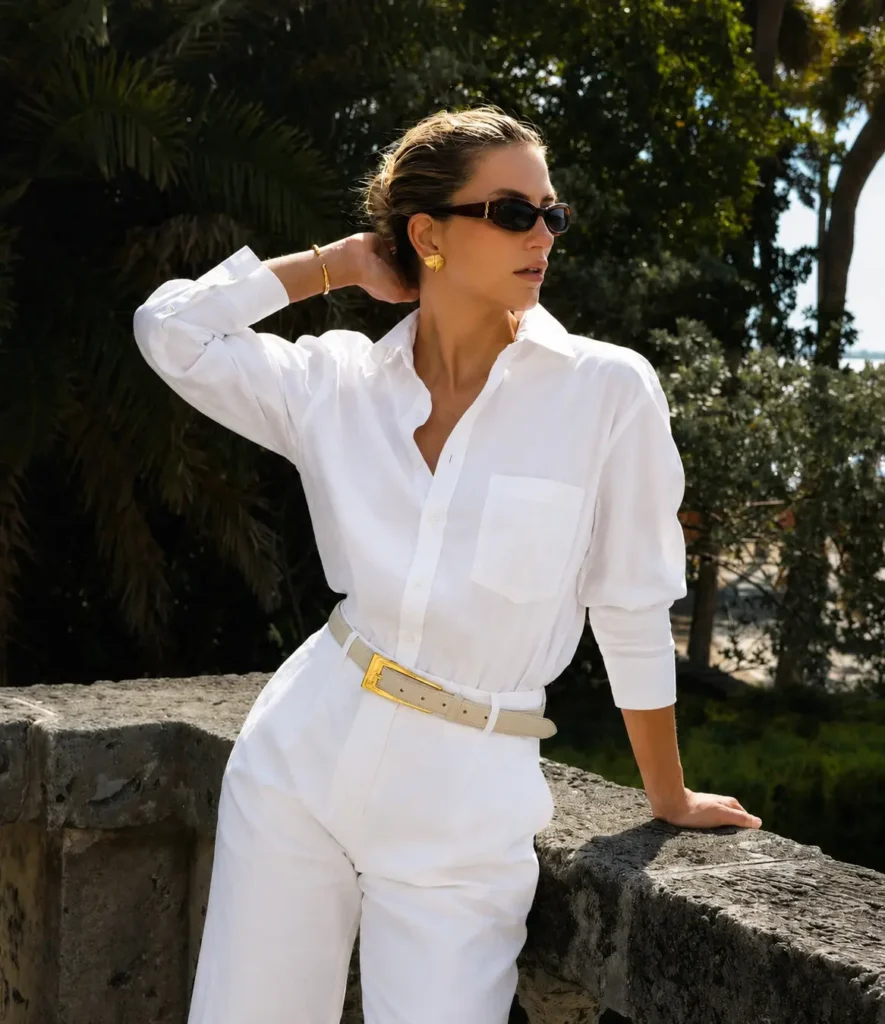
The most-worn item in the capsule and the one most people under-buy. It pairs with all four bottoms, layers under the cardigan, blazer, and sweater vest, and works untucked with white jeans on a weekend.
What to check: enough body that the shirt holds its shape when you move. Thin, papery cotton looks cheap under any blazer. The collar should stand on its own.
2. Cream Oxford Shirt (Cotton)
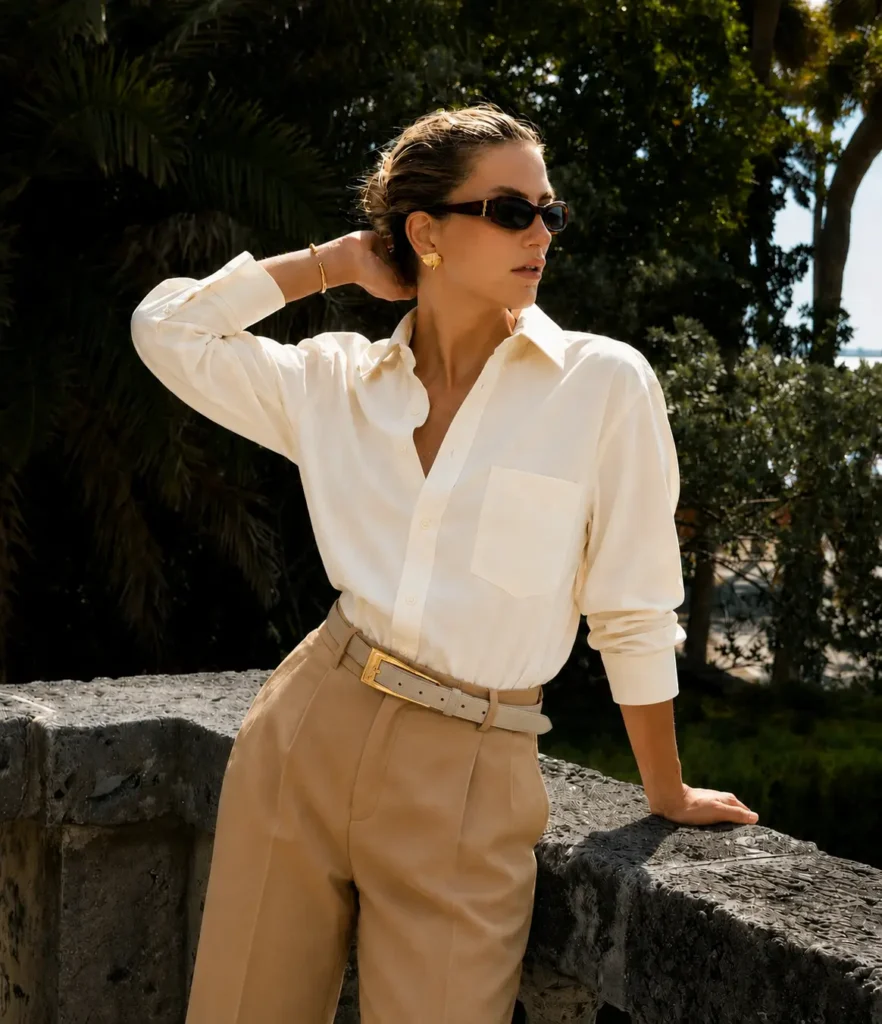
The button-down’s softer sibling. Oxford cloth has a heavier, more textured weave, which makes it read casual where the button-down reads formal. That one distinction doubles your shirt options.
What to check: cream rather than white, so it does not compete with piece one and sits comfortably against camel and chocolate brown.
3. Camel Cashmere Sweater
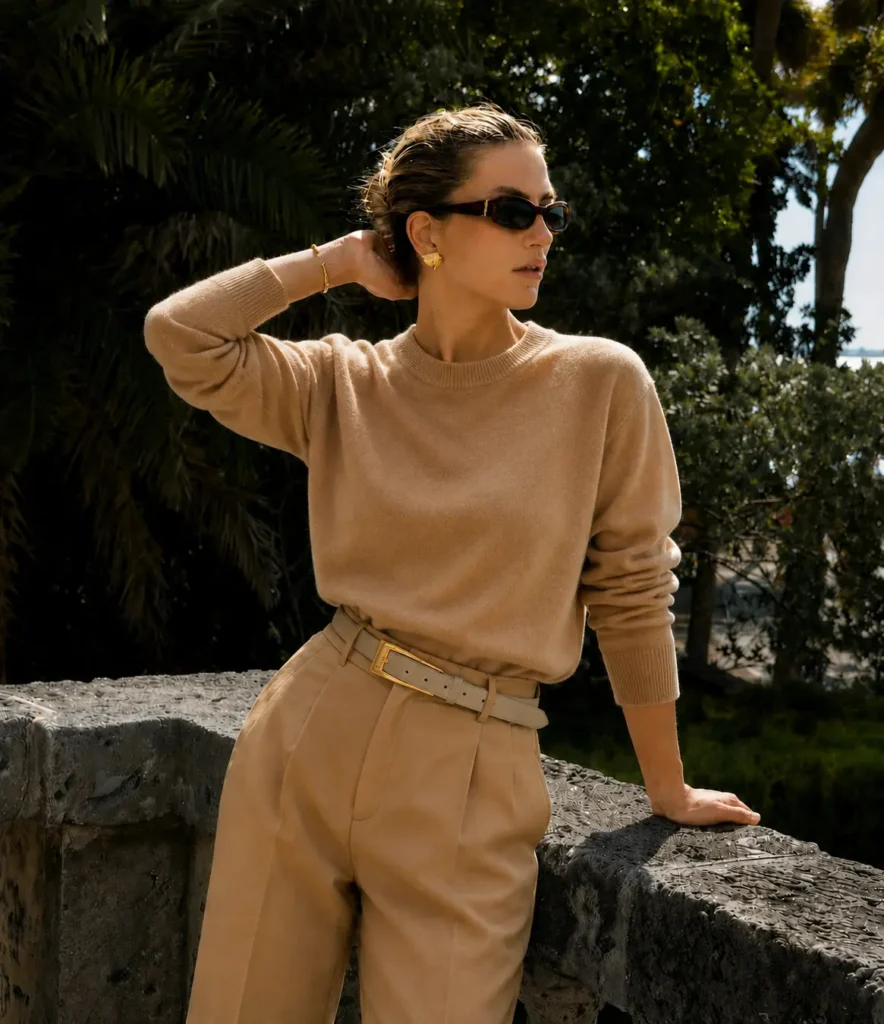
Camel is the workhorse color of the whole aesthetic. It flatters navy, charcoal, cream, and white simultaneously, which almost no other color manages. Wear it alone or over a collared shirt.
What to check: weigh it in your hand. Good cashmere has heft relative to its thinness. If it feels weightless and slightly fuzzy in the shop, it will pill within a month.
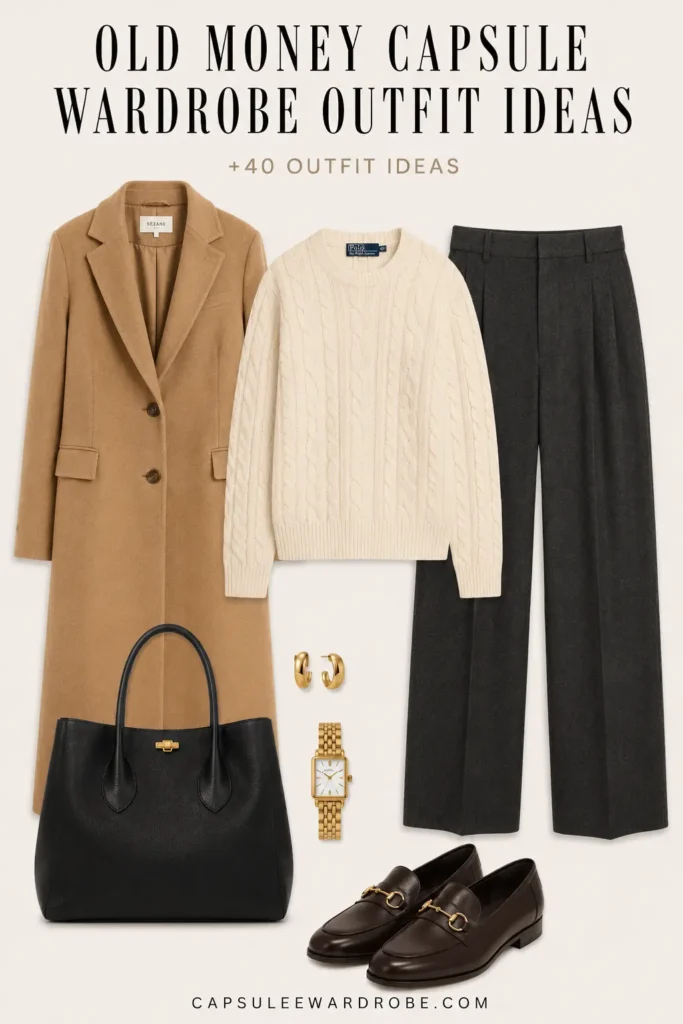
4. Ivory Cable-Knit Sweater (Wool)
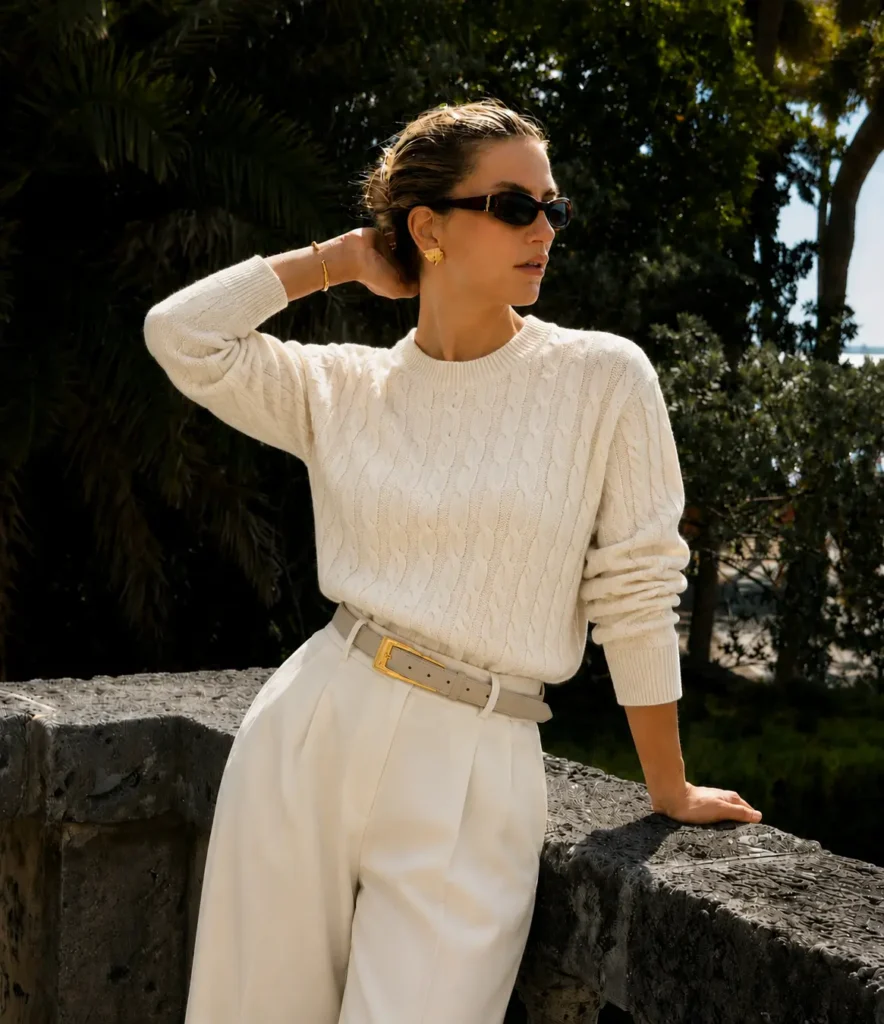
The texture piece. A capsule built entirely on smooth surfaces photographs flat and looks flatter in person. The cable knit is what gives winter outfits dimension.
What to check: wool rather than cashmere here. You want structure, not drape.
5. Black Turtleneck
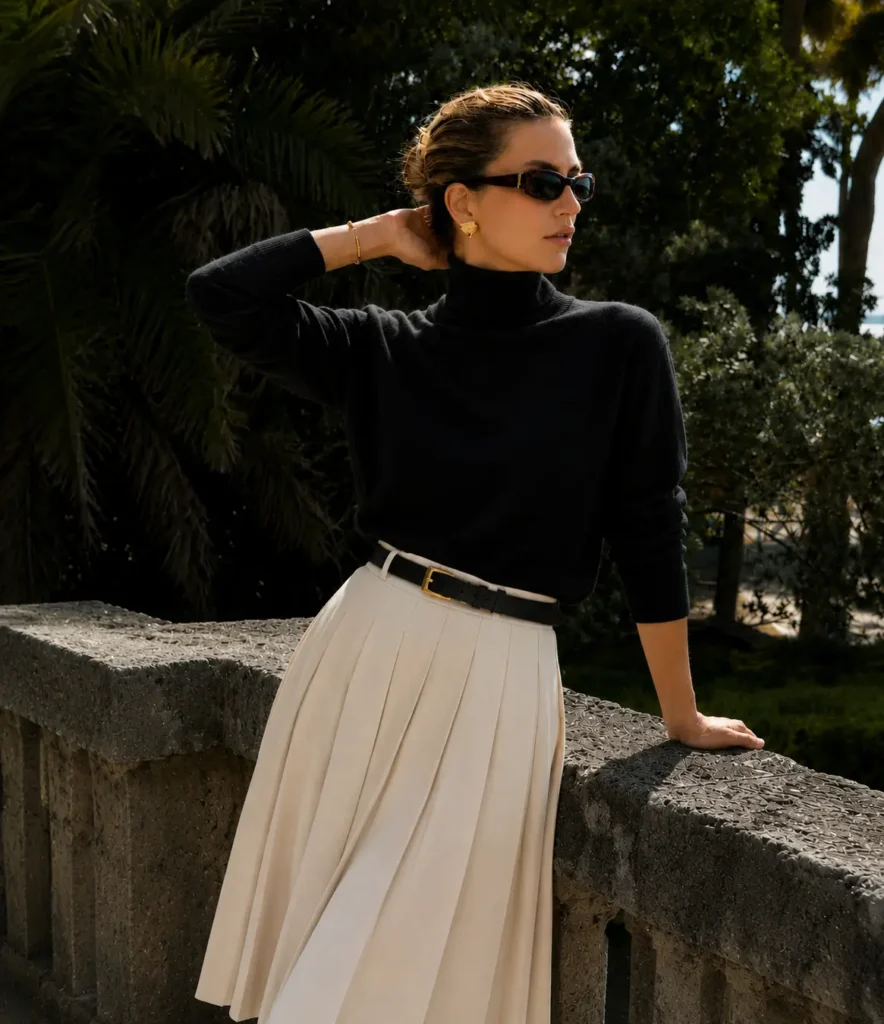
The most efficient garment in the capsule. It goes under the blazer, under the sweater vest, under every coat, and it makes the pleated midi skirt look considered instead of costume.
What to check: fine gauge, close to the body, with a neck that folds cleanly. A turtleneck that gapes at the throat undoes the whole effect.
6. Navy Polo (Cotton)
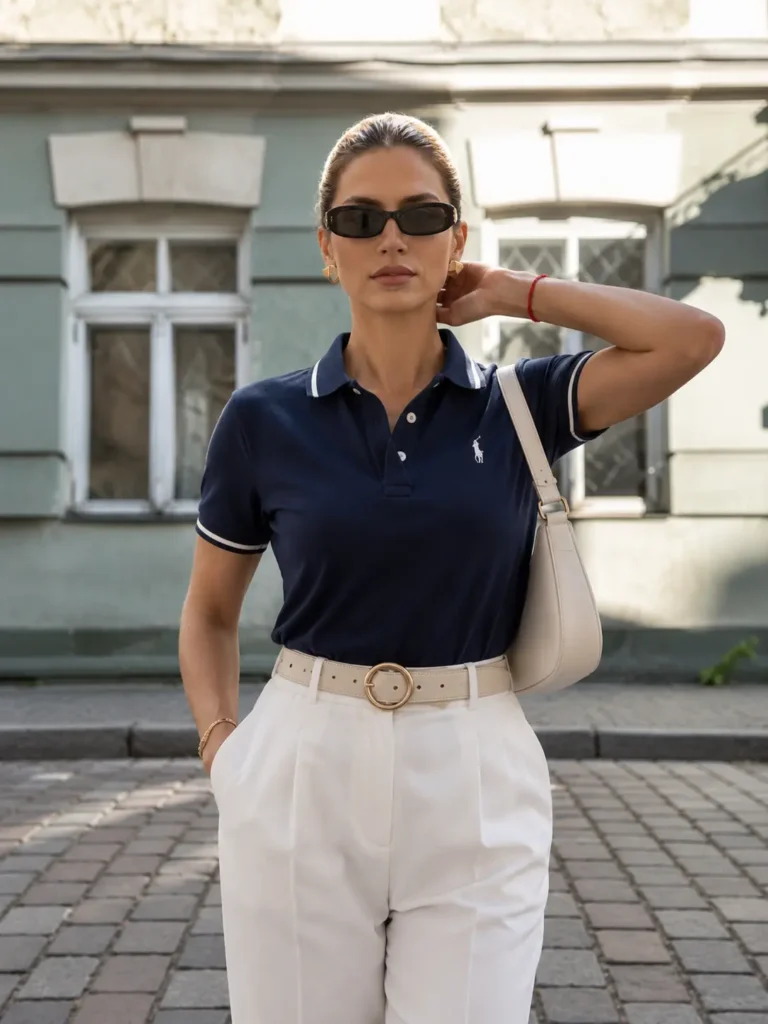
The warm-weather counterpart to the turtleneck, and the piece that keeps this wardrobe wearable in July. Tucked into cream wide-leg trousers, it is one of the strongest summer looks in the set.
What to check: a firm collar and a placket that lies flat.
7. Camel Sweater Vest (Wool)
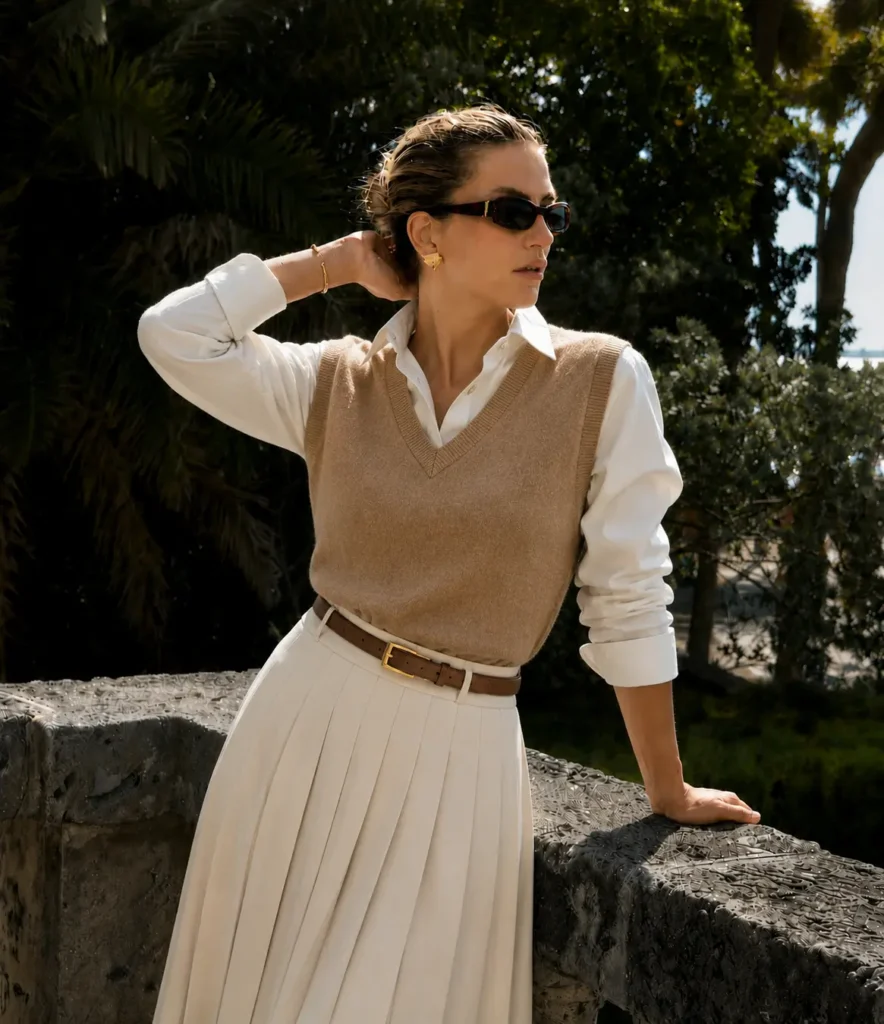
Layered over the white button-down or cream oxford, this produces the single most recognizable silhouette in old money dressing.
What to check: keep it fitted. An oversized vest collapses the shape and immediately looks borrowed.
Bottoms: 4 Pieces
8. Charcoal Tailored Trousers (Wool)
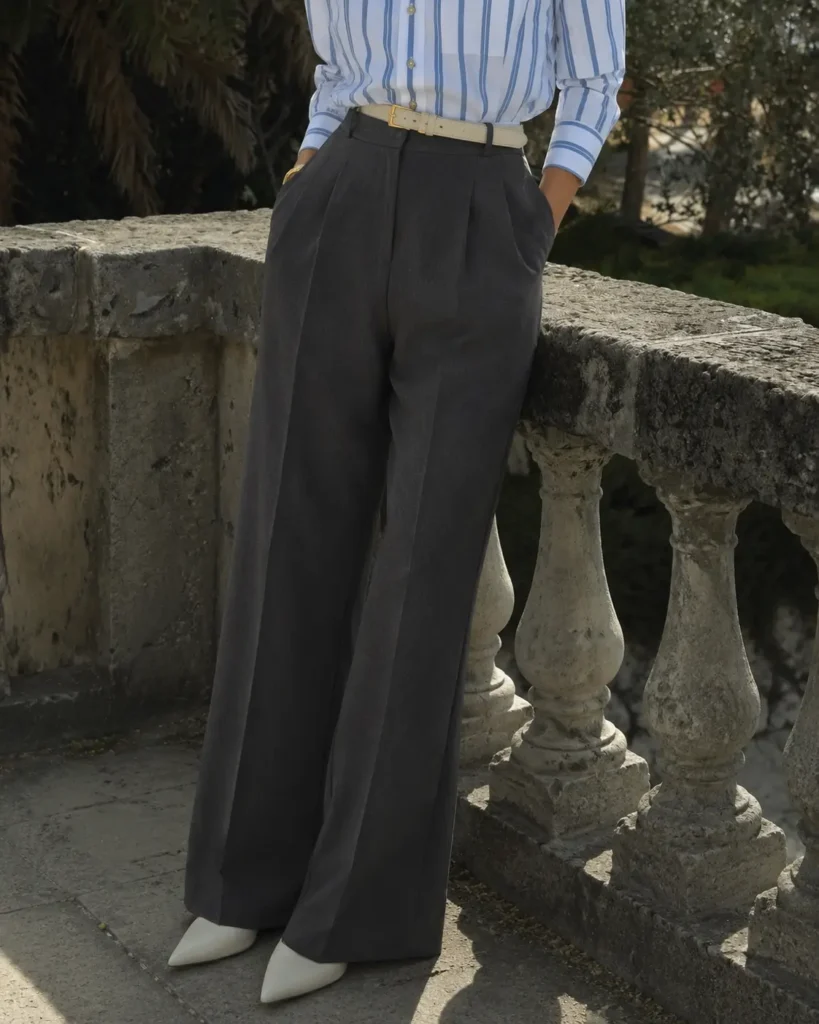
Your most formal bottom, and the piece that anchors the wardrobe for work. These carry every top in the capsule.
What to check: hemmed to graze the top of your shoe. Charcoal is more forgiving than black under office light and less severe in daylight.
9. Cream Wide-Leg Trousers
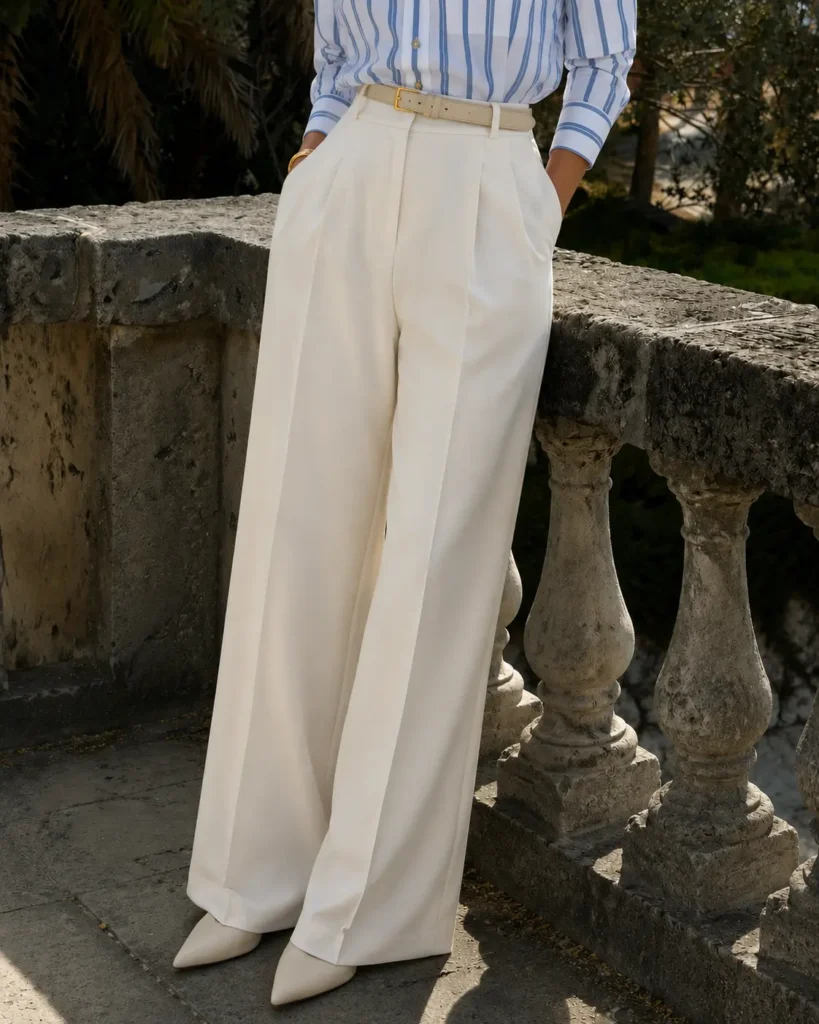
The volume piece. Wide-leg trousers in cream do something specific: they make casual tops look intentional. The polo, cashmere sweater, and button-down all elevate when paired with them.
What to check: length matters more here than anywhere else. Trousers that puddle look sloppy, ones that hover above the ankle look accidental.
10. Navy Pleated Midi Skirt
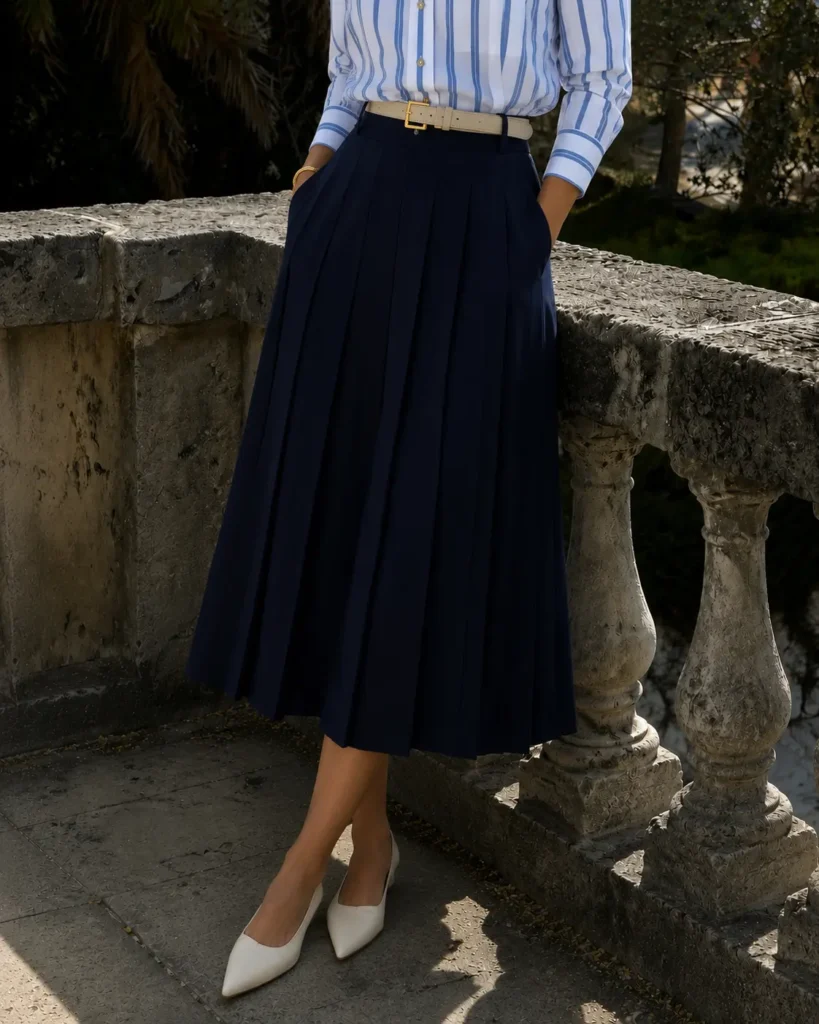
Pleats add movement without adding pattern, which is exactly the trade this aesthetic wants. Worn with the black turtleneck, it is the strongest single look in the wardrobe.
What to check: mid-calf length, which photographs better than shorter or longer. Test it seated as well as standing.
11. White Jeans
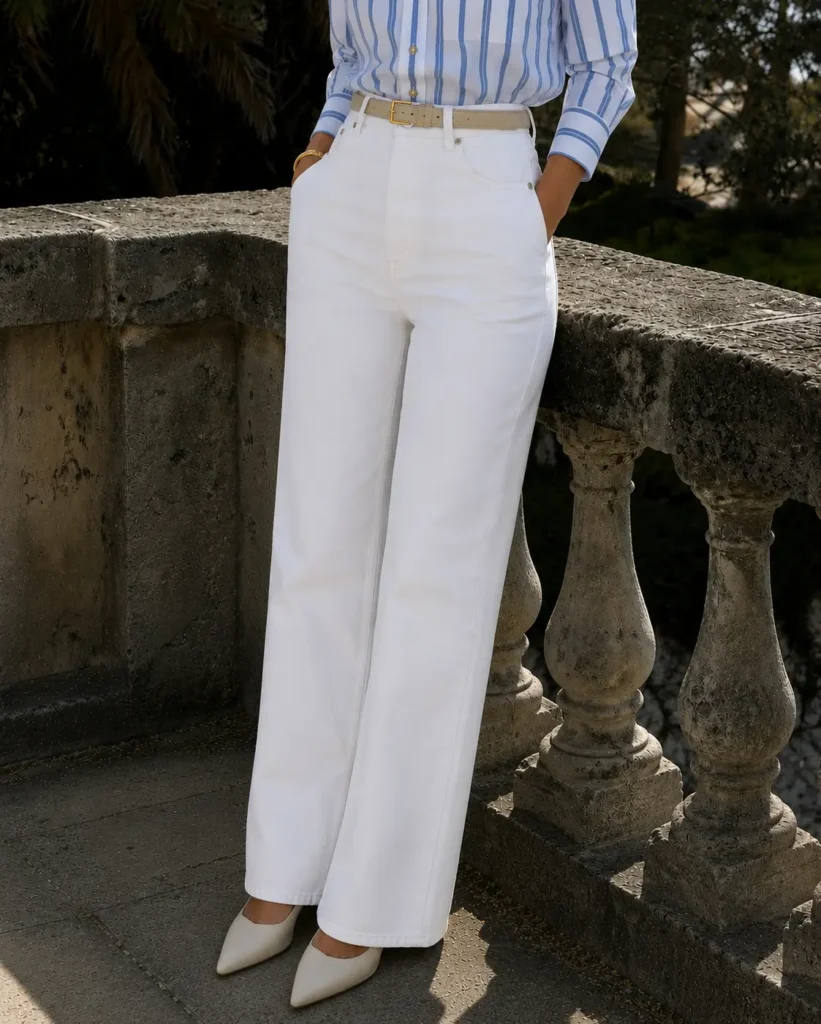
The concession to real life. White jeans in a rigid or lightly structured denim keep the capsule wearable on weekends without breaking the palette. With the navy blazer and loafers, they are genuinely dressy.
What to check: avoid heavy distressing, visible whiskering, or stretch so soft the leg loses its line.
Seasonal swap: an A-line skirt in beige or chocolate brown can replace the pleated midi if pleats do not suit your frame. It sits closer through the hip and gives a cleaner line under a blazer.
Dresses: 2 Pieces
12. Black Shift Dress
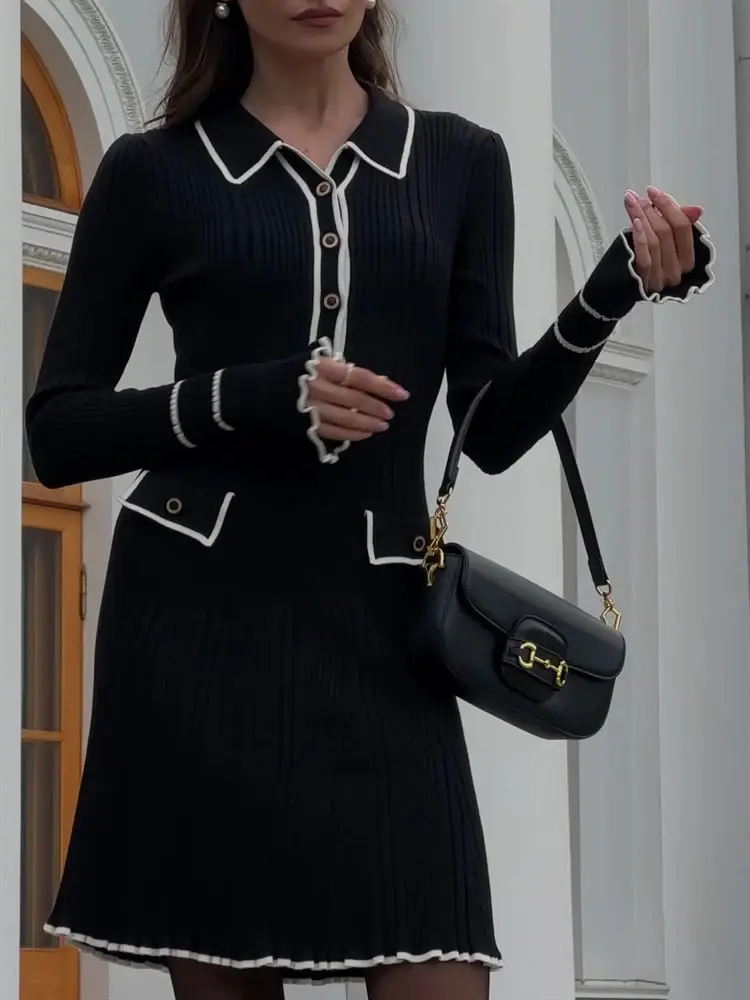
The problem-solver. It handles dinners, presentations, and anything you did not plan for. Add the pearl necklace for evening, the cardigan for daytime, the navy blazer for work, and you have three genuinely different outfits from one garment.
What to check: wool or a wool blend with a clean neckline. It should skim rather than cling.
13. Beige Shirt Dress
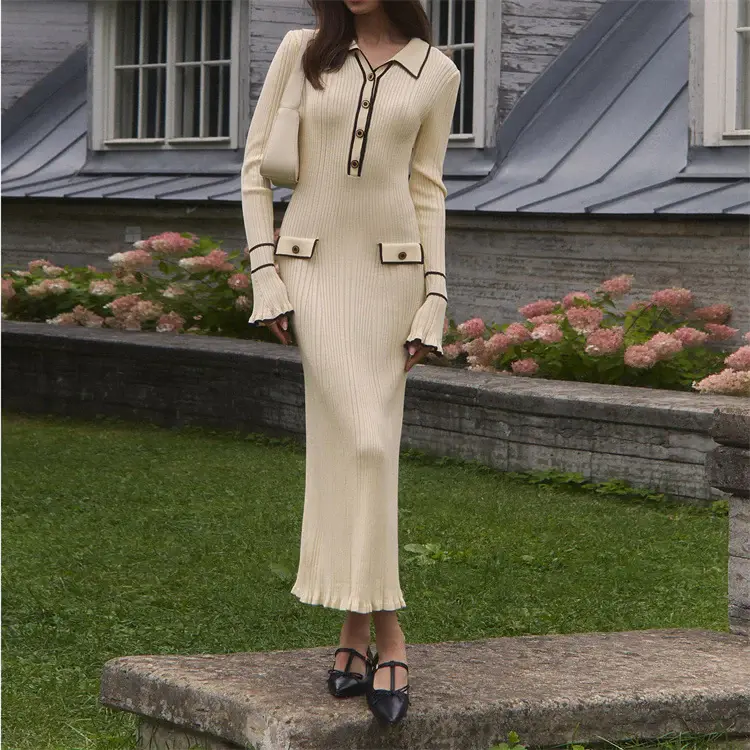
The most versatile dress shape you can own, because it is really a shirt that happens to reach your calf. Belt it, wear it open over jeans and a turtleneck as a light layer, or wear it closed with loafers.
What to check: cotton or linen, depending on your climate.
Third Pieces: 2 Pieces
14. Navy Blazer (Wool)
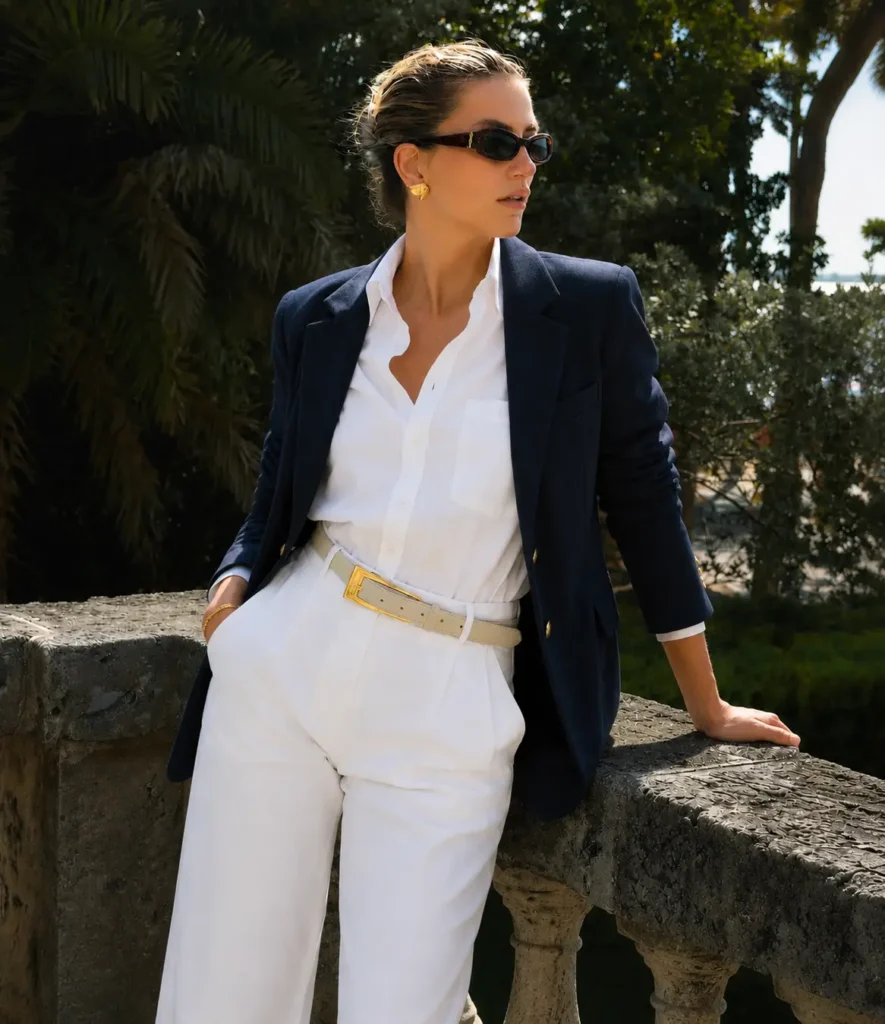
The center of gravity for the whole capsule. It goes over every top, every bottom, and both dresses.
What to check: the shoulder seam must end exactly where your shoulder ends. That one measurement decides whether the jacket looks tailored or borrowed, and it is the alteration a tailor cannot easily fix. Get it right in the fitting room.
Seasonal swap: a linen blazer in cream or beige for summer. Same shape, unlined or half-lined. It will wrinkle, and that is the point. This is the one place in the wardrobe where creasing reads as correct rather than careless.
15. Cream Cardigan (Cashmere)
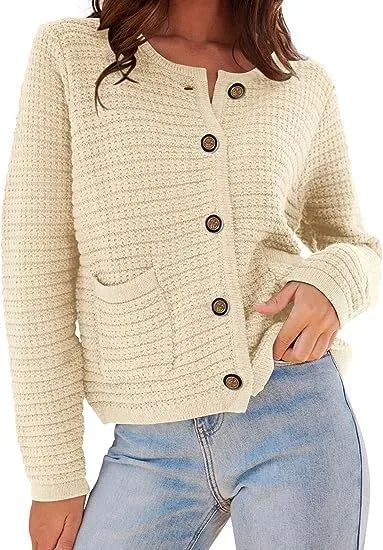
The soft alternative to the blazer, and the piece that makes the wardrobe feel lived-in rather than staged. Wear it buttoned as a top, open as a layer, or draped over the shift dress.
What to check: fine gauge, and cream rather than camel so it does not compete with the sweater.
Outerwear: 3 Pieces
16. Beige Trench Coat
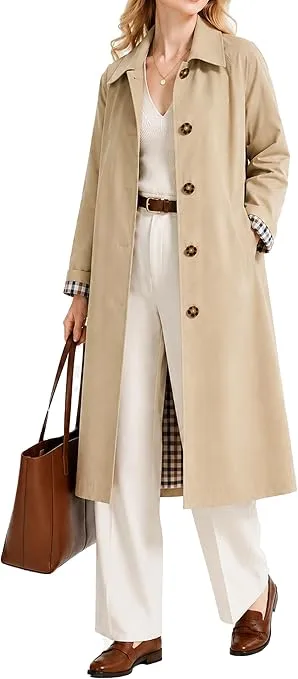
The three-season coat. Over the shirt dress in spring, over the blazer in autumn, over almost anything in unpredictable weather.
What to check: a belt you can tie rather than buckle, a collar that stands, and a length below the knee. Shorter trenches lose the line entirely.
17. Camel Coat (Wool)
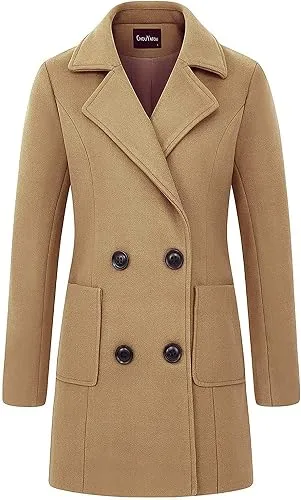
The piece people will remember. You wear it over everything, so it is seen more than anything underneath it. If your budget is finite, this is where the largest share should go.
What to check: cut straight or gently tapered, long enough to cover the pleated midi skirt.
18. Navy Wool Peacoat
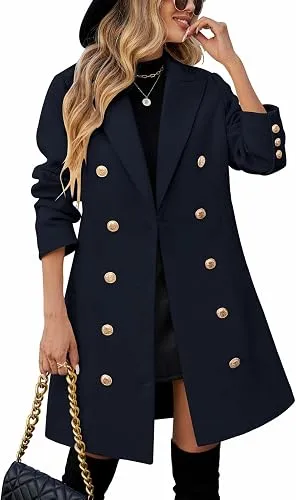
The practical winter alternative. Shorter, warmer, and easier to move in than a full-length coat. It handles the cold days where the camel coat would feel too formal.
What to check: navy, so it works against every other color in the palette.
Shoes: The 8-Pair Edit
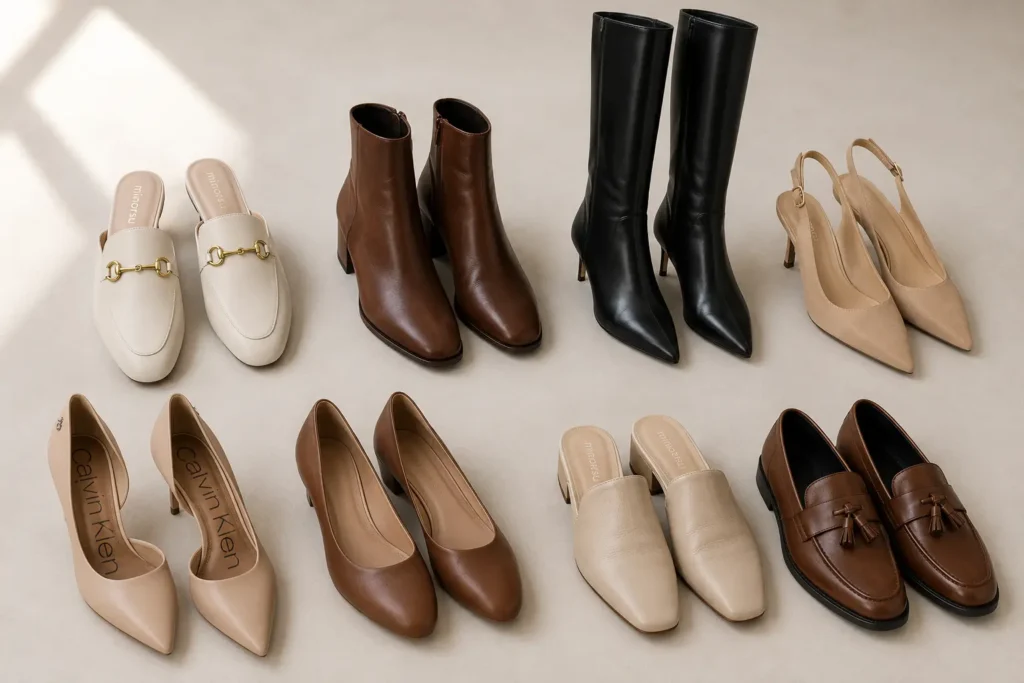
Shoes sit outside the 18 because they replace on a different cycle. A well-made leather shoe outlasts most garments. A poorly made one fails faster than anything in your closet. This is the category where the gap between good and cheap shows fastest, and it shows from across a room.
Buy in this order. The first three cover roughly 80 percent of what the wardrobe needs.
Buy These First
- Loafers (leather, chocolate brown or black). The defining shoe of the aesthetic and the only pair that works with all four bottoms plus both dresses.
- Ballet flats (leather, cream, beige, or black). The most comfortable elegant option available. A slightly lower topline elongates the leg.
- Classic pumps (leather, black or beige). Your formal shoe, and what turns the shift dress into evening wear. Beige close to your skin tone lengthens the leg more than black.
Add These Next
- Slingback heels (leather). The open back breaks the line at the heel, which is why slingbacks flatter under a midi skirt better than a closed pump.
- Kitten heels (leather). The daily heel. Low enough to walk in, high enough to shift trousers from casual to considered.
- Knee-high boots (leather, chocolate brown or black). The strongest autumn and winter option. The shaft should end just below the knee and sit close without gripping.
- Ankle boots (leather, chocolate brown or black). Your practical winter shoe. Choose a shaft at or just above the ankle bone.
- Mules (leather). The summer equivalent of the loafer. A low block heel is more wearable than a flat.
One Rule on Color
Keep the whole edit within chocolate brown, black, cream, and beige. A shoe outside the palette pairs with a fraction of the wardrobe and quietly reduces your outfit count.
Accessories: The 11 Finishing Pieces
Restraint is the operating principle. An elegant capsule wardrobe is defined as much by what is absent as by what is present, and accessories are where that discipline is easiest to lose. Every item here has a job.
Carry
Silk scarf. The most versatile accessory in the set. At the neck, tied to the tote handle, or holding hair back, it changes an outfit without changing a garment. Look for hand-rolled edges and a weight that drapes.
Leather tote (chocolate brown or black). The daily bag. It should stand upright on its own when empty.
Structured handbag. Smaller and more formal, for evenings when the tote reads as too practical.
Wear
Pearl earrings. Worn nearly daily. Modest in scale. Oversized pearls read as costume.
Pearl necklace. Occasional. A single strand at collarbone or just below.
Gold watch. Small face, simple band. Scale is the thing to get right.
Thin gold bracelet. One, alone or with the watch. Not a stack.
Leather belt (chocolate brown and black). Structural, not decorative. It defines the waist on both dresses. Small matte buckle, roughly an inch wide.
Finish
Gloves (leather, chocolate brown or black). One of the few accessories that immediately elevates winter outerwear. Buy them fitted.
Rectangular sunglasses. A clean neutral frame, sized within the width of your face.
Headband. The simplest way to make an outfit look finished. Works especially well with the cable-knit and trench coat.
The Governing Rule
Three accessories maximum per outfit, counting bag, jewelry, and belt together. Beyond three, the look stops being understated, and understatement is the entire point.
The Outfit Math: How 18 Pieces Become 40 Outfits
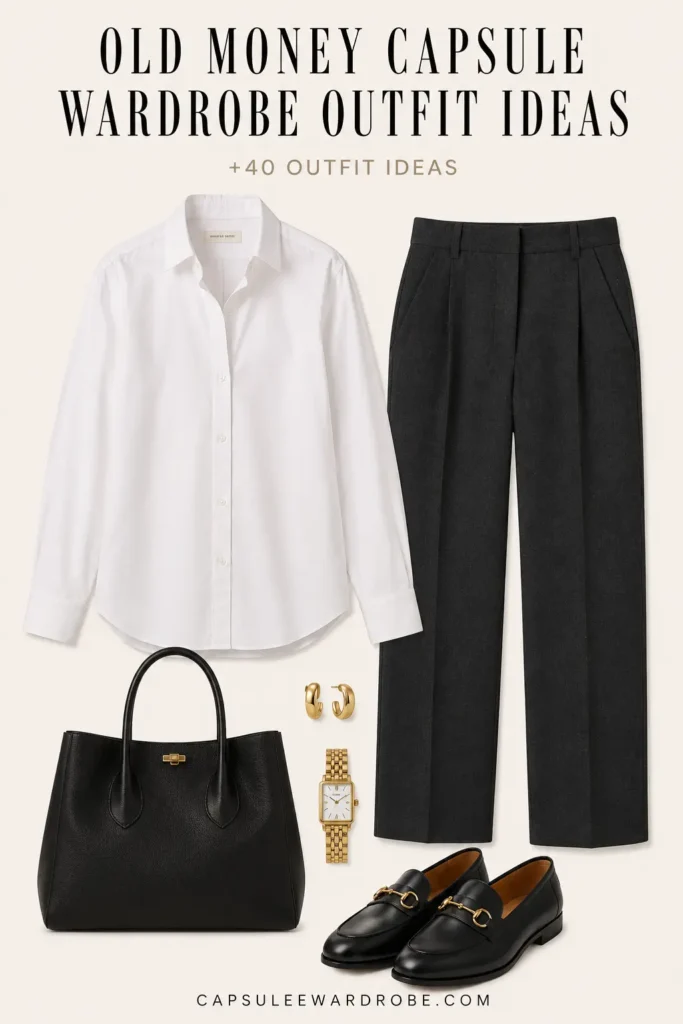
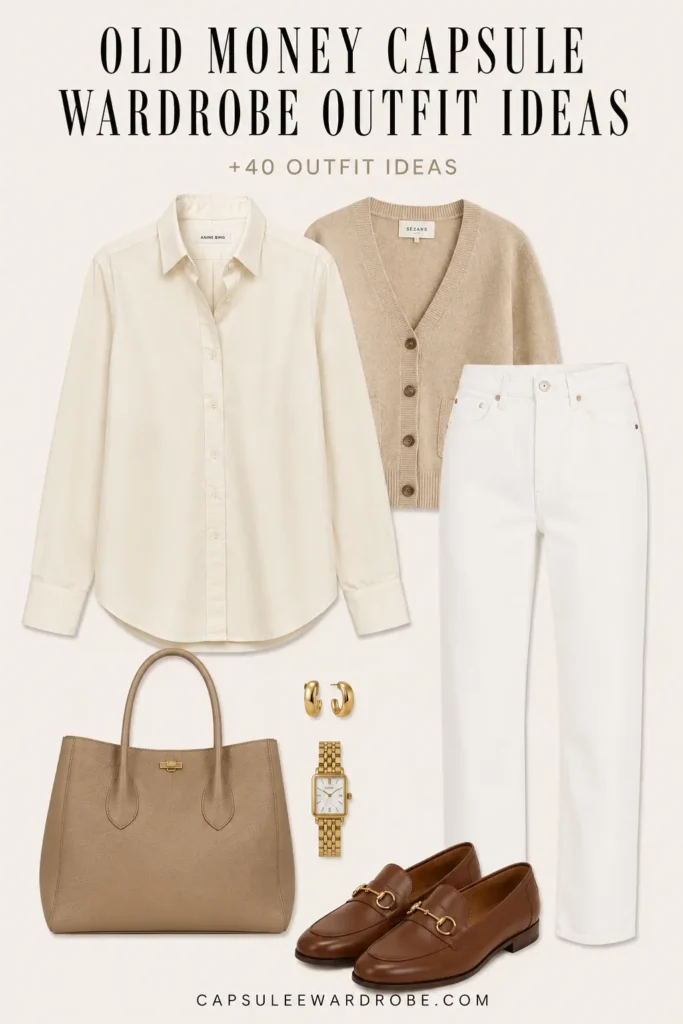
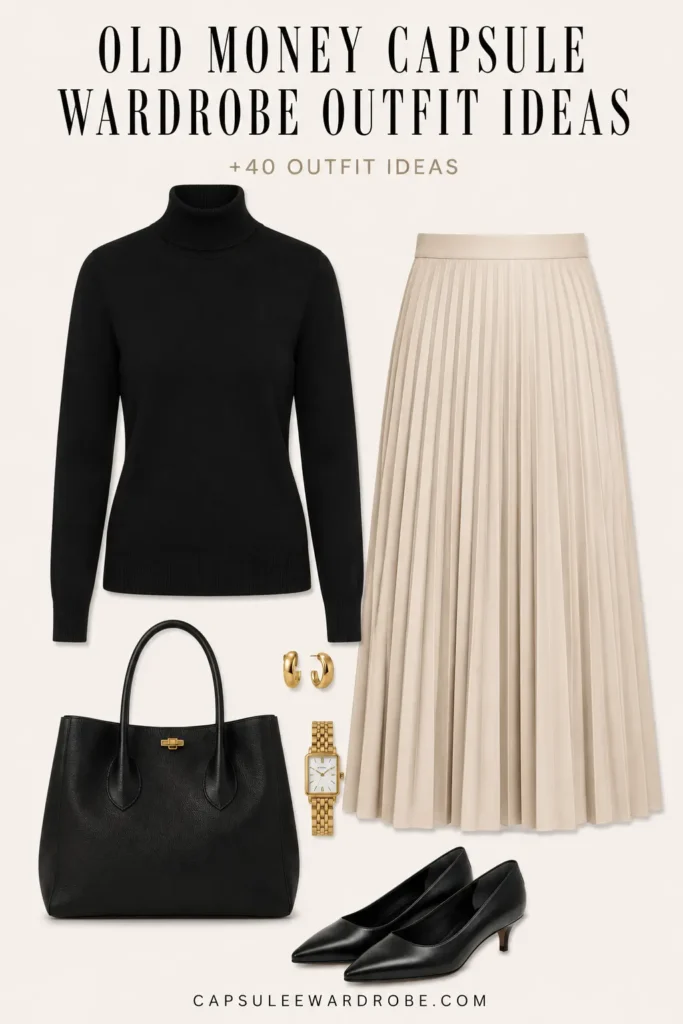
Here is the honest arithmetic. Nobody in this space shows their work, which is why the numbers you see elsewhere tend to be inflated.
28 top-and-bottom combinations. Seven tops multiplied by four bottoms. Because the palette is tight and every top is a neutral, all 28 pairings genuinely function. None of them clash, and none require a third piece to rescue them.
| Items | Charcoal trousers | Cream wide-leg | Navy pleated midi | White jeans |
| White button-down | 1 | 2 | 3 | 4 |
| Cream oxford | 5 | 6 | 7 | 8 |
| Camel cashmere | 9 | 10 | 11 | 12 |
| Ivory cable-knit | 13 | 14 | 15 | 16 |
| Black turtleneck | 17 | 18 | 19 | 20 |
| Navy polo | 21 | 22 | 23 | 24 |
| Camel sweater vest* | 25 | 26 | 27 | 28 |
*The sweater vest is worn over the white button-down or cream oxford, which is why it counts as its own look rather than as a layer.
6 dress-based outfits. Two dresses, three treatments each: worn alone with a belt, worn with the cream cardigan, worn under the navy blazer. That is outfits 29 through 34.
6 layered combinations that change the outfit’s character. Not every layer creates a new outfit. A coat thrown over an existing look is still that look.
But six combinations shift the silhouette enough to count: blazer over turtleneck and midi skirt, cardigan over polo and wide-leg trousers, blazer over button-down and white jeans, cable-knit over the shirt dress worn as a skirt, cardigan over the shift dress with the belt, and the sweater vest over the button-down under the blazer. Outfits 35 through 40.
Total: 40 outfits.
What I have deliberately not done is multiply by outerwear. Adding three coats to 40 outfits technically produces 120 combinations, and that is how the larger numbers you see elsewhere get manufactured.
A coat over an outfit is the same outfit in colder weather. Counting it twice is arithmetic, not styling. Shoes and accessories multiply it further still, and for the same reason I have left them out of the count.
The broader principle here, that a tight palette produces exponential combinations while a varied one produces linear ones, is the foundation of the entire format. It is covered in more detail in this guide on how to build a capsule wardrobe from the ground up.
Season by Season
The same 18 pieces carry all four seasons. What changes is which pieces lead and how many layers sit between you and the weather.
Spring Old Money Capsule Wardrobe
The trench coat becomes the default outer layer. The cream oxford shirt, white jeans, and beige shirt dress do most of the work, with the cream cardigan handling cool mornings. The linen blazer swap comes in here if you made it. Ballet flats and loafers replace boots almost entirely.
Strongest spring outfit: beige shirt dress, belted, with the trench coat open over it and loafers.
For a broader seasonal framework beyond this specific aesthetic, the spring capsule wardrobe guide covers piece counts and transitional layering in more detail.
Summer Old Money Capsule Wardrobe
This is where most old money wardrobes quietly fail, because the aesthetic is fundamentally built on layers. The solution is fabric rather than fewer clothes: linen and cotton carry the old money aesthetic into heat where wool and cashmere cannot. The navy polo, white button-down, cream wide-leg trousers, white jeans, and beige shirt dress become the working wardrobe. Mules, silk accessories, and the rectangular sunglasses do the styling work that layering usually handles.
Strongest summer outfit: navy polo tucked into cream wide-leg trousers with a leather belt and mules.
The summer capsule wardrobe guide goes further into hot-weather fabric selection if you live somewhere the linen blazer is still too warm.
Autumn/Fall Old Money Capsule Wardrobe
The best season for this wardrobe, because layering is the aesthetic’s native language. The camel sweater vest over the white button-down, the navy blazer over the turtleneck, the cable-knit under the trench coat. Tweed enters here if you add a textured piece. Ankle boots and knee-high boots replace flats.
Strongest autumn outfit: black turtleneck, navy pleated midi skirt, camel coat, knee-high boots.
More on transitional layering in the fall capsule wardrobe guide.
Winter Old Money Capsule Wardrobe
Everything works at once. The camel coat and navy wool peacoat split duty between formal and practical days. The ivory cable-knit sweater, black turtleneck, and camel cashmere sweater rotate underneath. Charcoal tailored trousers and the navy pleated midi skirt handle bottoms. White jeans stay in rotation and look sharper in winter than most people expect. Leather gloves and the silk scarf carry the accessory load.
Strongest winter outfit: ivory cable-knit sweater over the white button-down with the collar out, charcoal tailored trousers, camel coat, ankle boots.
The winter capsule wardrobe guide covers cold-weather layering counts if you are in a genuinely severe climate.
The Neutral Palette, and Why It Is Only Nine Colors
Navy. Camel. Cream. Beige. Ivory. Charcoal. Chocolate brown. Black. White.
That is the entire range, and the restriction is doing more work than any individual garment. Three rules govern how it is used.
Two neutrals per outfit, three at most. Camel and cream. Navy and white. Charcoal and ivory. Adding a fourth color starts to fragment the eye and the outfit stops reading as one deliberate thing.
Tonal beats contrast. Cream, beige, camel, and ivory sit within a few shades of each other, and stacking them, such as a cream cardigan over an ivory cable-knit with beige trousers, produces the most expensive-looking result available in this entire palette. It also happens to be the hardest to get wrong.
Black is a supporting color, not a base. This is where a lot of old money wardrobes go astray. Black is efficient and slimming and easy, but a wardrobe built on black reads as urban and modern rather than inherited. In this capsule, black appears in exactly two garments, the turtleneck and the shift dress, and that ratio is correct.
Note also what the palette excludes: no bright accents, no pattern beyond texture. Tweed, cable knitting, and pleats supply visual interest. Print does not appear at all. This is not because patterns are wrong, but because they multiply badly. A patterned piece pairs with fewer things, which reduces your outfit count and undoes the whole exercise.
How Much It Costs: Three Budget Tiers
Most guides tell you to buy investment pieces and stop there. Here is what an investment wardrobe actually costs in US dollars in 2026, at three levels.
The $500 Build (Secondhand + High Street)
This is the version most people should start with. Roughly 60 percent secondhand, 40 percent new.
Buy secondhand: the trench coat, the wool peacoat, the cashmere sweaters, the leather handbag, the silk scarf. These are the pieces where thrift and consignment stores offer the biggest discount on quality, often 70 to 85 percent off.
Buy new: shirts, denim, and shoes. Shirts because fit and freshness matter. Shoes because used shoes have already molded to someone else’s foot.
Where to compromise: accept a wool-blend coat instead of pure wool. Accept a leather-trimmed bag instead of full leather.
Where not to compromise: never buy synthetic shoes, and never buy a polyester blouse. Both look wrong in daylight, and no amount of styling fixes it.
The $1,500 Build (Mid-Market)
The realistic target for most people building over 12 to 18 months.
This tier lives at J.Crew, Brooks Brothers’ core lines, Uniqlo for cashmere and fine cotton, Everlane, Quince, and the house labels at Nordstrom. Coats run $200 to $400. Cashmere runs $100 to $200. Leather shoes run $150 to $300.
At this tier, put around 45 percent of your budget into outerwear and shoes. They are the most visible pieces, they last the longest, and they carry the whole outfit.
The $5,000+ Build (Investment)
Only three pieces genuinely justify investment prices: your coat, your shoes, and your bag. Everything else has strong mid-market options that are hard to distinguish once worn.
This is where heritage brands earn their money. Burberry for the trench coat, Ralph Lauren for tailoring and knitwear, Hermès for the silk scarf, and the designer floors at Saks, Net-A-Porter, and luxury department stores generally.
If you are building this alongside a professional wardrobe, the business casual capsule wardrobe guide overlaps heavily with this one. The navy blazer, charcoal tailored trousers, white button-down, and classic pumps do double duty in both.
| Budget Tier | Estimated Cost | Ideal For | Best Purchases | Recommended Sources |
| Starter Build | ~$500 | Beginners | Secondhand outerwear, knitwear, leather accessories | Thrift stores, consignment shops, vintage stores |
| Mid-Market Build | ~$1,500 | Most wardrobes | Premium outerwear, knitwear, leather shoes | J.Crew, Brooks Brothers, Uniqlo, Everlane, Quince, Nordstrom |
| Investment Build | $5,000+ | Long-term investment | Luxury coat, leather shoes, handbag | Burberry, Ralph Lauren, Hermès, Saks Fifth Avenue, Net-A-Porter |
Want a printable version? Take this table shopping with you, or use our general capsule wardrobe checklist to track what you already own. The single biggest reason capsule wardrobes fail is buying a nineteenth thing that does not match the other eighteen.
The cost-per-wear calculation
This is the arithmetic that makes the whole capsule defensible.
A camel coat at $400, worn 80 times a winter across five winters, costs $1 per wear. A $90 coat worn 30 times before it loses shape costs $3 per wear.
The expensive coat is less than half the price of the cheap one, and it looks better throughout.
Shoes make the point even more sharply, because the wear counts are higher. Loafers worn three times a week for four years reach roughly 600 wears.
At $250, that is 42 cents per wear. At $60 for a pair that lasts one year, it is 62 cents, and you looked worse the whole time.
The calculation reverses on low-visibility, low-frequency items. A shift dress worn eight times a year does not justify the same spend regardless of quality, because the wear count is too low to amortize anything.
Apply cost-per-wear as a filter, not a slogan. It argues for spending more on some things and considerably less on others.
The capsule format itself is what makes the math work. When you own 18 pieces instead of 80, each one absorbs far more wear, which means quality pays for itself faster.
This is the underexamined argument for capsules generally, and it applies across every version of the format, including the capsule wardrobe for women framework this build is based on.
Adapting the Capsule to You
The 18 pieces are a framework, not a uniform. Four adjustments make it yours.
By Body Shape and Proportion
Not flattery rules, just fit mechanics.
- Longer torso: high-rise trousers and skirts, plus a shorter cardigan, will balance the proportion.
- Shorter torso: mid-rise bottoms and longer layering pieces work better.
- Broader shoulders: avoid heavy shoulder padding in blazers and choose a soft, natural shoulder.
- Fuller bust: V-necks and open collars sit better than crewnecks and turtlenecks, and a cardigan often works better than a pullover.
- For sizing, fit, and proportion guidance beyond this, our plus size capsule wardrobe guide covers cuts and construction in more detail.
- The single highest-impact adjustment for anyone:
- Hem your trousers. A $20 alteration changes how expensive a $60 pair of trousers looks more than any brand upgrade will.
By Lifestyle and Life Stage
Same 18 pieces, different weighting.
- Corporate: add a second pair of wool trousers, drop the denim
- Working from home: add a second cashmere sweater, drop one pair of pumps
- Teaching: you need more washable, more comfortable pieces than this list assumes — our teacher capsule wardrobe adapts the same principles for long days on your feet
- Over 50: the old money aesthetic suits this stage exceptionally well. See our capsule wardrobe over 50 guide for fit and fabric adjustments
- Pregnant or postpartum: most of these silhouettes will not work through all three trimesters. Our maternity capsule wardrobe keeps the same neutral palette in cuts that adjust
- Cruising or resort travel: the palette translates well, but the piece list changes. See our cruise capsule wardrobe
Seven Mistakes That Undo the Whole Effect
- Relying on beige alone – Neutral colors cannot replace quality fabrics, proper tailoring, or structured fits.
- Wearing oversized everything – Loose blazers, coats, and knitwear hide the clean silhouette that defines old money style.
- Over-accessorizing – Too many necklaces, bracelets, rings, or statement bags take away the understated elegance.
- Choosing matching sets – Tonal separates with different textures look more refined than identical co-ords.
- Ignoring tailoring – Even expensive clothing looks average if the fit is not adjusted to your body.
- Wearing shiny synthetic fabrics – Glossy polyester and faux leather instantly reduce the luxury appearance.
- Treating it like a costume – Build a wardrobe you can wear every day, not just for aesthetic photos.
Care, Longevity, and Cost-Per-Wear
- Rotate wool and cashmere – Give sweaters and blazers a full day of rest between wears to keep their shape.
- Alternate leather shoes – Let loafers and dress shoes dry for 24 hours before wearing them again.
- Wash less, air more – Air wool, tweed, and cashmere after wearing instead of frequent washing.
- Use proper hangers – Hang coats and blazers on wide wooden hangers to maintain their structure.
- Fold knitwear – Store cashmere and wool sweaters folded to prevent stretched shoulders.
- Brush natural fabrics – Use a clothing brush to remove dust and keep wool looking fresh.
- Store garments correctly – Use breathable garment bags and cedar blocks to protect clothes during storage.
- Repair before replacing – Fix loose buttons, small tears, and worn soles early to extend the life of investment pieces.
- Protect premium fabrics – Keep cashmere, silk, and wool away from direct sunlight and moisture during storage.
- Focus on cost per wear – High-quality pieces become more affordable over time because they last for years.
Where to Start
If this is more than you want to take on at once, start with six things: the white button-down, the camel cashmere sweater, the charcoal tailored trousers, the navy blazer, a pair of loafers, and a leather belt. Wear only those for two weeks. You will learn quickly which of the remaining pieces you actually need, and it usually is not all of them.
Then have the trousers hemmed and the blazer sleeves shortened. That single afternoon at a tailor will do more for how the wardrobe looks than the next three items you buy.
The capsule works because of restraint, not accumulation. Eighteen pieces, eight pairs of shoes, eleven accessories, one narrow palette, natural fabrics, and a good tailor. That is the whole method, and everything else is decoration.
Frequently Asked Questions
What is an old money capsule wardrobe?
It is a small, fixed set of clothing, typically 15 to 20 pieces, built around natural fabrics like cashmere, wool, silk, linen, and cotton in a narrow neutral palette. The goal is a wardrobe that looks established rather than new, achieved through fabric quality and precise fit rather than visible expense.
How many pieces should an old money capsule wardrobe have?
Eighteen clothing items is a well-balanced target, producing around 40 distinct outfits, supported by about eight pairs of shoes and eleven accessories. Twelve garments is the practical minimum for a functioning wardrobe with roughly 20 outfits. Beyond about 25 pieces you begin losing the benefit of the format, since combinations stop multiplying meaningfully and the wardrobe starts behaving like an ordinary closet.
What is the 3-3-3 rule for a capsule wardrobe?
The 3-3-3 rule means choosing three tops, three bottoms, and three pairs of shoes, nine items in total, and dressing exclusively from them for a set period, usually a week or a month. It is a short-term styling exercise designed to reveal how many outfits a small set actually produces. It is often misdescribed as a rule about colors or textures. It is not. It refers to garment categories.
What is the 5-4-3-2-1 rule for a wardrobe?
The 5-4-3-2-1 rule is a shopping framework for a seasonal refresh: five tops, four bottoms, three pairs of shoes, two dresses or jackets, and one accessory, fifteen items for the season. It is a purchasing limit rather than a storage or organization system, and it is designed to stop open-ended seasonal buying.
What is the difference between old money style and quiet luxury?
Quiet luxury is the broader category: expensive, unbranded clothing in a contemporary cut, usually cool-toned and relaxed. Old money style sits within it but adds a traditional accent, with warmer neutrals like camel and cream, more structured tailoring, and pieces such as the sweater vest, pleated midi skirt, and trench coat that carry a slightly heritage association. Old money is the more classical of the two.
What colors are old money?
Navy, camel, cream, beige, ivory, charcoal, chocolate brown, black, and white. Camel and navy are the most useful because they pair with everything else in the range. Black should be used sparingly, since a wardrobe built primarily on black reads modern and urban rather than traditional.
What fabrics should an old money wardrobe use?
Cashmere, wool, silk, linen, cotton, leather, and tweed. The common quality is that all of them improve or soften with age rather than degrade. Visible synthetic sheen is the most reliable indicator that a garment does not belong in this wardrobe.
What shoes work with an old money capsule wardrobe?
Loafers first, since they are the defining shoe of the aesthetic and pair with every bottom and both dresses in the capsule. Then ballet flats for daily comfort and classic pumps for formal occasions. Beyond that, slingback heels and kitten heels for dressier days, knee-high boots and ankle boots for cold weather, and mules for summer. Keep all of them in leather, in chocolate brown, black, cream, or beige.
What accessories does an old money wardrobe need?
Eleven pieces cover everything: a silk scarf, a leather tote, a structured handbag, pearl earrings, a pearl necklace, a gold watch, a thin gold bracelet, leather belts in chocolate brown and black, leather gloves, rectangular sunglasses, and a headband. The governing rule is three accessories maximum per outfit, counting bag, jewelry, and belt together.
Can you build an old money capsule wardrobe on a budget?
Yes, and the constraint often improves the result. Three levers do most of the work: buy fewer pieces than you think you need, spend disproportionately on the camel coat, navy blazer, and loafers since they are the most visible items, and budget for alterations. A tailored moderate-priced garment consistently outperforms an untailored expensive one. Building in stages over six to nine months also lets you buy outerwear at end-of-season prices.
Is old money style still relevant in 2026?
Yes, and structurally so. It is built on garments that have been in continuous use for decades: the trench coat, navy blazer, white button-down, cashmere sweater, tailored trousers, loafers. None of them are tied to a current cycle. A classic capsule wardrobe of this kind does not require replacement when the cycle turns, because it was never keyed to the cycle in the first place. That is the practical argument for the old money aesthetic over any trend-driven alternative.
How is this different from a French capsule wardrobe?
They overlap considerably. Both prioritize quality, restraint, and neutral palettes. The differences are in emphasis: French dressing tends toward a slightly more relaxed, less structured silhouette and admits more black, while old money style leans more tailored and warmer in palette. The French capsule wardrobe guide covers that approach in detail if you want to compare the two directly.

Emma studied fashion but could never get her own closet under control. Capsule wardrobes finally fixed that. Now she writes about what actually worked for her, in the hope it saves you a few frustrating mornings.