A closet can be full and still feel difficult to use. You may own plenty of clothes, yet only reach for the same few pieces because the rest do not fit your lifestyle, coordinate easily, or feel right together.
A capsule wardrobe is a way to solve that problem. Instead of focusing on owning the fewest clothes possible, you create a more intentional collection in which most pieces can be worn in several ways.
What Is a Capsule Wardrobe?
A capsule wardrobe is a curated collection of versatile clothing that works together to create multiple outfits. The pieces are chosen around your lifestyle, personal style, climate, and preferred colors rather than a fixed number of items or a specific minimalist aesthetic.
In simple terms, it means having fewer random clothes and more clothes that work well together.
A capsule might include jeans you can wear with several tops, a blazer that works with trousers and denim, a sweater that layers under your coat, and shoes that suit multiple outfits. The exact pieces will be different for everyone.
A capsule wardrobe does not have to be all beige, black, or white. It does not have to contain exactly 30 or 33 pieces, and it does not mean giving up trends. The important part is that the wardrobe feels coordinated, useful, and appropriate for your real life.
Capsule Wardrobe Definition
A simple capsule wardrobe definition is:
A capsule wardrobe is a planned group of interchangeable clothes, shoes, and sometimes accessories that can be mixed and matched to make many useful outfits.
The word capsule suggests something compact, but the concept is more about function than hitting the smallest possible number. Someone with 25 pieces and someone with 50 pieces can both have a capsule wardrobe if their clothes are intentionally chosen and work together.
How Does a Capsule Wardrobe Work?
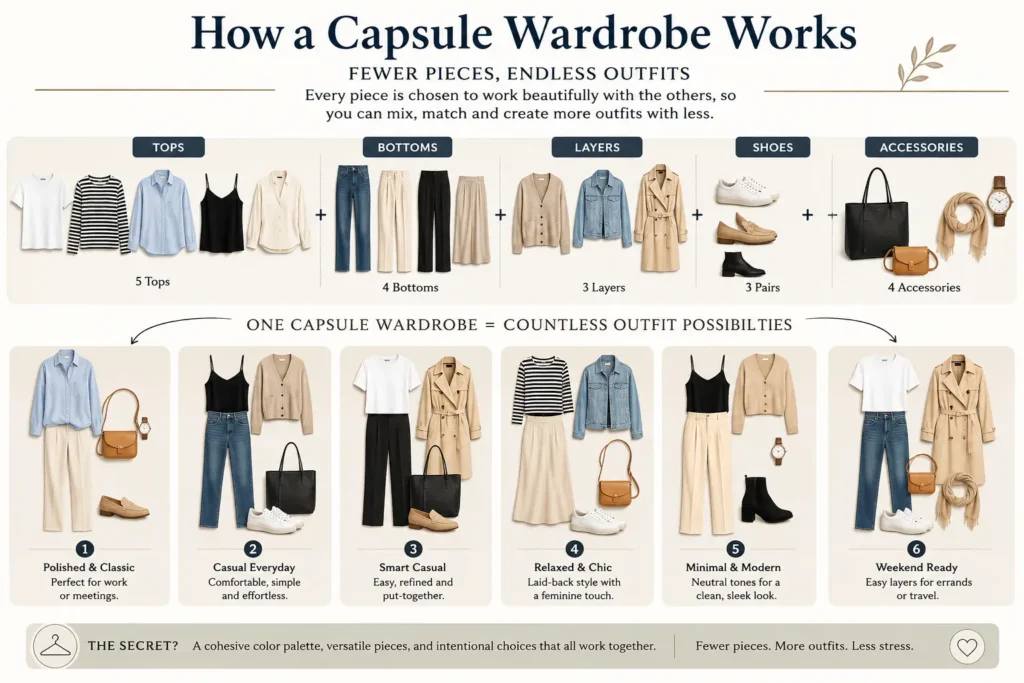
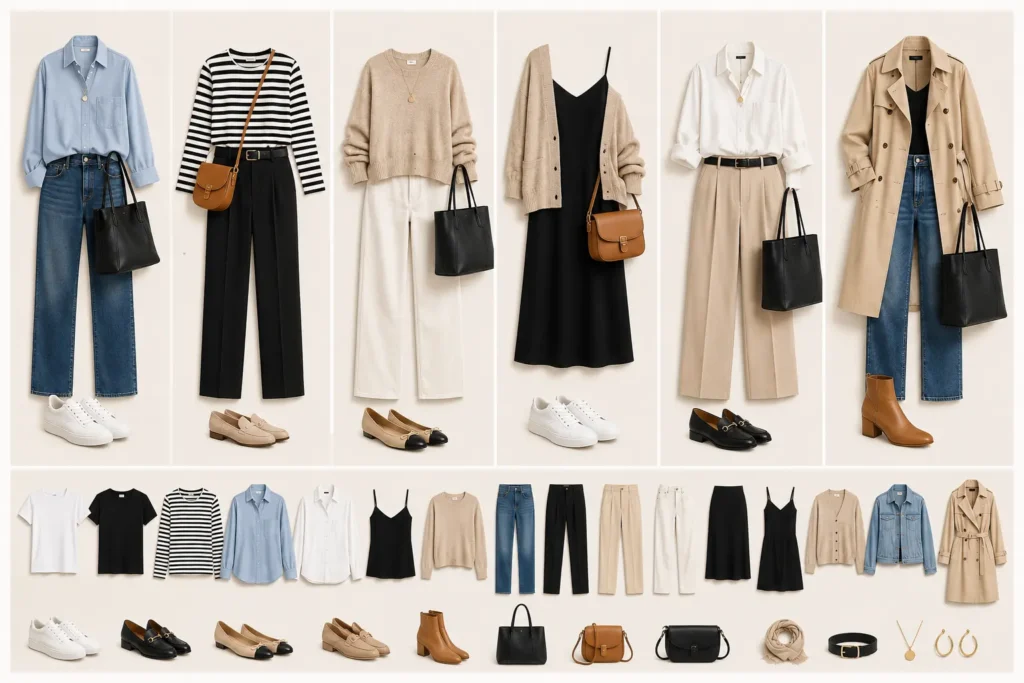
A capsule wardrobe works by increasing the number of useful combinations you can make from the clothes you own.
Imagine you have:
- 6 tops
- 4 bottoms
- 3 layering pieces
- 2 pairs of everyday shoes
You are not limited to 15 outfits. If the colors, proportions, and styles coordinate, the same pieces can be recombined in many ways.
For example, one white button-down could be worn with jeans and sneakers on the weekend, tucked into trousers with loafers for work, or layered under a sweater with boots in cooler weather. Instead of each item having only one purpose, it becomes part of several outfits.
That is the basic capsule wardrobe concept: each piece should make other pieces in your closet more useful.
What Is the Purpose of a Capsule Wardrobe?
The purpose is not simply to own less. It is to make getting dressed easier and make more of your wardrobe wearable.
A useful capsule helps you:
- Create outfits without starting from scratch every morning
- See what you actually own and wear
- Reduce purchases that do not match anything else
- Build a clearer personal style
- Keep enough variety for your lifestyle without unnecessary clutter
A smaller closet that does not meet your needs is not a successful capsule. The goal is a wardrobe that works harder for you.
Capsule Wardrobe vs. a Traditional Wardrobe
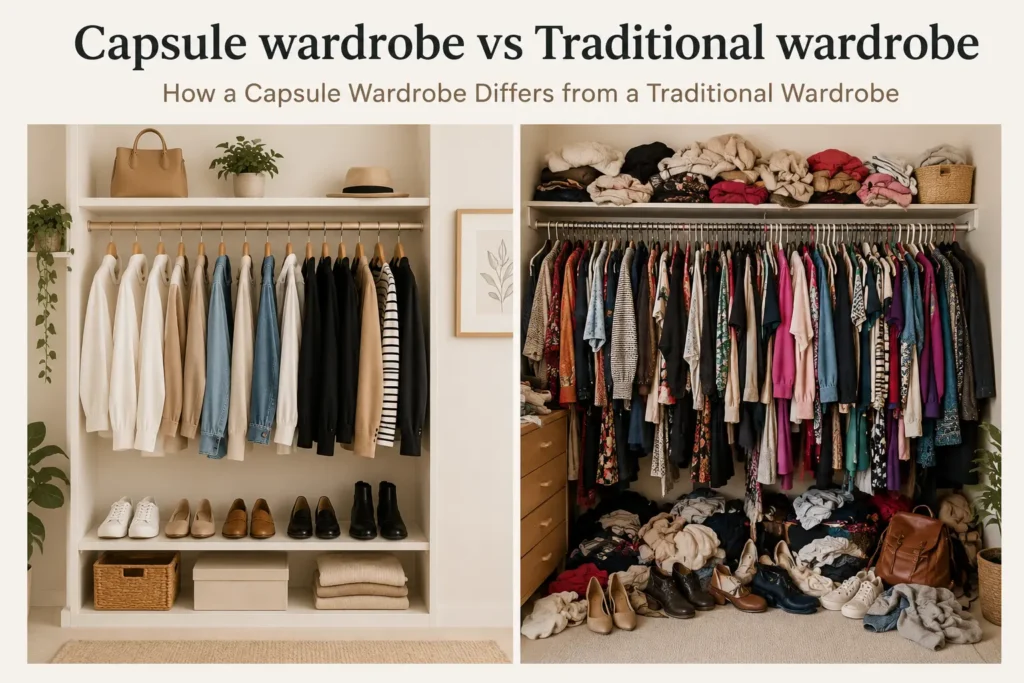
A traditional wardrobe often grows piece by piece. You may buy something for a sale, an event, a trend, or simply because you like it. There is nothing inherently wrong with that, but over time the closet can contain many pieces that do not work together.
A capsule wardrobe is planned more intentionally.
| Traditional Wardrobe | Capsule Wardrobe |
|---|---|
| May grow without an overall plan | Built around a clear wardrobe plan |
| Pieces may be difficult to combine | Most pieces coordinate with several others |
| Can contain many rarely worn items | Prioritizes clothes you regularly wear |
| Purchases may be made individually | New pieces are considered in relation to the whole wardrobe |
| Variety often comes from owning more | Variety comes from recombining versatile pieces |
A capsule wardrobe can still include statement pieces, prints, color, and trends. The difference is that they are chosen with the rest of the closet in mind.
What Does a Capsule Wardrobe Include?
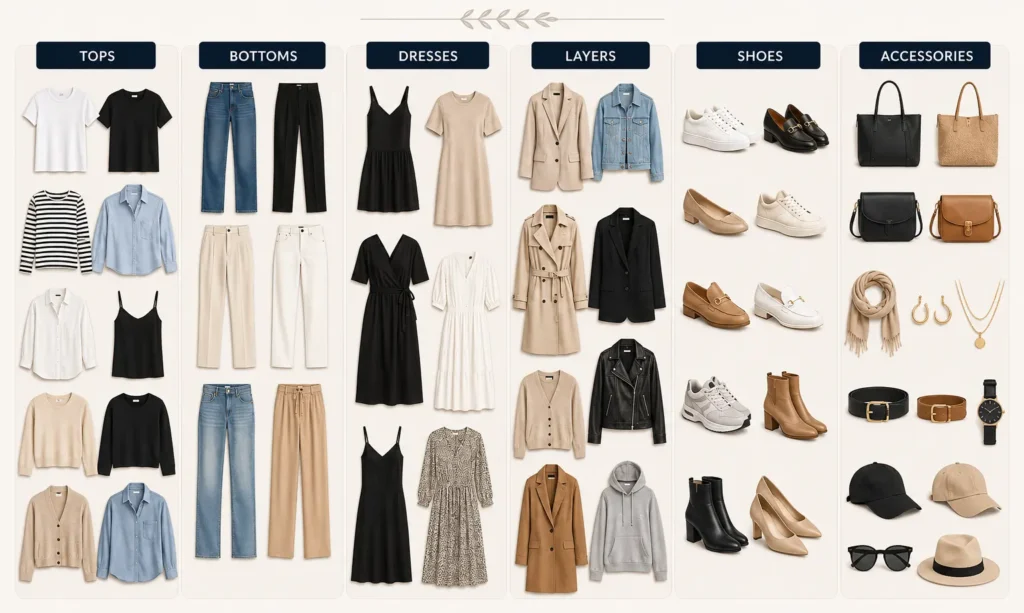
There is no universal capsule wardrobe checklist, but most capsules contain a balanced mix of the categories you need for daily life.
Tops
Your tops are usually some of the most frequently repeated pieces. Depending on your style, these could include T-shirts, button-down shirts, blouses, knit tops, tanks, polos, or long-sleeve basics.
The best choices are not necessarily the most basic-looking ones. They are the tops you enjoy wearing and can pair with several bottoms and layers.
Bottoms
Jeans, trousers, skirts, shorts, chinos, or other everyday bottoms form the foundation of many outfits. A few well-fitting options can often do more than a large collection of similar pieces.
Dresses and One-Piece Outfits
Dresses, jumpsuits, or other one-piece outfits are optional. If you wear them often, they deserve space in your capsule. If you never wear them, you do not need to include them just because a checklist says you should.
Layers and Outerwear
Layers help a capsule work across temperatures and occasions. Your selection might include a cardigan, blazer, sweater, denim jacket, trench, lightweight jacket, or winter coat.
Climate matters here. Someone living in a warm region will need a very different layering system from someone with long, cold winters.
Shoes
A practical capsule usually includes shoes for your most common activities. Sneakers, loafers, boots, flats, sandals, or dress shoes may all make sense depending on your routine.
Accessories
Bags, belts, scarves, jewelry, watches, and sunglasses can add personality and change the feel of repeated outfits. Some capsule methods count accessories in the total number of pieces; others do not.
If you want a more detailed starting list, use this capsule wardrobe checklist and adapt it to your own routine rather than treating it as a strict shopping list.
How Many Pieces Should Be in a Capsule Wardrobe?
There is no universal number of clothes required for a capsule wardrobe.
You will often see numbers such as 20, 30, 33, 40, or 50 online. They can be useful frameworks, but none of them defines whether a wardrobe is a capsule.
The right number depends on factors such as:
- Your job and dress code
- Climate and seasonal changes
- How often you do laundry
- Your social activities
- Whether you exercise regularly
- How much outfit variety you enjoy
- Whether shoes and accessories are included in your count
A very streamlined seasonal capsule might contain around 20–30 pieces, while another person may be happier with 40–50 or more. A year-round wardrobe may naturally contain more than a capsule built for one season.
Instead of asking, “Am I under the correct number?” ask:
- Do I regularly wear most of these clothes?
- Can I create enough outfits for my actual week?
- Do my pieces work together?
- Is getting dressed reasonably easy?
- Am I keeping items only because I think I should?
If the wardrobe supports your life without feeling unnecessarily crowded, the exact count matters much less.
A Simple Capsule Wardrobe Example
A beginner does not need to buy an entirely new closet. A simple everyday capsule could be built mostly from clothes already owned.
Here is one example of a 25-piece clothing and shoe capsule:
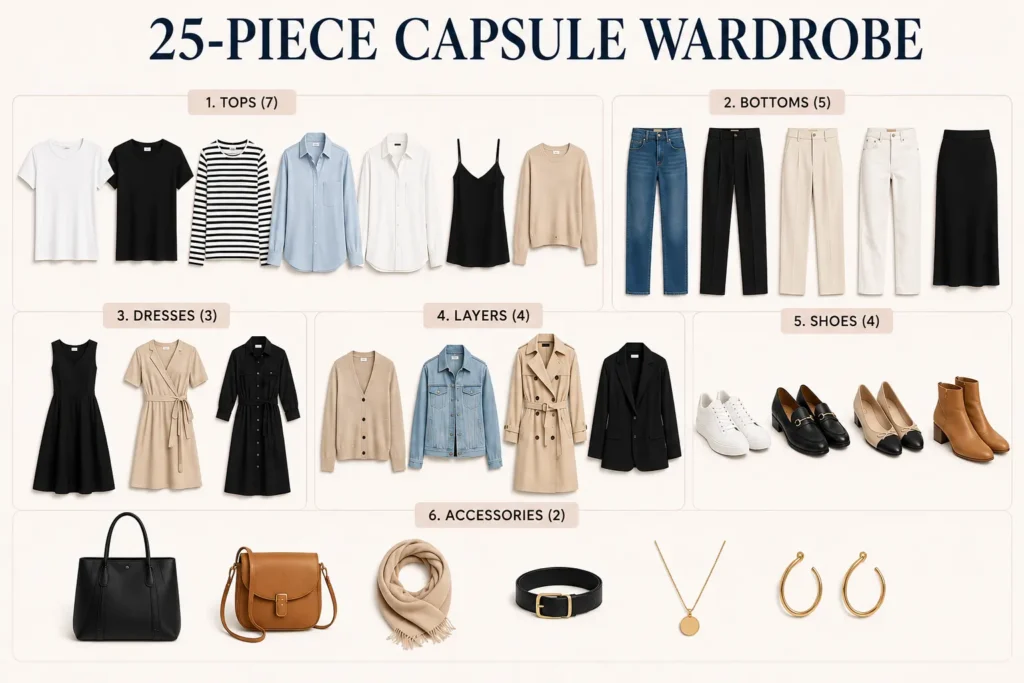
7 Tops
- 2 everyday T-shirts
- 1 striped or patterned top
- 1 button-down shirt
- 1 elevated blouse or shirt
- 1 long-sleeve top
- 1 lightweight knit
5 Bottoms
- 1 pair of straight-leg jeans
- 1 pair of darker jeans
- 1 pair of tailored trousers
- 1 relaxed everyday pant
- 1 skirt or seasonal bottom
2 One-Piece Options
- 1 casual dress or jumpsuit
- 1 more polished dress or one-piece outfit
6 Layers
- 1 cardigan
- 1 sweater
- 1 blazer
- 1 casual jacket
- 1 weather-appropriate lightweight layer
- 1 coat or heavier seasonal layer
5 Pairs of Shoes
- Everyday sneakers
- Loafers or flats
- Ankle boots
- A seasonal shoe
- A dressier option
This is only an example, not a formula everyone should copy.
The important part is the relationship between the pieces. If the button-down works with three or four bottoms, the blazer works over several tops, and the shoes complement most outfits, a relatively small collection can create substantial variety.
A person who wears dresses every day might need fewer bottoms. Someone who works from home might replace the blazer with another knit. A student, parent, office worker, or frequent traveler will each make different choices.
Why Do People Choose a Capsule Wardrobe?
People build capsule wardrobes for different reasons. Some want less clutter, some want to shop more thoughtfully, and others simply want to make mornings easier.
1. It Can Reduce Decision Fatigue
A closet with many disconnected choices can make getting dressed surprisingly tiring. You may have dozens of tops and bottoms but still struggle to find combinations that feel right.
A capsule reduces that friction because more of the options have already been chosen to work together.
This can mean:
- Faster morning decisions
- Easier outfit planning
- Fewer last-minute clothing changes
- More confidence in familiar outfit combinations
2. It Can Make Your Closet Easier to Organize
Capsule planning encourages you to notice what you actually wear.
Clothes that no longer fit your life, uncomfortable purchases, duplicates, and items kept “just in case” become easier to identify. You do not have to get rid of everything outside your capsule, but understanding your core wardrobe can make the whole closet clearer.
3. It May Help You Spend More Intentionally
A capsule wardrobe does not require expensive clothes or a full shopping trip.
In fact, a good place to begin is with what you already own.
Once you know your most-worn pieces and genuine wardrobe gaps, shopping questions change from “Do I like this?” to:
- Can I wear this with several things I own?
- Does it fill a real gap?
- Does it suit my lifestyle?
- Would I choose it if it were not on sale?
- Can I imagine at least a few realistic outfits with it?
That can reduce impulse purchases and clothes that rarely leave the hanger.
4. It Can Make Travel Packing Easier
The same principles are useful when packing. Coordinated clothes allow you to bring fewer pieces without being limited to only a couple of outfits.
A travel capsule wardrobe applies the concept specifically to luggage, weather, activities, repeat wear, and comfortable shoes.
5. It Can Clarify Your Personal Style
Personal style is not necessarily created by owning more clothes.
When you pay attention to what you repeatedly wear, you start noticing patterns: favorite silhouettes, preferred fabrics, recurring colors, comfortable proportions, and the level of formality that suits your life.
Those patterns can become the foundation of a capsule that feels personal rather than generic.
What Makes a Capsule Wardrobe Work?
A capsule is successful when it makes your real wardrobe more functional. Five principles matter more than following a predetermined shopping list.
Versatility
A useful piece should normally work with more than one outfit.
That does not mean every garment must match everything else. A statement dress can still belong in a capsule if you wear it regularly. But most core pieces should have more than one styling option.
Before adding something, ask:
- Can I wear it in at least a few realistic outfits?
- Does it work with pieces I already own?
- Can I dress it up, down, or layer it when useful?
A Wardrobe Built for Your Actual Lifestyle
One of the most important capsule wardrobe basics is simple: dress for the life you actually live.
A corporate professional may need several tailored pieces. A remote worker may use more comfortable knits and casual trousers. A student may prioritize practical layers and everyday shoes. A frequent traveler may value lightweight, wrinkle-resistant clothing.
Building for an imagined lifestyle is one of the fastest ways to end up with a beautiful capsule that you rarely wear.
Fit and Comfort
A versatile garment is not useful if you avoid wearing it.
Comfort, fit, fabric, movement, and care requirements all affect how often a piece earns its place. The best capsule is not the one that looks most impressive laid out on a bed; it is the one that works when you actually get dressed.
Coordinating Colors
A cohesive palette makes mixing easier, but that does not mean every capsule must be neutral.
You might choose black and cream as base colors, then add olive and burgundy. Another person may build around navy, denim, white, red, and soft blue. Someone else may love prints and brighter colors.
The goal is coordination, not beige.
Quality Appropriate to Your Budget
Because core pieces may be worn often, durability matters. However, “quality over quantity” should not be interpreted as “buy the most expensive version.”
Look for the best combination of fit, fabric, construction, comfort, care, and price that makes sense for your budget. A piece that lasts and gets worn regularly provides more value than an expensive item that does not suit your life.
What a Capsule Wardrobe Is — and Isn’t
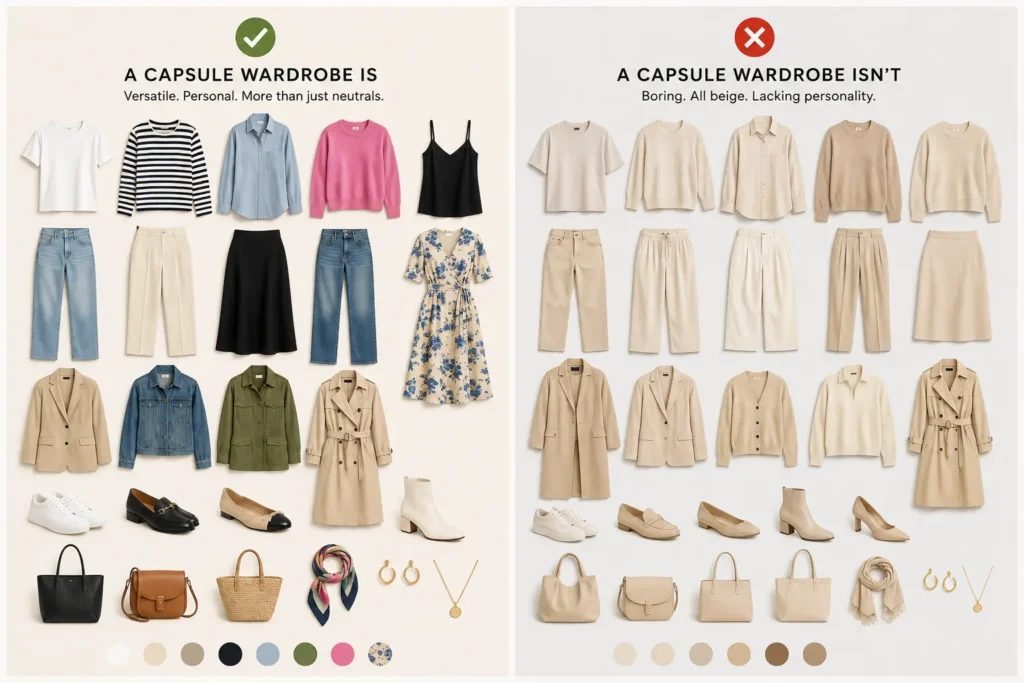
Capsule wardrobes are often presented online with rigid rules that can make the idea more confusing than it needs to be.
Here is what the concept actually means.
It Is Not an All-Neutral Wardrobe
Black, white, navy, cream, camel, and grey are popular because they are easy to combine. They are not mandatory.
Your capsule can include pink, green, red, prints, stripes, or other colors you genuinely wear.
It Does Not Require a Fixed Number of Pieces
There is no official rule saying a capsule must contain 30, 33, 40, or any other exact number.
Specific challenges may use limits, but the broader capsule wardrobe concept does not.
It Is Not Only for Minimalists
A capsule can appeal to minimalists, but you do not have to pursue minimalism to use one.
You can enjoy fashion, accessories, color, and variety while still maintaining a coordinated core wardrobe.
It Does Not Mean Giving Up Trends
Trends can be part of your wardrobe.
A practical approach is to keep a versatile foundation and introduce trends through pieces you genuinely like and can wear with what you already own. A trend becomes a problem only when it leads to purchases that do not fit your style or cannot be integrated into your closet.
It Does Not Mean Throwing Away Most of Your Clothes
You can create a capsule without dramatically decluttering your entire closet.
Start by identifying the pieces you wear most. You may keep occasionwear, sentimental clothing, specialty sportswear, or off-season items outside your active capsule.
It Does Not Require Buying a New Wardrobe
A shopping haul is usually the opposite of the best starting point.
Your existing closet can show you which colors, fits, and categories you already rely on. Fill gaps only after you understand what is missing.
How to Start a Capsule Wardrobe
Once you understand what a capsule wardrobe is, the simplest way to start is to work with your existing clothes.
- Review what you actually wear. Look at the pieces you repeatedly choose, not only the clothes you wish you wore.
- Think about your real week. Consider work, school, home, social plans, exercise, weather, and other recurring activities.
- Identify your core colors. Notice which shades already work well together.
- Choose versatile favorites. Start with pieces that fit, feel comfortable, and can be worn in several outfits.
- Create outfits before shopping. Test combinations to see where the wardrobe works and where it feels limited.
- Identify genuine gaps. A missing layer or shoe may be more useful than buying another version of something you already own.
- Adjust gradually. A capsule is something you refine over time, not something you have to finish in one weekend.
For a detailed process, including wardrobe editing, lifestyle analysis, color planning, and outfit testing, follow the full guide on how to build a capsule wardrobe.
Do Capsule Wardrobes Have to Be Neutral?
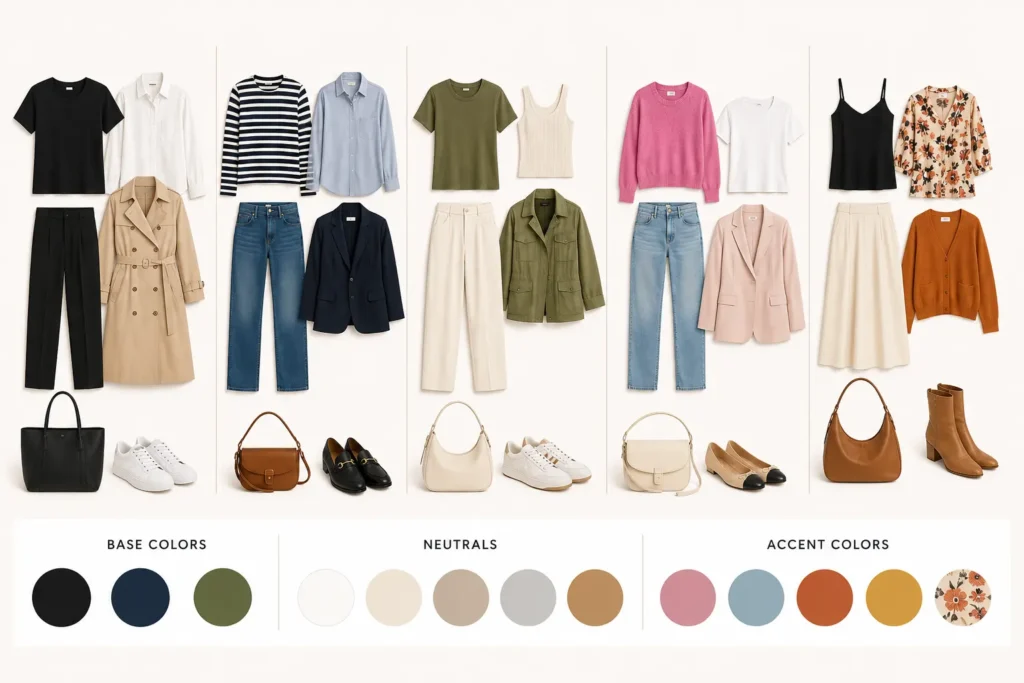
No. A capsule wardrobe can be colorful.
Neutral colors are common because they make coordination straightforward, but the best palette is one you actually enjoy wearing.
A simple approach is to choose:
- One or two base colors
- A few coordinating neutrals
- One or more accent colors
- Prints or patterns that connect with those colors
For example, a palette might combine navy, cream, denim, olive, and burgundy. Another might use black, camel, white, red, and leopard print.
The test is not “Is this color neutral?” It is “Can I wear this piece with enough of my wardrobe to make it useful?”
If choosing coordinating shades is the part you find difficult, the capsule wardrobe color palette guide explains how to create a practical palette without removing personality.
Different Types of Capsule Wardrobes
The principles stay the same, but the clothes should change with the person wearing them.
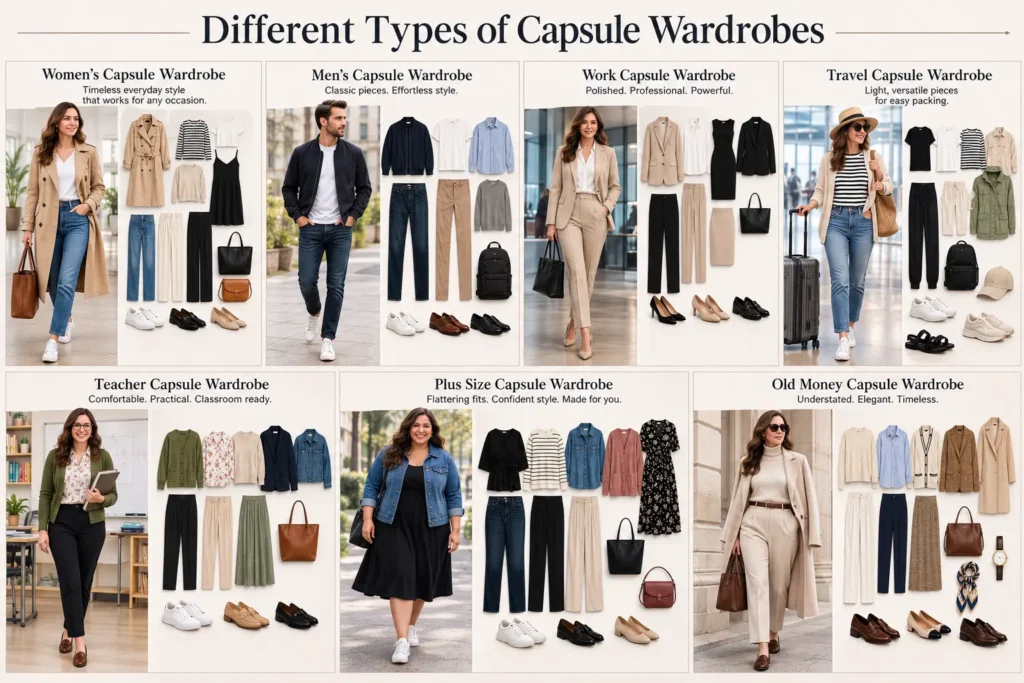
Women’s Capsule Wardrobe
A women’s capsule wardrobe might combine everyday tops, denim, trousers, dresses, layers, and a small shoe rotation. The exact balance should reflect lifestyle and personal style rather than a generic list of “must-have” pieces.
Men’s Capsule Wardrobe
A men’s capsule wardrobe may be built around T-shirts, shirts, knitwear, jeans, chinos or trousers, jackets, and versatile footwear. Formality can be adjusted for work, weekends, or a mix of both.
Work Capsule Wardrobe
A work capsule wardrobe focuses on repeatable professional outfits. Depending on the dress code, that may mean blazers and tailored trousers or polished knitwear, simple shirts, and smart-casual shoes.
Travel Capsule Wardrobe
A travel capsule prioritizes pieces that can be reworn, layered, and packed efficiently. Climate, trip length, laundry access, and planned activities matter more than copying a standard packing list.
Lifestyle and Personal-Style Capsules
Capsule wardrobes can also be adapted around a specific lifestyle, body-fit needs, or fashion aesthetic. For example, a teacher capsule wardrobe may prioritize comfortable, polished pieces that work across a busy school week, while a plus-size capsule wardrobe can focus on versatile pieces chosen around personal fit, proportions, comfort, and style preferences.
A capsule can also reflect a distinct aesthetic rather than a purely minimalist look. An old money capsule wardrobe, for instance, may emphasize classic silhouettes, understated styling, and pieces that can be repeated in polished combinations. These variations show why there is no single capsule wardrobe that works for everyone.
Seasonal Capsule Wardrobes
Some people keep one core wardrobe and rotate a few pieces as the weather changes. Others prefer a separate capsule for each season.
A spring capsule wardrobe may introduce lighter layers and transitional shoes, while a summer capsule wardrobe emphasizes breathable fabrics and warm-weather outfits. A fall capsule wardrobe often adds knitwear, jackets, and boots, while a winter capsule wardrobe needs warmer layers and weather-appropriate outerwear.
You do not need four completely different closets. Seasonal capsules can share a large portion of the same foundation.
Capsule Wardrobe vs. Minimalist Wardrobe
The terms are related, but they do not mean exactly the same thing.
A capsule wardrobe primarily focuses on coordination, versatility, and outfit creation. A minimalist wardrobe usually places greater emphasis on simplicity and reducing possessions.
Someone can therefore have:
- A small minimalist capsule
- A larger capsule that is not especially minimalist
- A minimalist wardrobe that does not follow a formal capsule system
The approaches often overlap because both can encourage thoughtful shopping and less clutter, but their goals are not identical.
For a deeper comparison, see capsule wardrobe vs minimalist wardrobe.
Capsule Wardrobe Methods and Challenges
You may also come across wardrobe challenges that use specific numbers. These can be useful experiments, but they are not rules for every capsule wardrobe.
Project 333
Project 333 is a wardrobe challenge based around choosing 33 items for three months. It gives people a defined limit that can help them observe their clothing habits and experiment with a smaller active wardrobe.
The broader capsule wardrobe concept does not require you to follow the 33-item rule.
The 10-Item Wardrobe
A 10-item wardrobe is a much more compact approach centered on a very small core collection, often supported by additional basics or accessories depending on the method.
It can be useful as an experiment in versatility, but most people do not need to limit their everyday wardrobe to ten total items.
The History of the Capsule Wardrobe
The capsule wardrobe may feel like a product of modern minimalism, but the idea of building a small, coordinated wardrobe has a much longer history.
Early Origins of the Concept
Small groups of coordinating garments appeared in fashion discussions well before today’s capsule-wardrobe trend. The underlying idea was practical: clothing becomes more useful when pieces share a consistent line, purpose, and color direction.
That principle remains central today.
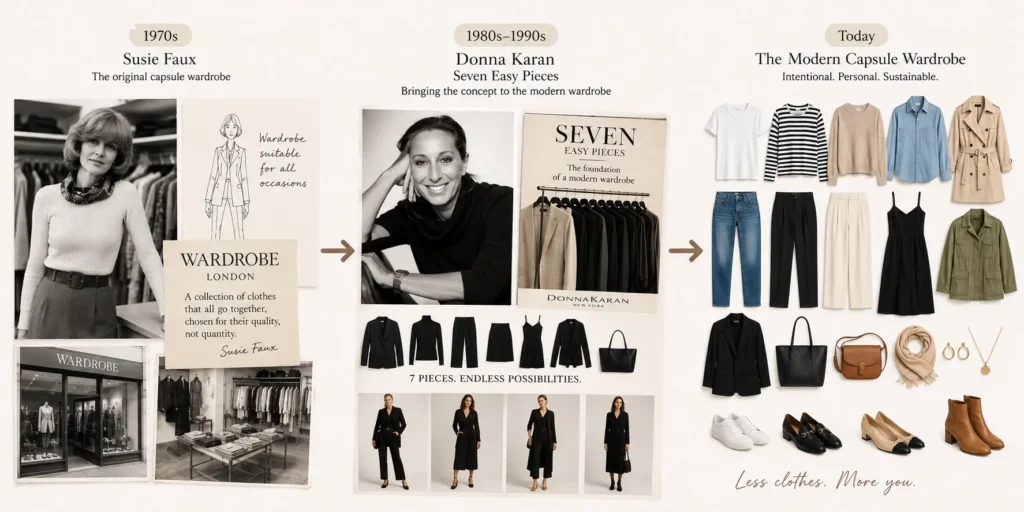
Susie Faux and the Modern Capsule Wardrobe
The modern term is widely associated with Susie Faux, who owned the London boutique Wardrobe in the 1970s.
Faux promoted the idea of a compact collection of dependable pieces that would not quickly go out of style. A strong foundation could then be refreshed with seasonal or more expressive additions rather than replaced completely.
That idea still describes a practical modern capsule: establish a useful core, then adapt it as your needs change.
Donna Karan and Seven Easy Pieces
The concept gained wider fashion attention in the 1980s when Donna Karan presented her Seven Easy Pieces approach.
The collection demonstrated how a limited group of coordinated garments could be styled in different ways rather than requiring a separate outfit for every situation.
Although modern capsules are not limited to seven items, the same principle remains relevant: versatility can create variety without relying entirely on quantity.
How the Idea Evolved
Today’s capsule wardrobes are more flexible than many older interpretations.
Some people use them to simplify shopping. Others use seasonal capsules, travel capsules, work wardrobes, or wardrobe challenges. Social media has also popularized highly neutral minimalist versions, but that is only one aesthetic.
The underlying concept remains simple: choose clothes intentionally so more of your wardrobe works together.
Common Capsule Wardrobe Mistakes
A capsule should make your wardrobe easier, not create another set of rules to worry about. These are some of the most common mistakes beginners make.
Buying Too Many “Essentials”
Seeing a list of wardrobe basics can make it tempting to buy everything at once.
But you do not need five white T-shirts if you rarely wear white T-shirts. A useful essential is something you repeatedly wear, not an item that appears on every fashion checklist.
Building for an Imagined Lifestyle Instead of Your Real One
A wardrobe can look perfect on paper and still fail in daily life.
If you work from home, rarely attend formal events, and walk most places, a capsule dominated by blazers, heels, and delicate clothing will probably frustrate you.
Start with how you spend your time.
Choosing Colors That Do Not Work Together
Your wardrobe does not need to be neutral, but some degree of coordination matters.
If several favorite pieces can only be worn with one specific item, you may have fewer usable combinations than the size of your closet suggests.
Ignoring Versatility
A beautiful item can still be a poor capsule choice if you never know how to wear it.
Before buying, think in outfits rather than individual garments.
Following the Numbers Too Strictly
Thirty pieces are not automatically better than forty.
If your climate, job, hobbies, or laundry schedule require more clothing, use more. The goal is functionality—not winning a competition to own the smallest wardrobe.
Replacing Everything Too Quickly
Your first capsule does not need to be perfect.
Wearing it will teach you more than planning it endlessly. Give yourself time to notice what you reach for, what you avoid, and which gaps actually matter before spending money.
Is a Capsule Wardrobe Right for You?
A capsule wardrobe can be useful if you:
- Have plenty of clothes but regularly feel you have nothing to wear
- Want faster and easier outfit decisions
- Own many pieces that do not coordinate
- Want to make your closet easier to manage
- Frequently regret clothing purchases
- Want a clearer sense of personal style
- Prefer to shop more intentionally
- Need a flexible wardrobe for work, travel, parenting, school, or another busy lifestyle
It may be less appealing if you genuinely enjoy maintaining a very large wardrobe, regularly wear a wide range of highly specialized styles, or prefer constant experimentation with completely different aesthetics.
Even then, you can still use capsule principles without committing to a small wardrobe. Creating a coordinated work capsule or travel capsule, for example, can be useful even if the rest of your closet is extensive.
The Bottom Line
A capsule wardrobe is not about reducing your closet to the smallest possible number or making everyone dress the same way. It is about choosing clothing more intentionally so the pieces you own are easier to wear together.
Start with what you already have. Notice the clothes you reach for most, build outfits around them, and identify the gaps that genuinely make getting dressed difficult. Your capsule can be neutral or colorful, small or relatively generous, casual or polished. What matters is that it supports your real lifestyle.
Once you understand the concept, the next step is learning how to build a capsule wardrobe around your own clothes, colors, routine, and personal style.
Frequently Asked Questions
What is a capsule wardrobe?
A capsule wardrobe is a curated group of versatile clothes that can be mixed and matched into multiple outfits. It is built around your lifestyle, personal style, and preferred colors rather than a universal list or fixed number of pieces.
What does capsule wardrobe mean?
“Capsule wardrobe” means a relatively compact, intentional wardrobe in which the pieces are chosen to work together. The focus is on coordination and usefulness rather than simply owning as little clothing as possible.
How many clothes should be in a capsule wardrobe?
There is no required number. Some people are comfortable with around 20–30 pieces for a season, while others need 40, 50, or more. Your lifestyle, climate, laundry habits, and dress code should determine the size.
What should be included in a capsule wardrobe?
Most capsules contain tops, bottoms, layers, outerwear, shoes, and any dresses or one-piece outfits the wearer regularly uses. Accessories may be included or counted separately.
Do shoes count in a capsule wardrobe?
They can. Some people include shoes in their total item count, while others track clothing separately. There is no universal rule, so choose the method that makes your wardrobe easiest to plan.
Do accessories count in a capsule wardrobe?
Accessories can be part of a capsule, but they do not have to count toward a numerical limit unless you are following a specific challenge. Bags, belts, scarves, and jewelry can add variety without requiring many additional clothes.
Does a capsule wardrobe have to be neutral?
No. Neutral colors make mixing easier, but they are not a requirement. A capsule can include bright colors, prints, and patterns as long as enough pieces coordinate to create useful outfits.
Can you follow fashion trends with a capsule wardrobe?
Yes. You can add trends that fit your personal style and work with your existing clothes. A versatile core simply makes it easier to experiment without feeling that you need to rebuild your wardrobe every season.
Can a capsule wardrobe change with the seasons?
Yes. You can rotate weather-specific items such as sandals, linen, knitwear, coats, and boots while keeping many core pieces year-round. How much you rotate depends on your climate.
What is Project 333?
Project 333 is a wardrobe challenge in which participants select 33 items to wear for three months. It is one structured way to experiment with a smaller wardrobe, but it is not the definition of a capsule wardrobe.
What is the 5-4-3-2-1 wardrobe method?
The 5-4-3-2-1 method is commonly used as a travel-packing framework. Versions vary, but it generally limits different clothing categories to help create several outfits from a compact selection. It is a packing strategy rather than a rule for all capsule wardrobes.
Are capsule wardrobes only for minimalists?
No. Minimalists often use capsule wardrobes, but anyone can use the concept. You can own more clothes, enjoy trends, wear bold colors, and still maintain a coordinated capsule.

Emma studied fashion but could never get her own closet under control. Capsule wardrobes finally fixed that. Now she writes about what actually worked for her, in the hope it saves you a few frustrating mornings.