I used to stand in front of my closet every Sunday night, already dreading Monday morning. Not because of work itself, but because I genuinely could not figure out what to wear.
I owned plenty of clothes. I just didn’t own a system.
That changed the day I built my first work capsule wardrobe. I stopped buying pieces because they looked good on a hanger and started buying pieces that worked with everything else I owned.
Within a month, getting dressed took five minutes instead of twenty, and I still looked more put-together than I had in years.
If you’re tired of staring into a full closet with “nothing to wear,” this article will guide you in building a work capsule wardrobe, sometimes called an office capsule wardrobe, that actually fits your job, your budget, and your life.
You’ll get the exact pieces to buy, a color palette that ties everything together, and outfit formulas you can use starting Monday.
What Is a Work Capsule Wardrobe?
A work capsule wardrobe is a small, intentional collection of clothing built specifically for your job. Instead of owning fifty pieces that rarely mix and match, you own fifteen to twenty that do.
Every top works with every bottom. Every layer works with every shoe. Nothing sits in your closet unworn.
The idea borrows from the broader concept of a capsule wardrobe, but it’s narrowed down for one specific purpose: dressing for work without decision fatigue.
If you’re building your wardrobe from scratch, our 7-step guide to building a capsule wardrobe walks through the full process, and this article picks up from there and applies it specifically to office dressing.
Whether you call it a work capsule wardrobe or an office capsule wardrobe, the goal is the same: fewer pieces, more outfits, zero morning stress.
This isn’t about owning less for the sake of minimalism. It’s about owning better, so every single piece in your closet earns its spot.
If you’re curious how a work capsule fits into the bigger minimalism conversation, we break down the distinction in capsule wardrobe vs. minimalist wardrobe.
Audit Your Closet Before You Buy Anything New
Here’s the step almost everyone skips, and it’s the one that saves you the most money. Before you add a single new piece to your work capsule wardrobe, go through what you already own.
Pull every work-appropriate item out of your closet and lay it on your bed. Try each piece on. Ask yourself three things:
- Does it fit the way I want it to right now?
- Does it work with at least two other pieces I own?
- Have I actually worn it in the last six months?
Anything that fails two out of three questions goes into a donate pile. What’s left becomes the foundation of your new capsule.
You’ll almost always find you already own two or three of the fifteen pieces below, a black blazer, a decent pair of trousers, maybe a trench coat from a few winters ago.
Building around what you have instead of starting from zero cuts your shopping list in half and keeps your capsule feeling like you, not like a stranger’s Pinterest board.
Business Professional vs. Business Casual vs. Work-From-Home: Which One Are You Building?

Before you buy a single piece, you need to know which capsule you’re actually building. I see so many people skip this step, and it’s the number one reason a work capsule wardrobe falls apart before it even starts.
A blazer that’s perfect for a law firm is overkill for a hybrid marketing job.
Ask yourself three questions:
- What does my dress code actually require?
- How often am I in the office versus at home?
- Do I need pieces that survive a commute, or just a webcam frame?
This piece lists how most women build a work capsule. If you’d rather see the same principles applied to a men’s closet, our capsule wardrobe for men guide covers that version in more depth.
| Category | Pieces Needed | Key Difference |
| Business Professional | 18-22 pieces | Structured suiting, tailored trousers, minimal color, polished shoes |
| Business Casual | 12-15 pieces | Blazers paired with denim or chinos, more color and texture flexibility |
| Work-From-Home | 8-10 pieces | Comfortable but camera-ready tops, structured bottoms optional below the waist |
Not every job fits neatly into these three categories. If yours involves more movement or classroom time than a typical office, our teacher capsule wardrobe guide adapts these same principles for that environment.
Business Professional Capsule
If your office expects suits, structured blazers, and minimal color experimentation, you’re in business professional territory. This is common in law, finance, and traditional corporate environments where first impressions carry real weight.
This capsule leans on tailored trousers, a wool coat, and closed-toe pumps or loafers. Every piece should look intentional, not thrown together.
Fabrics matter more here than anywhere else: a slightly wrinkled cotton blouse reads very differently in a boardroom than it does in a creative studio, so prioritize wrinkle-resistant weaves and structured tailoring over trend pieces.
Business Casual Capsule
This is where most people actually land, and it’s the most flexible category. You can mix a blazer with dark denim one day and a pencil skirt the next.
A business casual capsule wardrobe gives you room to add personality without breaking dress code. It also tends to be the most forgiving budget-wise, since you’re not required to buy full suiting.
A handful of well-chosen separates does the heavy lifting.
Work-From-Home Capsule
Don’t skip building a capsule just because you’re home. You still need pieces that look sharp from the waist up for video calls, plus something comfortable enough to wear for eight hours straight.
A knit top, a structured cardigan, and joggers that don’t look like pajamas go a long way here.
In my experience, even fully remote workers feel the difference when they get dressed with intention. It creates a clearer mental separation between “on” and “off” hours than staying in loungewear all day.
The Work Capsule Wardrobe Color Palette
Color is where most work capsule wardrobes quietly fail. People buy beautiful individual pieces that never actually talk to each other.
The fix is a base color palette, a small set of neutrals that every piece in your closet can pair with.
Start with two or three core neutrals: black, navy, and gray are the most versatile combination for most offices. If your workplace leans warmer, swap navy for camel or brown.
White and off-white round this out as your base tops.
Once your neutrals are locked in, add one or two accent colors. A burgundy blouse or a deep green skirt goes a long way when everything underneath it is neutral.
The rule I always give people: your base color palette should let you get dressed in the dark and still know everything matches.
Resist the urge to buy trend colors for foundational pieces. Trousers, blazers, and coats should always come from your neutral palette.
Save color experiments for tops and accessories, since they’re cheaper to replace when trends shift.
15 Essential Pieces for Your Work Capsule Wardrobe
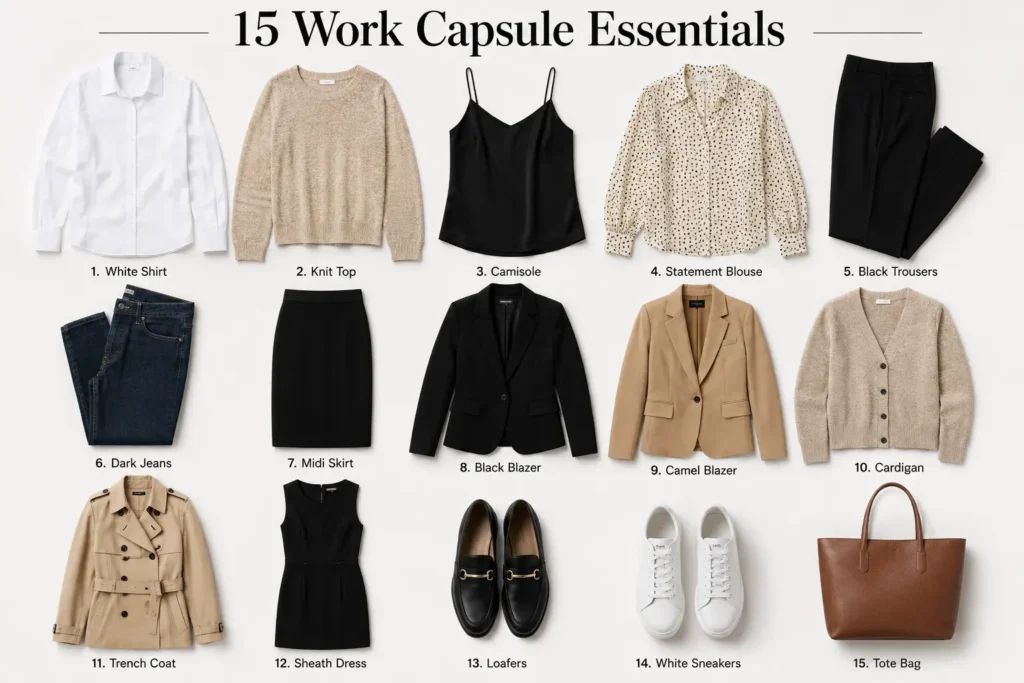
These fifteen pieces form the foundation of a work capsule wardrobe that works across business casual and business professional settings.
Adjust quantities based on your specific dress code, but this list covers 90% of office scenarios.
Tops & Blouses (4 pieces)

1. White button-up shirt
Non-negotiable. A crisp white button-up works under a blazer, alone with trousers, or tucked into a skirt.
Look for a slight drape if you want comfort, or a stiffer cotton if your office is more formal.
This single piece will likely get worn more than anything else you own, so don’t cut corners on fit. A shirt that gapes at the buttons or bunches at the waist undoes the polish of everything you pair it with.
2. Silk or silk-blend camisole
This is the piece nobody talks about enough. A camisole layers under blazers and cardigans, and it transitions from desk to dinner the moment you remove the top layer.
Keep it in a core neutral so it disappears under everything rather than competing with it.
3. Knit top in a core neutral
Soft, comfortable, and dressy enough for a Tuesday meeting. This is your reliable go-to on days you don’t want to think too hard.
A fine-gauge knit works best; anything too chunky adds bulk under a blazer.
4. One statement blouse
A single patterned or colored blouse breaks up the neutrals without derailing your palette.
Choose a print or color you genuinely love, since this is the one piece in your capsule that’s allowed to have personality. Everything else exists to support it.
Bottoms (3 pieces)
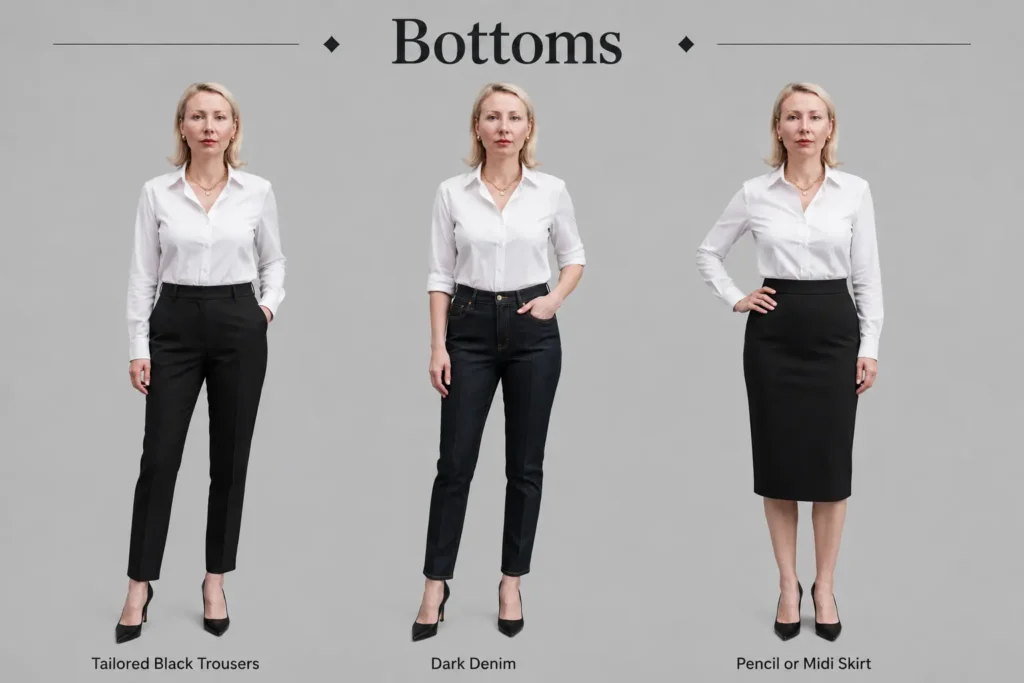
5. Tailored black trousers
The single most-worn piece in almost every work capsule wardrobe I’ve seen. Straight-leg or wide-leg both work, so choose based on your body and your office’s formality.
If you can only invest in one piece from this entire list, make it this one; it appears in more outfit formulas than anything else.
6. Dark denim
If your office allows business casual, dark, structured denim (no distressing, no fading) pairs with a blazer just as easily as a knit top.
Look for a straight or slightly tapered leg; anything too casual undermines the polish a blazer is supposed to add.
7. Pencil or midi skirt
One skirt in a neutral color gives you an entirely different silhouette without adding bulk to your closet.
A midi length works across more office cultures than a mini, and it layers over tights the moment the weather turns.
Layers (3 pieces)
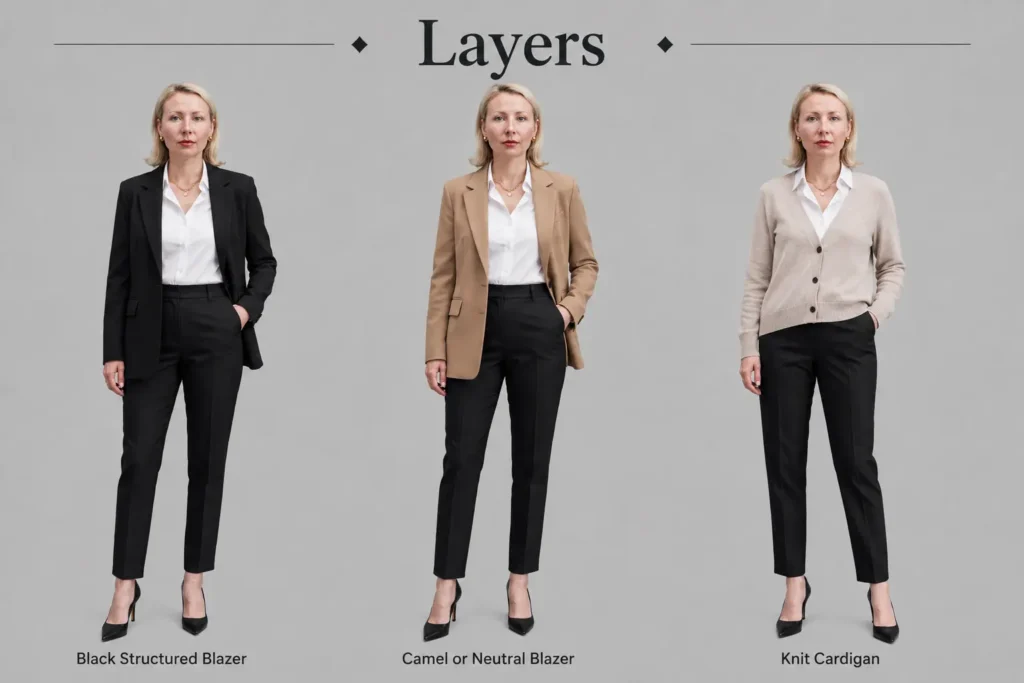
8. Black structured blazer
This is your anchor piece. It elevates jeans, softens a dress, and signals “put together” faster than anything else in your closet.
Look for a soft shoulder rather than a heavily padded one; it reads as modern rather than dated, and it’s more forgiving to layer over.
9. Camel or neutral blazer
A second blazer in a warmer neutral gives you range without duplicating your black one.
This is the piece that makes your capsule feel less like a uniform and more like an actual wardrobe.
10. Knit cardigan
Every office has that one freezing conference room. A cardigan in a core neutral solves it without you needing to carry a bulky sweater.
Choose a slightly longer length so it can double as a light layer over dresses too.
Outerwear & Dresses (2 pieces)
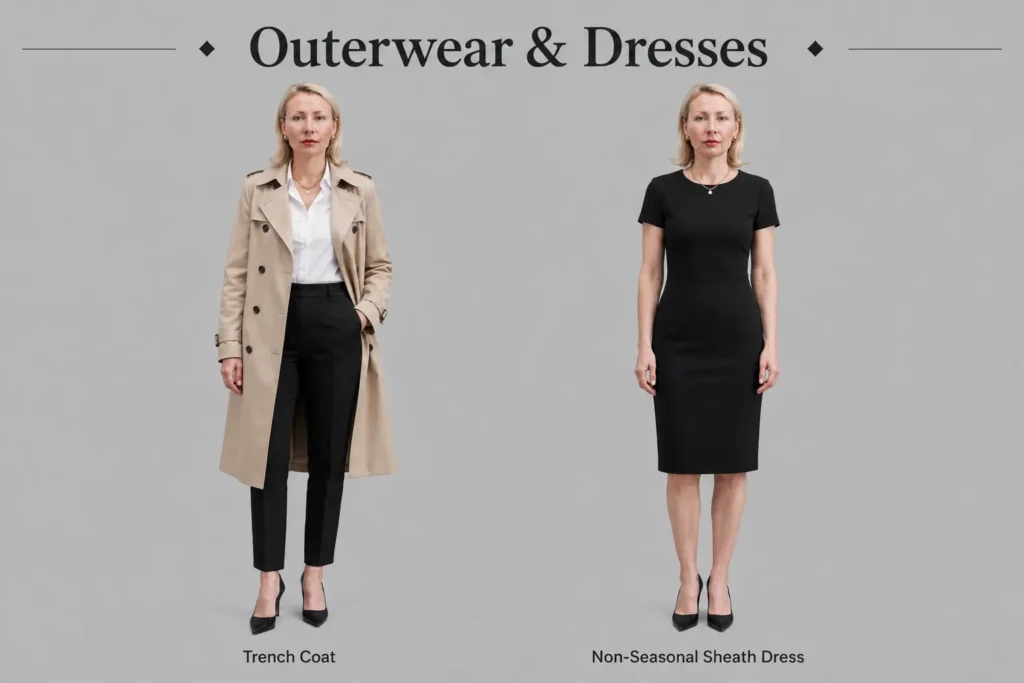
11. Trench coat
Works across three seasons and looks polished over almost anything underneath, from a suit to jeans and sneakers on a casual commute day.
A knee length in a classic khaki or black gives you the most flexibility.
It’s also one of the first pieces I pack for a work trip. If your job involves regular travel, our travel capsule wardrobe guide pairs well with this one for building a carry-on-friendly rotation.
12. Non-seasonal sheath dress
One reliable dress, worn alone in warmer months and layered under a blazer or cardigan the rest of the year, is one of the highest cost-per-wear pieces you can own.
Choose a fabric with a little stretch; you’ll reach for it far more often if it’s comfortable enough to wear through a full day at your desk.
For more dress and silhouette ideas beyond the office, our capsule wardrobe for women guide covers how to extend these same pieces into your weekend wardrobe.
Shoes (2 pieces)
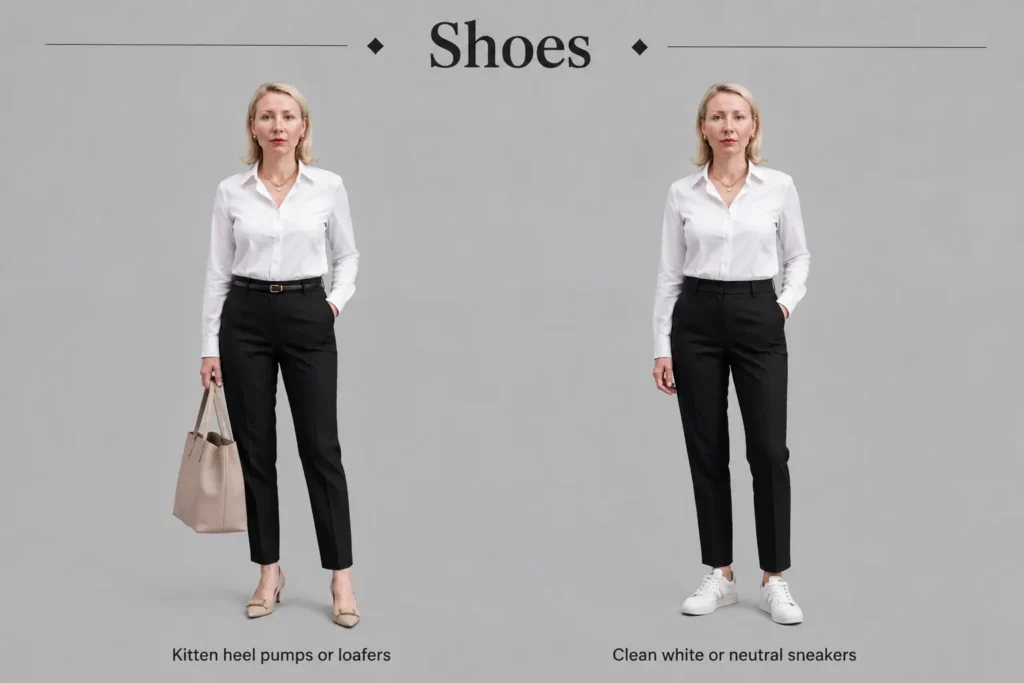
13. Kitten heel pumps or loafers
Comfortable enough for a full day on your feet, polished enough for client meetings.
A kitten heel gives you the polish of a pump without the discomfort of a higher heel by hour eight.
14. Clean white or neutral sneakers
For casual office days or a commute, a simple pair of sneakers keeps you comfortable without looking underdressed.
Skip anything overly athletic or logo-heavy; a minimal leather sneaker reads as intentional rather than sporty.
Bag & Accessories (1 piece)
15. Structured tote
A work bag needs to hold a laptop, carry over one shoulder, and still look professional.
This is worth the investment, since a bag with weak structure will sag and look tired within a year, no matter how nice the leather is.
Pair it with a single timeless belt in black or brown, a small piece, but one of the cheapest ways to make any outfit look finished.
Budget Tiers: Splurge vs. Affordable Picks
Not every piece deserves the same budget. This is where cost-per-wear matters most: divide the price of an item by how many times you’ll realistically wear it.
A $220 blazer worn twice a week for three years costs pennies per wear. A $30 blazer that pills after two washes costs more in the long run, even though it looked cheaper up front.
| Piece | Budget Approach | Investment Approach |
| Blazer | Affordable basics from mass retailers | Wool-blend structured tailoring |
| Trousers | Stretch-blend workwear lines | Fully tailored wool trousers |
| White shirt | Cotton poplin from any basic brand | Sealed-placket, non-iron cotton |
| Shoes | Faux leather loafers | Full-grain leather pumps or loafers |
| Bag | Structured vegan leather tote | Full-grain leather tote |
My advice: spend where the piece touches your body or gets worn most (trousers, shoes, blazer) and save where it doesn’t (bag lining, basic tees).
This is how you build a wardrobe that looks expensive without actually costing a fortune.
How to Build Outfit Formulas from Your Work Capsule
Once you own your fifteen pieces, the real magic is in the formulas. Instead of deciding from scratch every morning, use a repeatable structure: Top + Bottom + Layer + Shoe.
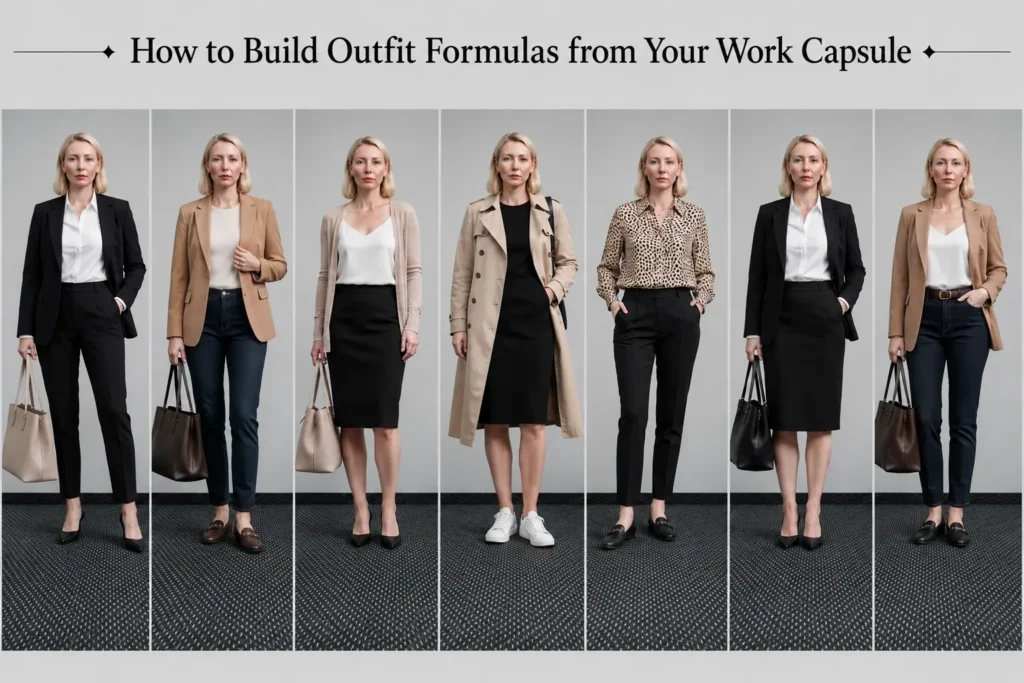
Plug in different pieces, and you’ll never run out of combinations.
Here are eight formulas to get you started:
- White button-up + black trousers + black blazer + kitten heels
- Knit top + dark denim + camel blazer + loafers
- Camisole + pencil skirt + cardigan + pumps
- Sheath dress + trench coat + sneakers (commute), swap to loafers at your desk
- Statement blouse + tailored trousers + no layer + loafers
- White button-up + midi skirt + black blazer + pumps
- Camisole + dark denim + camel blazer + loafers, belted at the waist
Fifteen pieces, mixed through formulas like these, can realistically produce over thirty distinct outfits. That’s more than a month of workdays without repeating a single look.
Once you’ve got a handful of formulas that feel effortless, write them down. I keep a running note on my phone with five or six combinations I already know work, so on a rushed morning, I’m not reinventing an outfit.
I’m just picking one off the list.
Adapting Your Work Capsule Wardrobe by Season
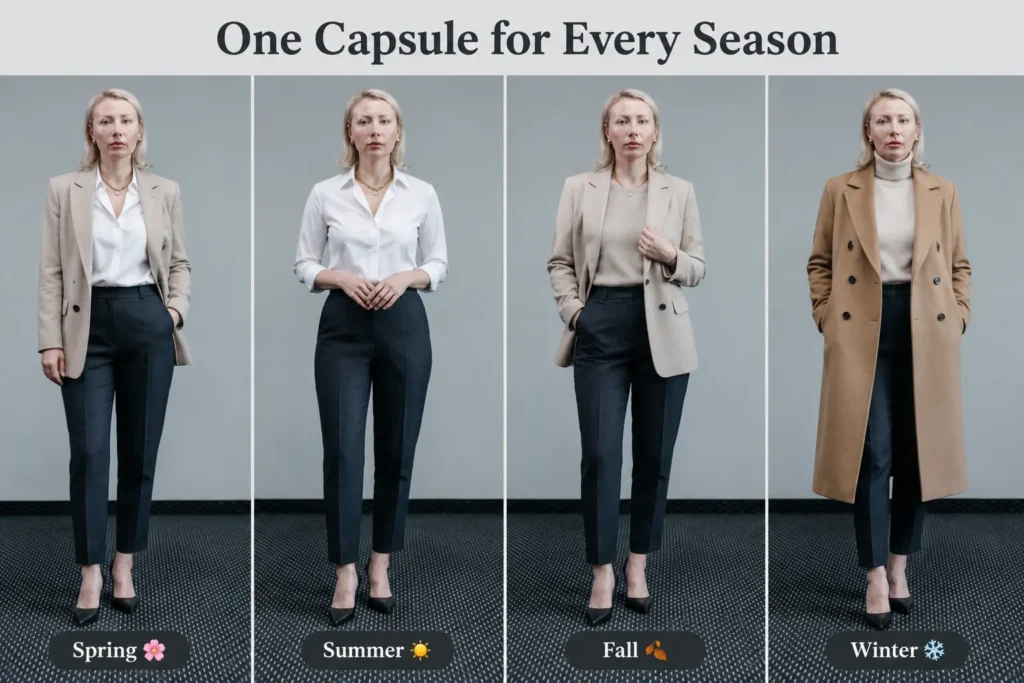
A work capsule wardrobe shouldn’t be rebuilt every season. It should flex. The base fifteen pieces stay constant; you’re only swapping fabric weight and adding or removing layers.
In colder months, lean on your winter capsule wardrobe principles: heavier knits, your wool trench, and closed-toe shoes exclusively. Cashmere or wool-blend layers keep you warm without adding bulk under a blazer.
When the weather turns, your spring capsule wardrobe swaps heavy knits for lighter blouses and introduces short-sleeve options under your blazers.
By summer, follow your summer capsule wardrobe approach: linen-blend trousers, sleeveless tops under blazers you can remove at your desk, and breathable fabrics that survive a commute.
And as temperatures drop again, your fall capsule wardrobe reintroduces your cardigans and trench coat, easing you back toward winter layering.
The pieces don’t change. The way you combine them does.
Common Work Capsule Wardrobe Mistakes to Avoid
Buying trend pieces as foundational items. Trends belong in accessories and statement tops, not in trousers or blazers that need to last years.
A trendy cut on a blazer looks dated within a couple of seasons; a classic cut just looks like you.
Ignoring your actual dress code. A gorgeous business professional capsule is wasted if your office is business casual. Match your capsule to your reality, not your Pinterest board.
If you’re unsure where your workplace actually lands, pay attention to what your manager or the most senior person on your team wears. It’s usually a more accurate guide than the official handbook.
Skipping the audit. Every few months, do a quick capsule audit. What have you actually worn? What’s sat untouched?
Follow a simple one-in-one-out rule: when something new comes in, something old goes out. This keeps your capsule from quietly bloating back into a full closet.
Set a recurring reminder if you have to; it’s easy to let this slide once the initial excitement of building your capsule wears off.
Forgetting workplace safety. If your role involves any fieldwork, client site visits, or physical tasks, prioritize closed-toe shoes and minimal jewelry over trend pieces.
A polished capsule still needs to be practical for your actual day.
Buying everything at once. Build your capsule gradually. Start with your black trousers and white shirt, then add pieces one at a time so you can see how new items actually perform in rotation.
Buying all fifteen pieces in one weekend often means you skip the “does this actually work with what I own” test, and that’s how mismatched pieces sneak back in.
Ignoring fit in favor of the “right” piece. A blazer that’s technically the correct color and cut won’t look intentional if it pulls across the shoulders or swallows your frame.
Tailoring a few key pieces, even just hemming trousers, makes a bigger visual difference than buying more clothes.
Start Building Today
You don’t need to buy all fifteen pieces this weekend. Start with your black trousers, white button-up, and one blazer; that alone gives you your first few outfit formulas.
Add pieces gradually, run your seasonal audit, and let cost-per-wear guide every purchase.
Want a printable version of this list to take shopping? Grab our free Capsule Wardrobe Checklist and check off each piece as you build your closet.
FAQs
How many pieces should a work capsule wardrobe have?
Most work capsule wardrobes work well between 12 and 22 pieces, depending on your dress code. Business casual sits toward the lower end; business professional or client-facing roles often need a few more.
What’s the difference between a work capsule wardrobe and an office capsule wardrobe?
Nothing meaningful. They’re the same concept. “Work capsule wardrobe” is the more commonly searched term, but both describe a curated set of pieces built specifically for your job.
Can a work capsule wardrobe work for a hybrid schedule?
Yes. Build slightly more toward your work-from-home pieces, then add two or three business-casual layers you only wear on in-office days.
Your camera-ready tops and structured bottoms should overlap so you’re not duplicating your closet.
How often should I update my work capsule wardrobe?
Do a full audit every season, but avoid rebuilding it completely. Swap in one or two new pieces as older ones wear out, rather than replacing everything at once.
Do I need to buy everything in the checklist to start?
No. Start with the pieces you’re missing that appear in the most outfit formulas, usually black trousers, a white button-up, and a black blazer.
Build outward from there over a few months rather than shopping all at once.
What if my job doesn’t have a strict dress code?
Lean toward a business casual capsule as your default. It’s the most flexible option and can be dressed up with a blazer for client-facing days or dressed down with sneakers for a quiet day at your desk.

Emma studied fashion but could never get her own closet under control. Capsule wardrobes finally fixed that. Now she writes about what actually worked for her, in the hope it saves you a few frustrating mornings.