You know the feeling. A closet full of clothes, and still nothing to wear. Mine wasn’t empty, it was stuffed, mostly with one-off pieces and things I bought for a life I don’t actually live.
Somewhere in my forties it clicked: the problem was never too few clothes. It was too many of the wrong ones, and not enough that worked together. That’s all a capsule wardrobe over 40 really is, a smaller set of pieces that mix, match, and layer so getting dressed stops being a daily fight.
This isn’t a “toss everything and start over” post. It’s a build system, and you can start with what you already own. I’ll cover how to plan it, what pieces to keep, how to pick colors that flatter you now, and how to get a hundred-plus outfits from a surprisingly small closet. There’s a free checklist at the end, too.
New to all this? Start with what a capsule wardrobe actually is. Otherwise, let’s get into it.
Why “Dress Your Age” Is the Worst Advice You’ll Ever Get
Somewhere along the way, someone decided that turning 40 meant you were supposed to start “dressing your age.” Cover your arms. Skip the bright colors. Retire anything remotely trendy. Fade politely into a sea of beige.
I want to gently retire that entire mindset, because it’s not just limiting. It’s a little insulting. The idea that a number on your birth certificate should dictate your hemlines is the same tired thinking that told us dial-up internet was the future. What does “dressing your age” even mean? If you lined up ten women who are exactly 43, they’d be wearing ten wildly different things, because style is personal and always has been.
So no, this guide isn’t about age-appropriate rules. It’s about dressing the body and the life you actually have right now, which, as it turns out, is a much more useful thing to organize your closet around.
What Makes a Capsule Wardrobe Over 40 Different
Here’s the part most articles skip, and it’s the part that matters most.
Building a capsule wardrobe for women in their twenties is a different project than building one in your forties, fifties, or sixties. Not harder, just different. And pretending otherwise is why so much generic advice falls flat.
Your body changed, and that’s not a failure. It’s biology. For a lot of us, perimenopause and menopause showed up with a softer middle, a shift in proportions, and the truly magical ability to be freezing and overheating in the same hour. Clothes that used to work simply do not anymore. That’s not something to fix or hide. It’s something to dress for honestly.
Temperature regulation is suddenly a real design requirement. When a hot flash can arrive mid-meeting, breathable fabrics and easy layers stop being a nice-to-have and become the whole strategy. You want pieces you can add and peel off without wrecking the outfit.
You already know yourself. This is the quiet superpower of dressing after 40. You’ve had decades to learn what you like, what you reach for, and what sits untouched. You don’t need to find your style from scratch. You need to trust it and stop second-guessing it.
Comfort and style are no longer at war. For years, we were sold the idea that looking good required a little suffering. It doesn’t. When you feel comfortable, you carry yourself with confidence, and confidence reads as style far more than any single garment does.
The Best Fabrics for a Warmer, Changing Body
Since fabric is doing so much heavy lifting now, it’s worth being picky. Reach for natural, breathable fibers and soft stretch:
- Cotton and linen for breathability in warmer months
- Modal and bamboo knits for that buttery drape that skims instead of clings
- Merino wool for cool weather (it regulates temperature beautifully)
- Knits with a little stretch for waistbands and anything that has to move with you
If a fabric is scratchy, stiff, or makes you sweat just looking at it, it doesn’t belong in your capsule, no matter how nice it looks on the hanger.
The 4-Step System to Build Your Capsule Wardrobe
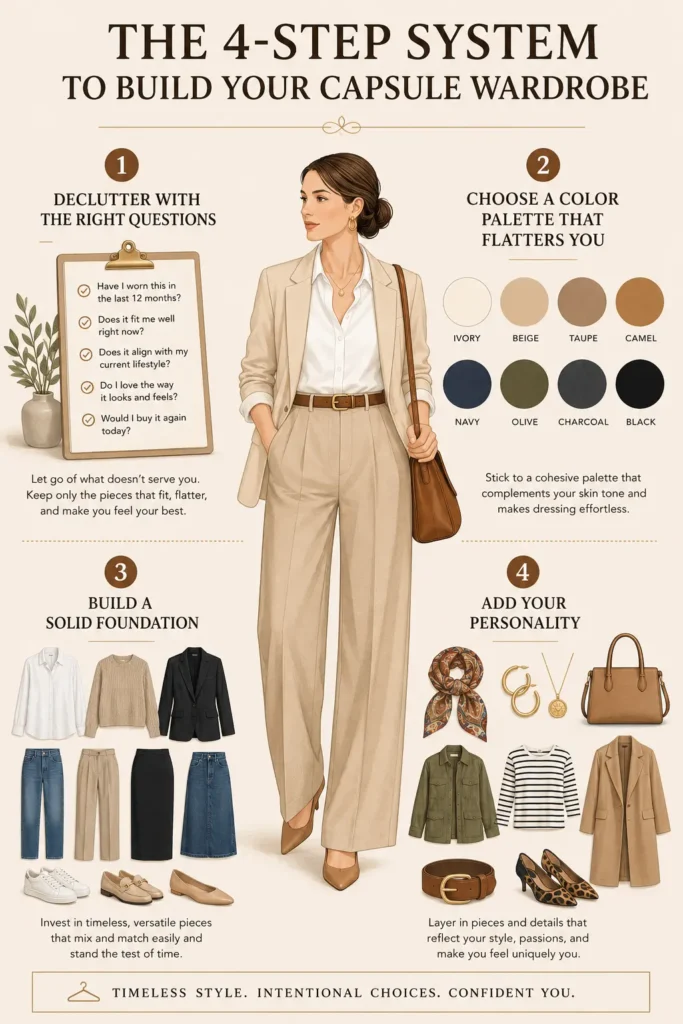
You can build a capsule wardrobe over 40 without buying a single new thing to start. In fact, I’d insist on it. Most of us already own more workable outfits than we realize. We’ve just never put the pieces together properly. Here’s the full method. (If you want the deep-dive version, I’ve written a longer guide on how to build a capsule wardrobe step by step.)
Step 1: Declutter With the Right Questions
Before you build anything, you have to get honest about what’s already in there. Pull it all out. Try things on, and I mean actually try them on, not the “I’m sure it still fits” fantasy version. Then run each piece through a few questions:
- When did I last actually wear this?
- Does it fit the body I have today, not the one I had in 2009, and not the one I’m hoping for?
- Does it work with the color palette I’m building (more on that in a second)?
- Does it pinch, pull, ride up, or dig in?
- Do I own something almost identical? If so, which do I genuinely reach for?
- Can I picture a real place in my current life where I’d wear it?
Anything that’s almost-right but not quite? Consider a tailor. A small nip at the waist or a shortened hem can turn a “meh” piece into a favorite for less than the cost of replacing it. Everything else can be sold, donated, or handed off. You’re making room for a wardrobe that works.
Step 2: Choose a Color Palette That Flatters You
This is where a capsule goes from “pile of clothes” to “everything mysteriously goes together.” The trick is a cohesive palette.
Start with 2 to 3 neutrals as your base: black, navy, grey, beige, ivory, or camel. These are your anchors, the colors most of your bottoms and layers will live in. Then add 1 to 2 accent colors you genuinely love. Not the ones you’re “supposed” to wear, the ones that make you feel like you.
And here’s the piece almost nobody mentions: pay attention to your undertone. Hold a warm color (like camel or olive) and a cool one (like true blue or fuchsia) up to your face in natural light. One will make you look rested and lit-up; the other will make you look a little tired. That’s your undertone talking. Warm undertones tend to glow in earthy tones and gold; cool undertones come alive in jewel tones and silver. You don’t need a full color analysis, just enough awareness to stop buying that one green that everyone loves but that turns you grey.
Neutrals don’t have to be boring, either. You can build a rich, interesting capsule almost entirely from them and let texture, prints, and accessories do the talking. If a capsule feels too pared-back for you, it’s worth understanding the difference between a capsule wardrobe and a strictly minimalist wardrobe. They overlap, but they’re not the same thing, and you get to decide where on that spectrum you’re happiest.
Step 3: Build a Solid Foundation
Think of your capsule like a house. You need a strong foundation before you start decorating. Your foundation is the workhorse layer: the tees, the great-fitting bottoms, the easy layers you’ll wear on repeat.
The golden rule here: every item should work with at least three other things in your closet. If a top only pairs with one specific pair of pants and one very specific mood, it’s not a foundation piece. It’s a diva, and divas don’t earn their spot in a capsule.
Step 4: Add Your Personality
A capsule is not a uniform. Once your foundation is solid, layer in the pieces that make it unmistakably you: a blazer in your power color, a statement necklace, a bold print, a scarf that pulls a whole look together. These are the additions, not the foundation. That distinction is everything. It keeps your wardrobe fresh without letting trends run the show.
The Exact Capsule Wardrobe Checklist for Over 40
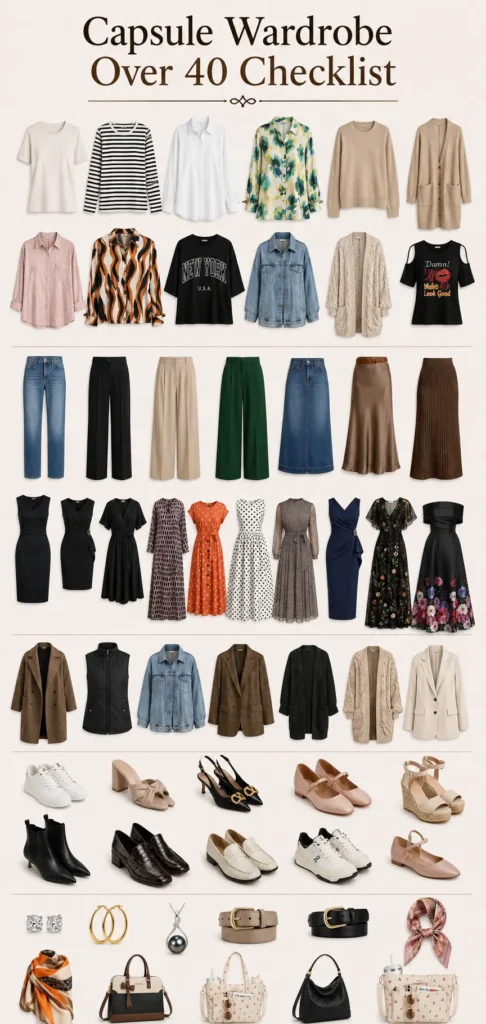
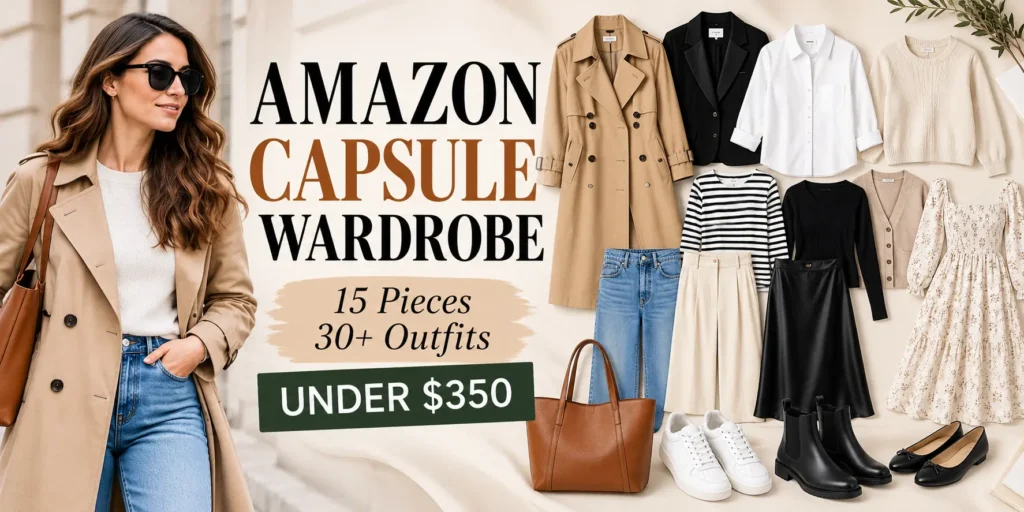
Alright, the part you actually came for: what goes in it, and how many of each. There’s no magic number (anyone who tells you it must be exactly 33 pieces is selling something), but most capsule wardrobes land somewhere between 25 and 40 pieces. If you’re staring at an empty page and need a starting formula, try the 5-4-3-2-1 rule: 5 tops, 4 bottoms, 3 accessories, 2 pairs of shoes, 1 dress. Build out from there based on your climate and your life.
📋 Free download: Grab the capsule-wardrobe-over-40-checklist — every piece below, plus a declutter test, a color-palette worksheet, and a body-shape cheat sheet, all on two pages you can print and check off by hand.
Tops (7 to 9)
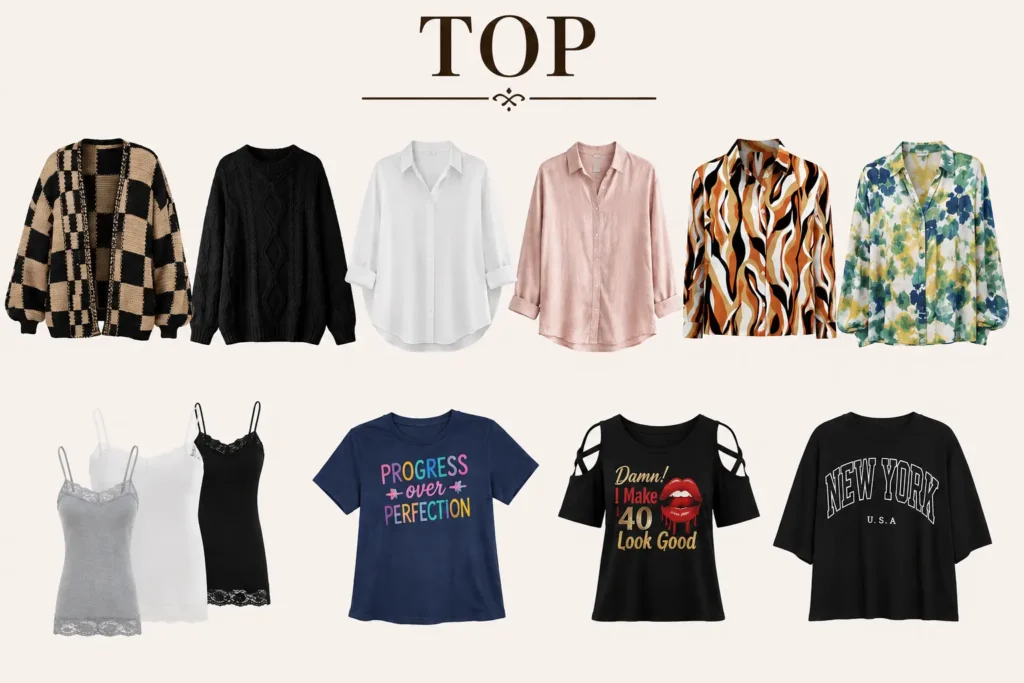
- 2 to 3 well-fitting tees that hold their shape
- 1 to 2 tanks or camisoles for layering
- 2 blouses that drape rather than cling
- 1 to 2 button-downs (white and one other)
- 1 easy layering knit or lightweight sweater
Bottoms (5 to 6)
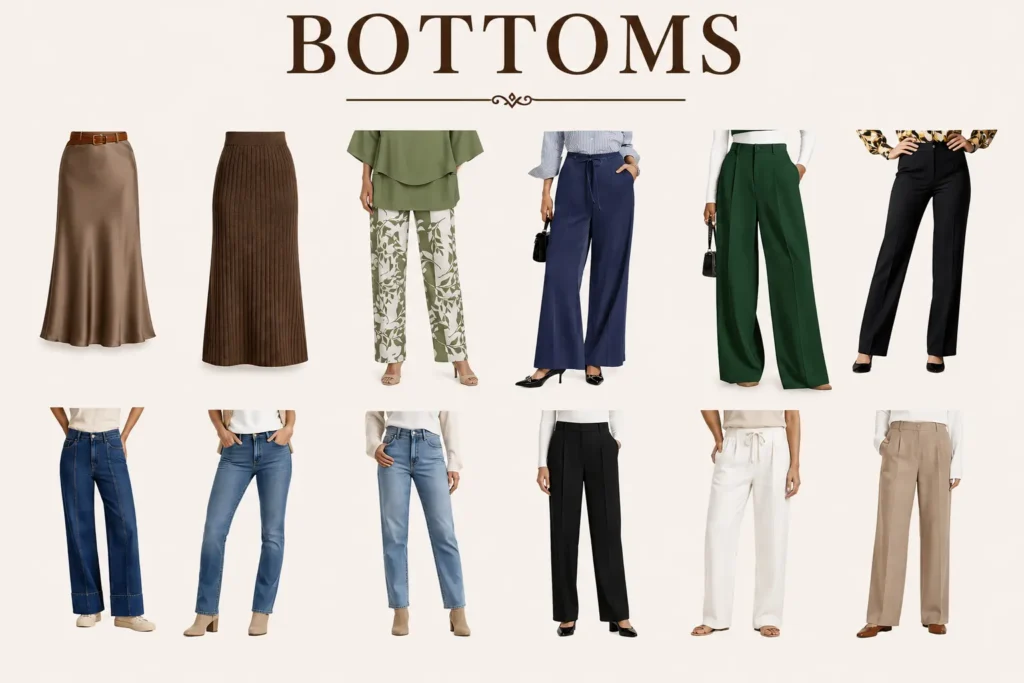
- 1 to 2 pairs of jeans, higher-rise with a little stretch (straight, wide, or barrel, whatever flatters you)
- 1 pair of trousers or dress pants
- 1 pair of easy casual pants (linen or a soft wide-leg)
- 1 skirt you can wear across seasons
Dresses (2 to 3)
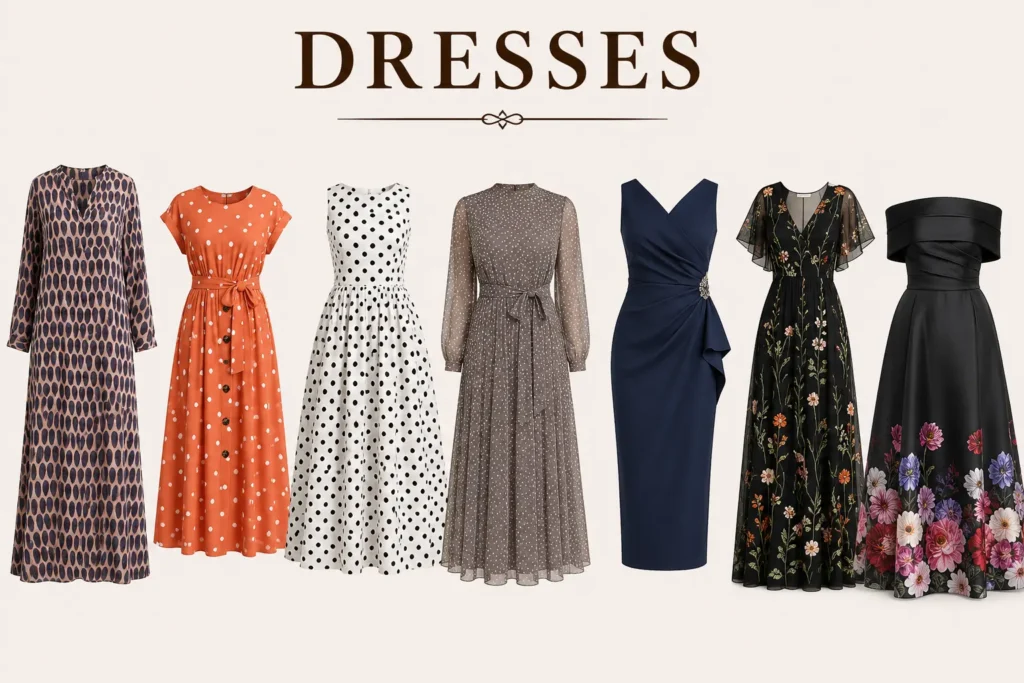
- 1 little black dress in a drapey knit that dresses up or down
- 1 easy day dress
- Optional: 1 wrap or shirt dress
Layers(4 to 5)
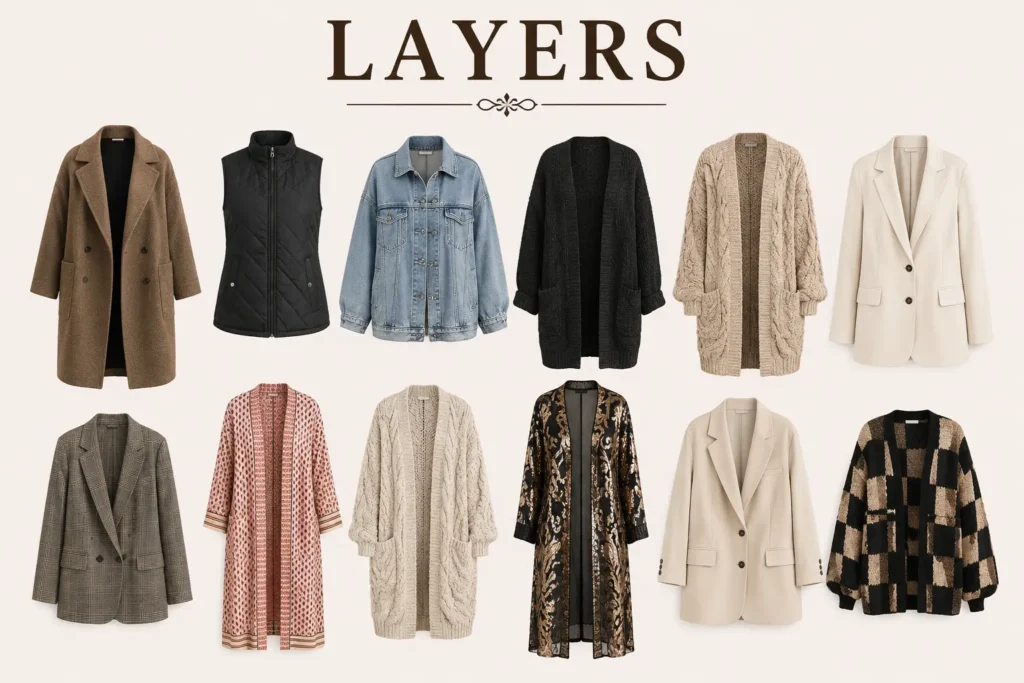
- 1 blazer
- 1 long cardigan or duster
- 1 denim jacket
- 1 vest (criminally underrated; a vest or long cardigan is often the “third piece” that finishes an outfit)
- 1 lightweight jacket or trench
Shoes (4 to 5)
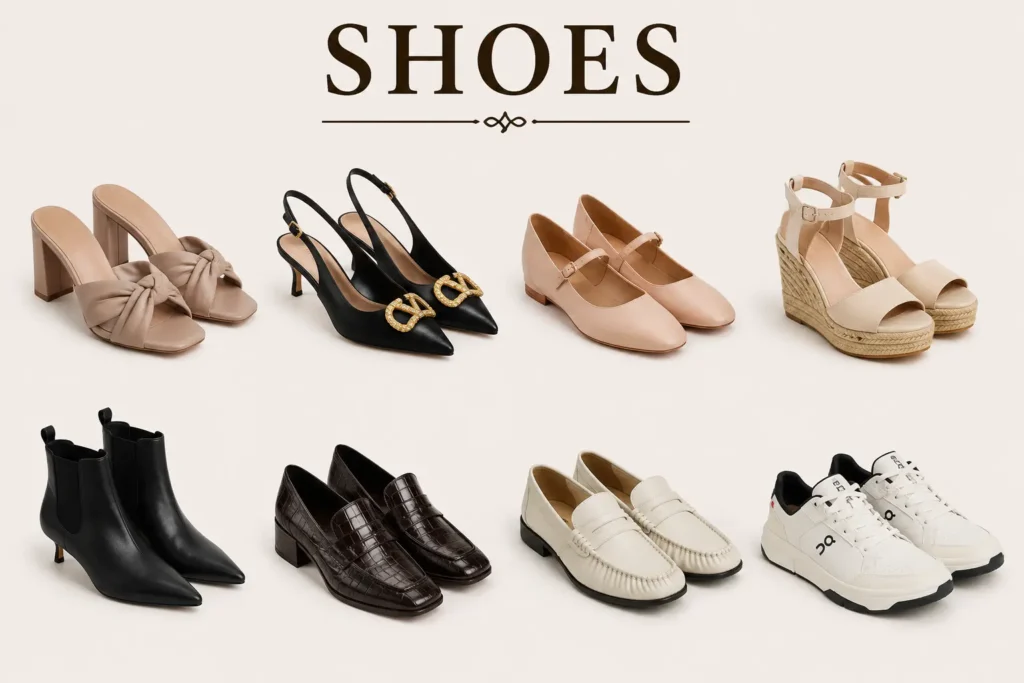
- 1 everyday flat or loafer
- 1 comfortable low heel, wedge, or kitten heel
- 1 pair of clean white sneakers
- 1 boot
- 1 sandal (seasonal)
Accessories (4 to 6)
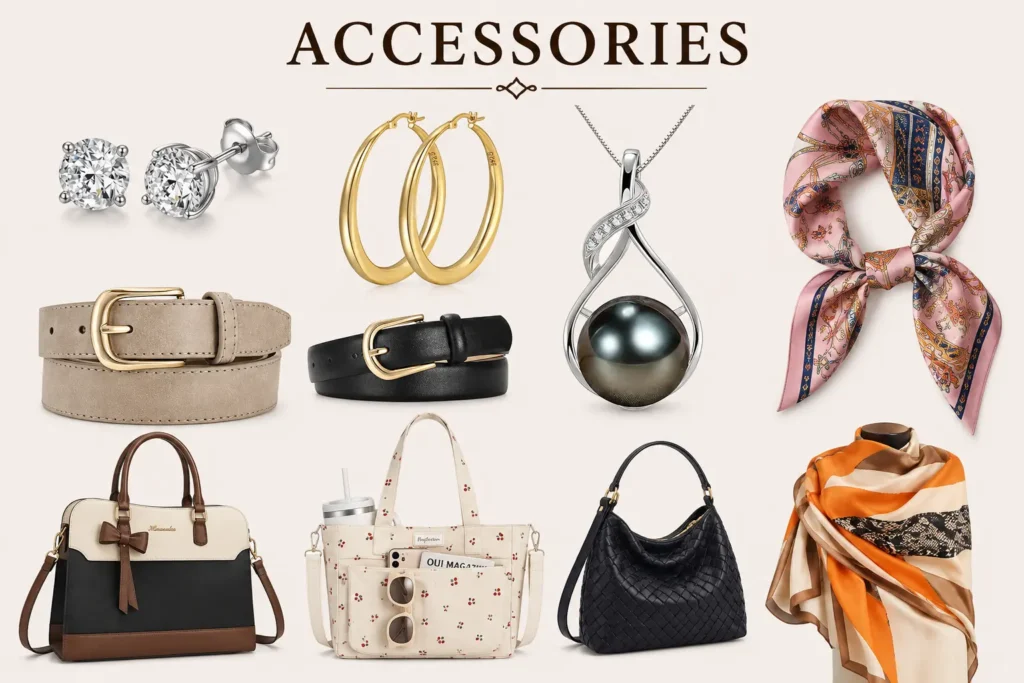
- 2 bags (one everyday crossbody, one tote or shoulder bag)
- 1 scarf
- 1 statement necklace and a pair of everyday hoops or studs
- 1 belt
That’s a complete, mix-and-match capsule that will carry you through most of what your week throws at you. If you’re petite or plus-size, the categories don’t change.
Just prioritize fit and proportion. I’ve got tailored guidance for both a petite capsule wardrobe and a plus-size capsule wardrobe if you want the specifics.
Capsule Wardrobe by Body Shape
Most over-40 capsule guides completely skip this, and it drives me a little crazy, because fit is the thing that changes how a capsule feels on a body that’s evolved. This isn’t about hiding anything. It’s about choosing silhouettes that make you feel put-together instead of fussy. Find yourself below.
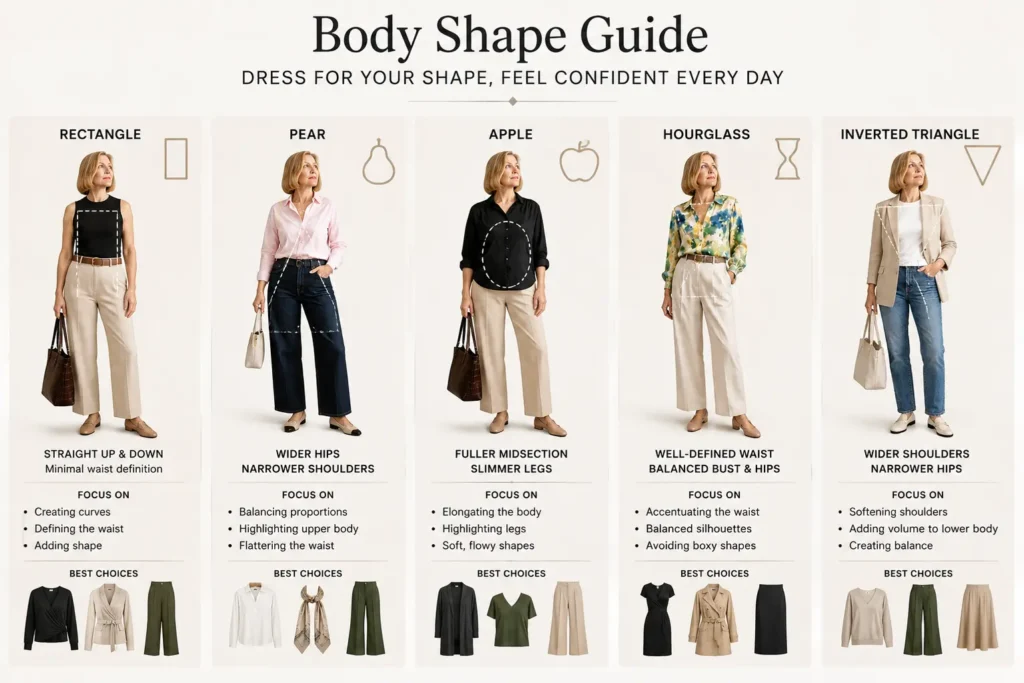
Rectangle (shoulders, waist, and hips roughly in line):
Your goal is to create the suggestion of a waist. Belts, wrap styles, and a well-placed third piece, like a cardigan that hits at the hip, do wonders. A striped tee alone might read a little straight up-and-down; add a layer, and suddenly you look intentional.
Pear (hips wider than shoulders):
Balance the eye upward. Detail, structure, and a little volume up top, like boat necks, interesting shoulders, and structured blazers, pair beautifully with cleaner bottoms in your darker neutrals.
Apple (weight carried around the middle):
Drape is your best friend. Look for soft knits that skim the midsection, open necklines that draw the eye up, and vertical lines that lengthen. A long, open cardigan or duster creates a flattering column.
Hourglass (defined waist, balanced shoulders and hips):
Keep that waist visible, because boxy, shapeless pieces work against you. Wrap dresses, tucked tops, and belted layers let your natural shape do the work.
Inverted triangle (shoulders broader than hips):
Soften the top and add a little interest below. Wider-leg trousers, A-line skirts, and simpler necklines balance out stronger shoulders.
Whatever your shape, the confidence rule beats every styling trick: wear the thing that makes you stand a little taller. That feeling is more flattering than any silhouette on a chart.
The Outfit Formula: How a Few Pieces Make 100+ Outfits
Here’s the math that changed how I see my closet.
I once pulled out just seven pairs of bottoms and methodically tried every top, every layer, every combination against them. It was tedious. I got sweaty and cranky. And I ended up with well over a hundred genuinely wearable outfits from the same handful of pieces. Same pants. Same tops. Different combinations. Suddenly I “had clothes” again, without buying anything.
That’s the whole secret of a capsule: versatility multiplies. A rough way to see it: if you have 8 tops, 5 bottoms, and 4 layers that all coordinate, you’re looking at well over a hundred combinations before you even add accessories.
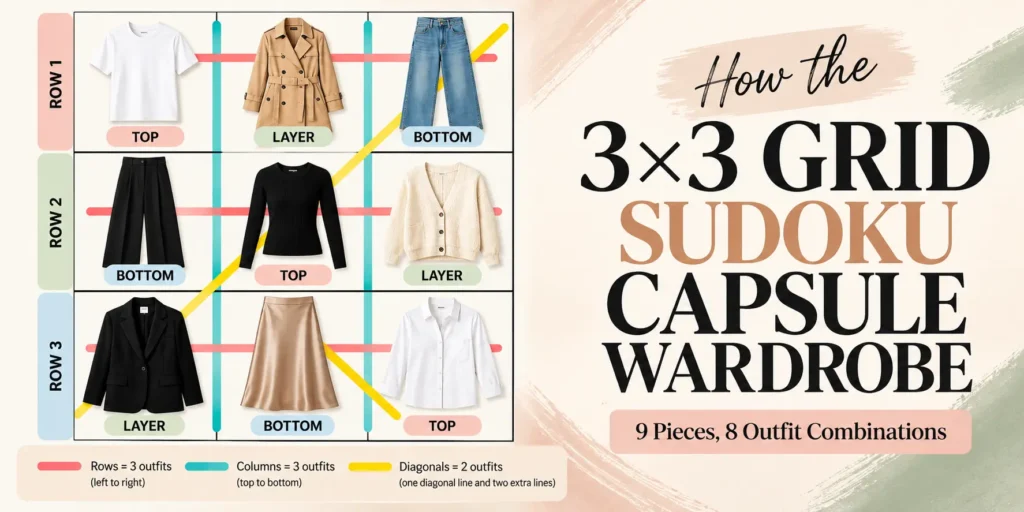
The tool that makes it click is the third-piece rule. Take any basic top and bottom (that’s two pieces), then add a third: a blazer, a cardigan, a vest, a scarf, or a bold accessory. Two pieces look like you got dressed. Three pieces look like you meant it. Once you internalize that, getting dressed becomes a two-minute equation instead of a daily crisis.
A few outfit recipes to prove it, all pulled from the checklist above:
- White tee + straight jeans + denim jacket + white sneakers
- Printed blouse + green wide-leg trousers + checked blazer + loafers
- LBD + long cardigan + low heels + statement necklace
- Pink button-down + beige midi skirt + belt + ankle boots
- Breton stripe top + straight jeans + cardigan + loafers
- Cream sweater + black trousers + blazer + ankle boots
- White button-down + straight jeans + checked blazer + loafers
- Printed blouse + black trousers + low heels + statement necklace
- White tee + green wide-leg trousers + denim jacket + sneakers
- Pink button-down + straight jeans + loafers + crossbody bag
- Black tank + wide-leg trousers + vest + flats + silk scarf
- Cream sweater + beige midi skirt + ankle boots + belt
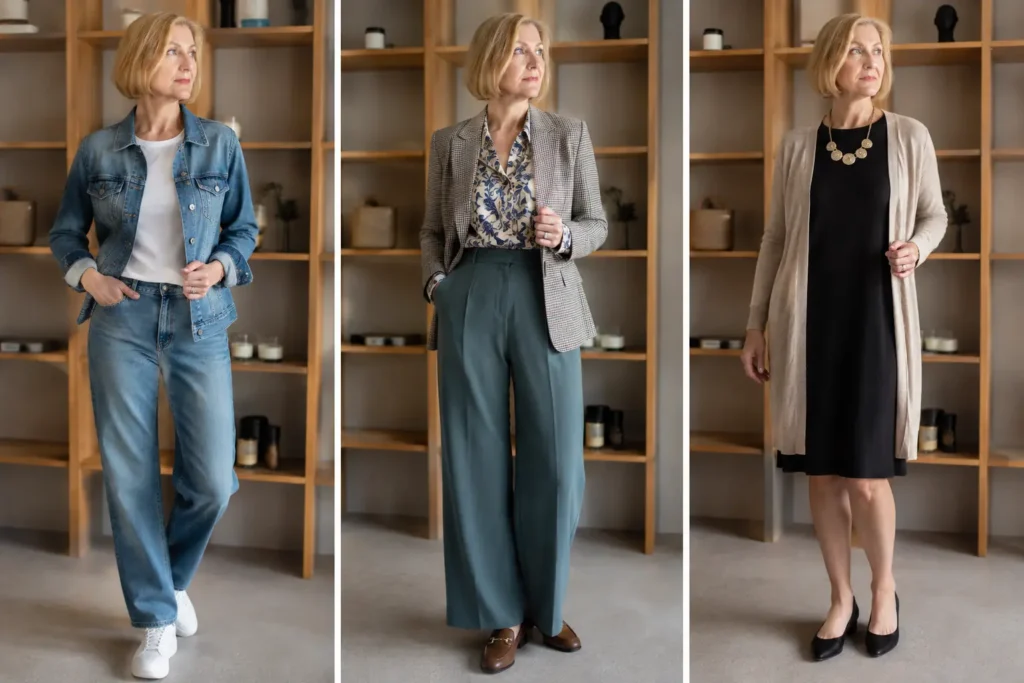
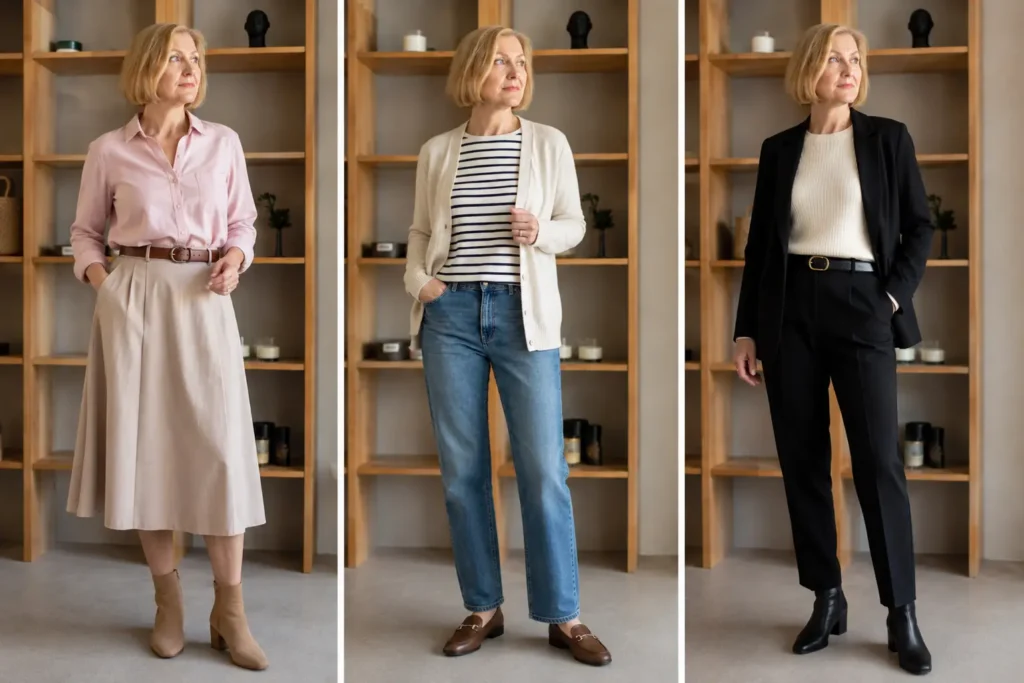
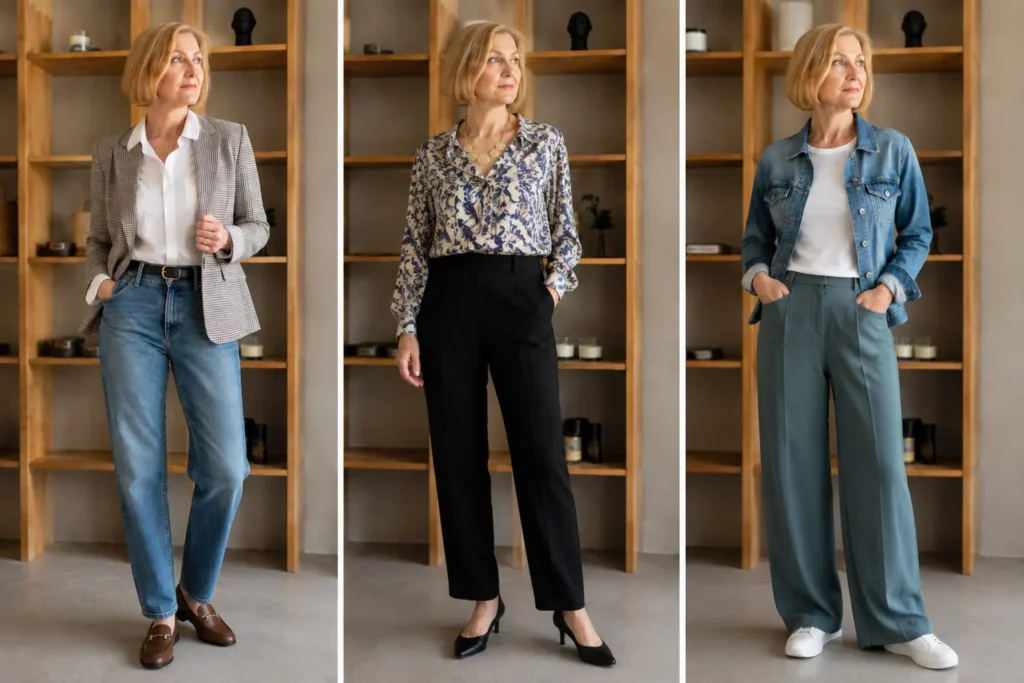
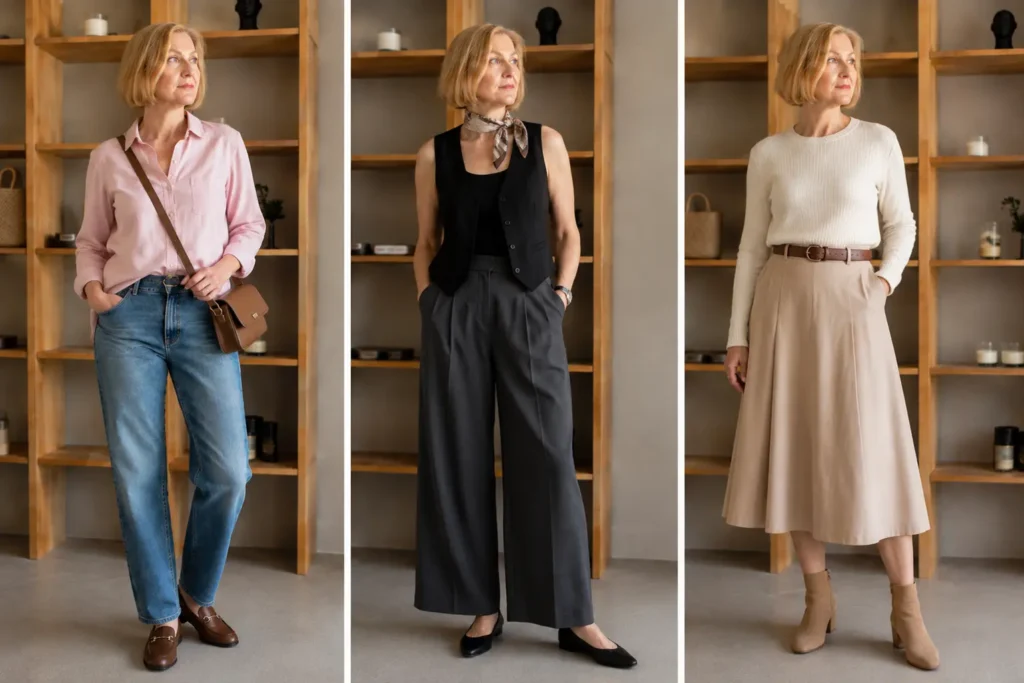
Same closet. Completely different days.
Seasonal Capsule Wardrobes Over 40
You don’t need a brand-new wardrobe every season. You need one strong core capsule and a smart way to flip roughly 20% of it as the weather turns. Here’s how the year tends to break down.
Spring Capsule Wardrobes Over 40
is all about transitional layers: the trench, the lightweight cardigan, a few brighter accents peeking through after a long winter. My full spring capsule wardrobe breaks it down piece by piece.
Summer Capsule Wardrobes Over 40
is where breathable fabrics earn their keep. Linen, cotton, easy dresses, and coverage options for anyone who (like me) doesn’t love shorts. The summer capsule wardrobe leans hard into staying cool without giving up on style.
Fall Capsule Wardrobes Over 40
is, frankly, the easiest capsule season, the one where layering does 80% of the work, and everything looks better with a jacket thrown over it. Here’s my fall capsule wardrobe if you want the full lineup.
Winter Capsule Wardrobes Over 40
is a layering game start to finish: sweaters, cardigans, vests, and coats stacked over your foundation pieces to add warmth and structure without needing more clothes. The winter capsule wardrobe covers how to stay warm and still look like yourself.
The beauty of this approach is that your neutrals and core pieces stay put year-round. You’re just swapping the seasonal layer and a couple of fabrics.
And once you’ve mastered the seasonal rhythm at home, the same skill makes packing a breeze. A travel capsule wardrobe is really just a mini version of everything you’ve already learned, and a carry-on capsule proves you can do a week (or a month) with astonishingly little.
Capsule Wardrobes for Every Part of Your Life
One capsule can genuinely stretch across most of your week, but a couple of areas deserve their own attention.
If your days are anchored by an office, a dedicated work capsule wardrobe built around a few great trousers, blazers, and blouses will save you more decision fatigue than anything else you do. And if your dress code lives in that fuzzy in-between zone, a business-casual capsule hits the sweet spot between “I have a real job” and “I’m comfortable.”
And if you’re drawn to a particular aesthetic, lean into it. A capsule is the perfect vehicle for a defined point of view. The effortless, quality-over-everything approach of a French capsule wardrobe or the understated polish of an old-money capsule both translate beautifully to a woman over 40, precisely because they’re built on timelessness rather than trend-chasing.
Where to Shop: US Brands by Budget
You don’t have to spend a fortune, and you don’t have to shop fast fashion, either. That closet full of cheap “going-out tops” is exactly what we’re leaving behind. Think in terms of cost-per-wear: a $120 blazer you wear 100 times is cheaper than a $30 one you wear twice.
- Budget-friendly: Target’s A New Day and Universal Thread, Old Navy, Uniqlo, Quince, and secondhand platforms like Poshmark and ThredUp (thrifted and preloved pieces are where the real treasure, and the real sustainability, lives).
- Mid-range: Everlane, J.Crew, Gap, Banana Republic, Madewell, Talbots, and Boden all do reliable, well-made staples in a wide size range.
- Investment: Eileen Fisher, Vince, and quality-focused labels for the pieces you’ll keep for a decade: your coat, your best trousers, your one perfect blazer.
Buy slowly. A capsule built one considered piece at a time will always beat a closet bought in a single panicked haul.
Common Capsule Wardrobe Mistakes Over 40
A few traps I’ve fallen into so you don’t have to:
- Shopping trend-first, style-second. Trends are the seasoning, not the meal. Build your foundation on what suits you, then add a trend or two as an accent. Trend-first wardrobes lead straight to overconsumption and a closet full of regret.
- Keeping the “divas.” That gorgeous top that goes with nothing? It’s holding a spot a workhorse could fill. Let it go.
- Dressing to disappear. We were taught to camouflage: hide the arms, the belly, the whole self, really. But confidence isn’t found in hiding. It’s found in clothes that fit and move and don’t need constant tugging.
- Ignoring fabric and temperature. A stunning piece that leaves you overheating or itching will never make it into rotation. Comfort is a feature, not a compromise.
- Chasing a magic number. Cohesion matters far more than count. Forty pieces that all work together beats twenty that don’t.
The Real Goal of All This
Here’s what I wish someone had told me at 41: the point of a capsule wardrobe over 40 isn’t minimalism for its own sake, and it isn’t about looking 25 again. It’s ease. It’s opening your closet and liking what you see. It’s getting dressed in three minutes flat and walking out the door feeling like yourself.
It turned out I didn’t need a new wardrobe. I needed to meet the one I already owned, and to build the next version of it with a little more intention and a lot less noise.
Start with a declutter. Pick your palette. Build a foundation that works together, then add the pieces that are unmistakably you. Grab the free checklist, try everything on, and trust the woman you’ve become to know what she likes.
She’s had plenty of time to figure it out.
Ready to build yours? Download the free capsule wardrobe checklist and start with what’s already in your closet.
Frequently Asked Questions
How many pieces should a capsule wardrobe have?
There’s no single right answer, but most capsule wardrobes contain 25 to 40 pieces. A good rule is less about counting and more about coordination: if every item works with at least three others, you’re doing it right. The 5-4-3-2-1 formula (5 tops, 4 bottoms, 3 accessories, 2 shoes, 1 dress) is a solid starting point to build from.
Can I build a capsule wardrobe over 40 without buying anything new?
Absolutely, and I’d recommend starting exactly that way. Most of us already own more workable outfits than we realize. Try on what you have, mix everything methodically, and only then identify the genuine gaps worth filling.
What are the best fabrics for perimenopause and menopause?
Look for breathable, temperature-regulating fibers: cotton, linen, modal, bamboo, and merino wool, plus knits with a little stretch. These handle hot flashes and body changes far better than stiff, synthetic, or clingy fabrics.
What colors should be in an over-40 capsule wardrobe?
Start with 2 to 3 neutrals (black, navy, grey, beige, ivory, or camel) and add 1 to 2 accent colors you love. Consider your undertone: warm skin tones glow in earthy shades and gold, cool tones in jewel shades and silver, so the colors flatter rather than wash you out.
How do I build a winter capsule wardrobe over 40?
Winter relies almost entirely on layering. Keep your core foundation pieces and add sweaters, cardigans, vests, and coats over them. Layers deliver warmth, structure, and variety without needing more clothes.
Is 40 too old to follow trends?
Not remotely. The shift after 40 isn’t giving up trends. It’s adopting them on your terms, usually as accents rather than the foundation. Try a trend through an accessory or a single piece styled in a way that actually suits you.
How is this different from a capsule wardrobe over 50 or 60?
The core method is identical, but fit and fabric priorities intensify with each decade. If you’re a bit further along, my guides for a capsule wardrobe over 50 and beyond go deeper on those specifics.

Emma studied fashion but could never get her own closet under control. Capsule wardrobes finally fixed that. Now she writes about what actually worked for her, in the hope it saves you a few frustrating mornings.