Let’s clear something up: neutral is not boring. That’s the lie that keeps people reaching for one more “fun” top they’ll wear twice and ignore forever.
A good neutral capsule wardrobe is the opposite of boring. It’s the thing that makes you look quietly expensive on a Tuesday with zero effort, because every piece already works with every other piece.
I’ve built these for clients for years, and the number that always surprises them is how few pieces it actually takes. Twelve. That’s it.
In this article, I’ll show you the exact 12, the colors that make them click, and the styling formulas that turn them into more than 30 real outfits.
What Is a Neutral Capsule Wardrobe (and Why 12 Pieces Is Enough)
Strip a wardrobe down to a tight run of neutrals like black, white, beige, grey and navy, keep the shapes simple, and something useful happens: nearly everything pairs with everything else. That’s the whole mechanism.
The palette does the coordinating for you, so a handful of pieces starts behaving like a much bigger closet. (New to the idea entirely? Start with what a capsule wardrobe is, then come back and narrow it to neutrals.)
None of this is new, which is exactly why it holds up. Donna Karan built her “Seven Easy Pieces” around the same logic back in the 1980s, a compact set that took a woman from day to night without a costume change. The goal was never owning less for its own sake. It was ease.
Here’s why the 12 piece neutral wardrobe capsule earns its keep:
- It kills decision fatigue. Fewer, better coordinated options mean faster mornings and less mental load. When your trousers already work with every top, choosing is effortless.
- It lowers your cost per wear. A piece you wear fifty times is a bargain even if it cost more upfront. A trend buy you wear twice never is.
- It resists trends. Neutrals don’t expire the way a novelty color does, so a good piece stays in rotation for years, not one season.
12 is the sweet spot for a core because it’s small enough to stay disciplined and large enough to generate real variety. Once you add the styling formulas later in this guide, twelve pieces comfortably clear thirty outfits.
Think of the 12 as your foundation. You can always expand, but you rarely need to. It’s a close cousin of the minimalist capsule wardrobe approach, just with a specific focus on a neutral palette.
Find Your Undertone First
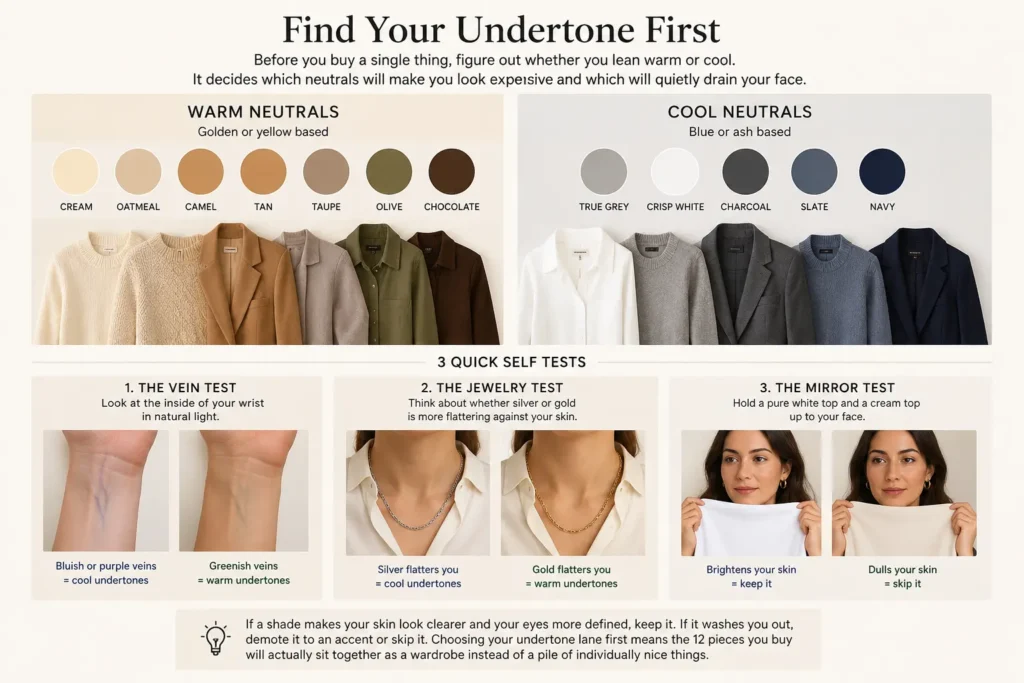
This is the step almost everyone skips, and it’s the reason so many neutral outfits look faintly off without the wearer being able to say why. Before you buy a single thing, figure out whether you lean warm or cool. It decides which neutrals will make you look expensive and which will quietly drain your face.
Neutrals split into two families:
- Warm neutrals: cream, oatmeal, camel, tan, taupe, olive, chocolate. These have a golden or yellow base.
- Cool neutrals: true grey, crisp white, charcoal, slate, navy. These have a blue or ash base.
Most people suit one family more than the other, and mixing the two carelessly is exactly what makes a tonal outfit feel disconnected. Here are three quick self tests:
- The vein test. Look at the inside of your wrist in natural light. Bluish purple veins usually mean cool undertones; greenish veins usually mean warm.
- The jewelry test. Think about whether silver or gold is more flattering against your skin. Silver tends to flatter cool undertones, gold tends to flatter warm.
- The mirror test. Hold a pure white top and a cream top up to your face. One will brighten you; the other will slightly dull you. That’s your answer.
You don’t need to be scientific about it. If a shade makes your skin look clearer and your eyes more defined, keep it. If it washes you out, demote it to an accent or skip it. Choosing your undertone lane first means the 12 pieces you buy will actually sit together as a wardrobe instead of a pile of individually nice things.
Capsule Wardrobe Neutral Colors: Choosing Your Palette
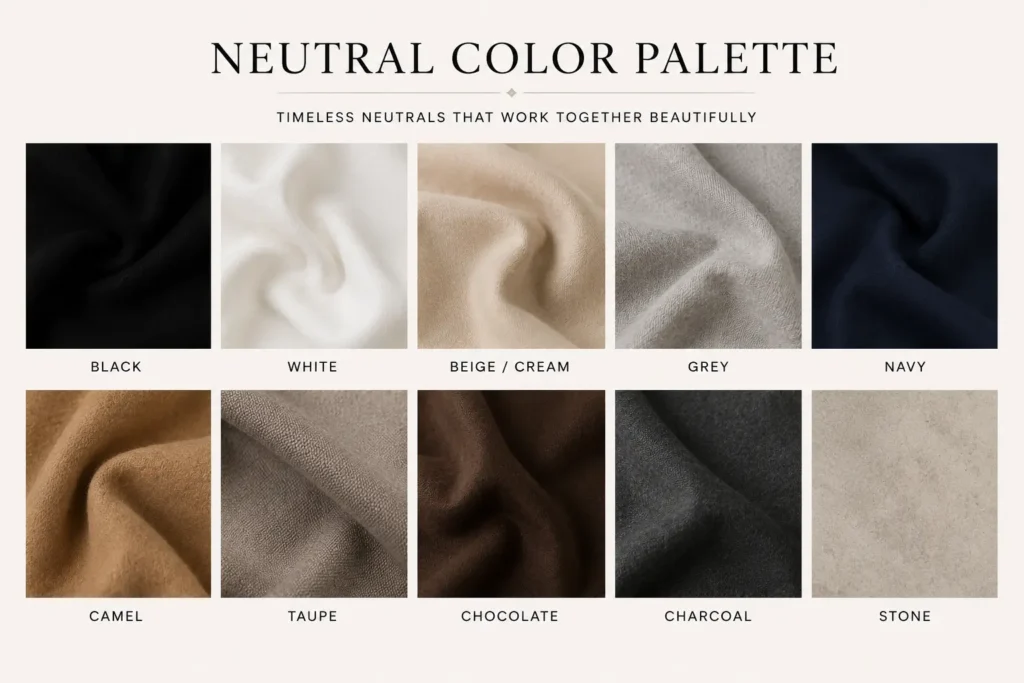
Now for the fun part, building your neutral color capsule wardrobe palette. The goal isn’t to own every neutral. It’s to pick a handful that repeat endlessly.
If you want to go deeper on this after finishing here, my full guide to choosing a capsule wardrobe color palette walks through building around accents too.
Here’s how the capsule wardrobe neutral colors break down.
Core neutrals (the hardest workers)
- Black: the most versatile anchor. Pairs with everything, sharpens everything, and reads polished with zero effort.
- White: your contrast and brightness. A crisp white top lifts every darker piece next to it.
- Beige and cream: soften hard contrast and add warmth. Camel’s approachable cousin.
- Grey: the quiet diplomat that bridges black, white, and beige.
- Navy: a softer substitute for black that flatters nearly everyone and moves easily from casual to formal.
Warm neutrals (if you tested warm):
camel, taupe, tan, olive, and a touch of terracotta as an accent.
Cool neutrals (if you tested cool):
charcoal, slate, stone, and true grey.
The 3 color formula for a 12 piece capsule
Don’t try to use all of them. For a 12 piece wardrobe, choose:
- One primary base: the color of your hardest working pieces (trousers, blazer, shoes). Black, navy, or charcoal for cool; camel or chocolate for warm.
- One secondary neutral: a supporting shade that layers with the base. Grey with black; cream with navy; ivory with camel.
- One light neutral: white or cream, to keep everything from going flat.
- Optional, one accent: a single richer color (rust, olive, burgundy, dusty blue) that shows up in a scarf, shoe, or bag. Two or three items, never more.
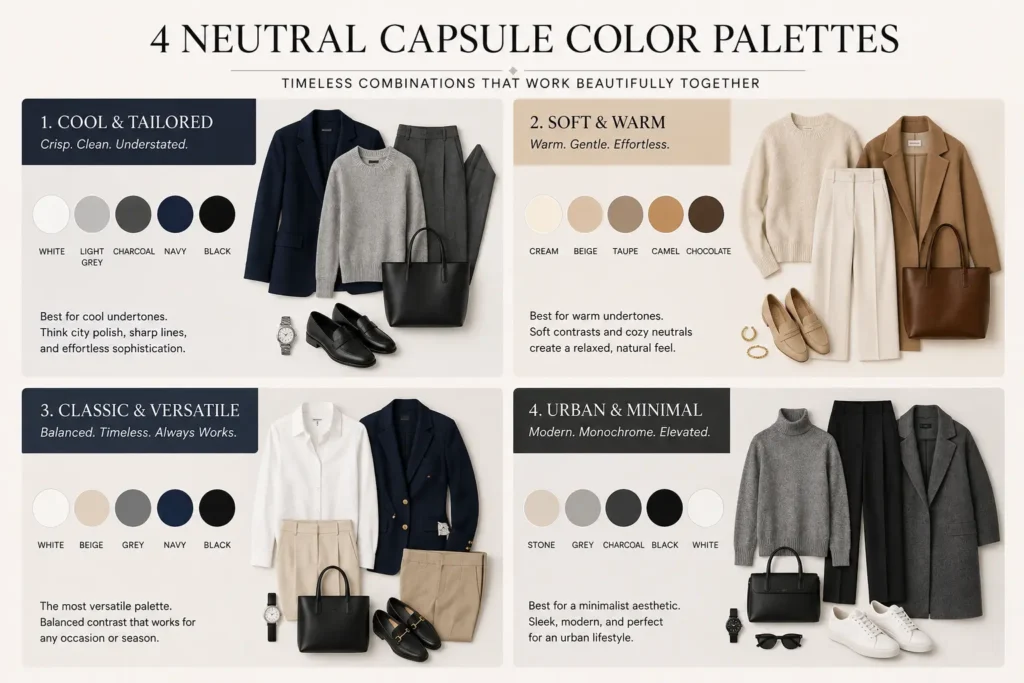
| Palette direction | Base | Secondary | Light | Accent idea |
| Cool and tailored | Black | Grey | White | Deep wine |
| Soft and warm | Camel | Chocolate | Ivory | Rust |
| Classic and versatile | Navy | Taupe | Cream | Dusty blue |
| Urban and minimal | Charcoal | Stone | White | Forest green |
The rule I give every client: you should be able to describe your palette in one sentence. “Navy, cream, taupe, and a little rust” works. “A mix of black, brown, blush, green, blue, and whatever” does not.
The 12 Piece Neutral Capsule Wardrobe (Your Core List)
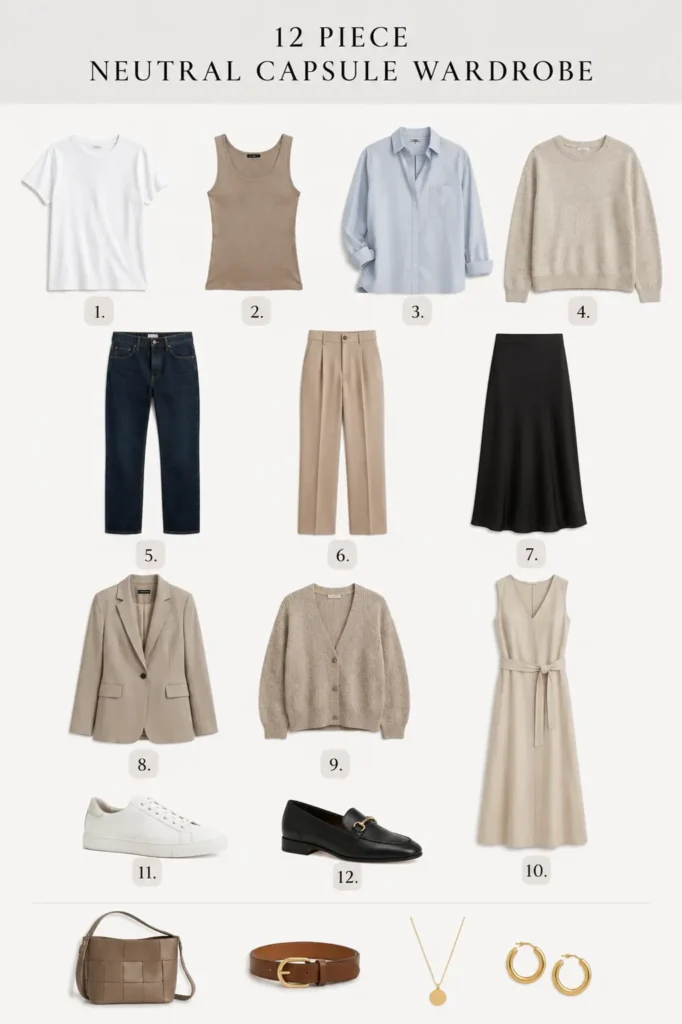
I’ve chosen these for range, not occasion. Each one earns its place because it can shift mood with styling, not because it does one job.
Build your version in your chosen palette. If you’d like a broader template to compare against, my complete capsule wardrobe for women covers the full year round set, and men can start from the capsule wardrobe for men guide instead.
Tops (4)

- White tee. The foundation of the neutral closet. Under a blazer, under a cardigan, on its own with jeans.
- Fitted tank. Layers under everything in warm weather and works as a clean base for a column of color.
- Crisp button-down shirt. Tucked into trousers, worn open over the tank, or layered under a knit with the collar showing.
- Fine-gauge knit or sweater. Your soft texture and instant polish in cooler months.
Bottoms (3)
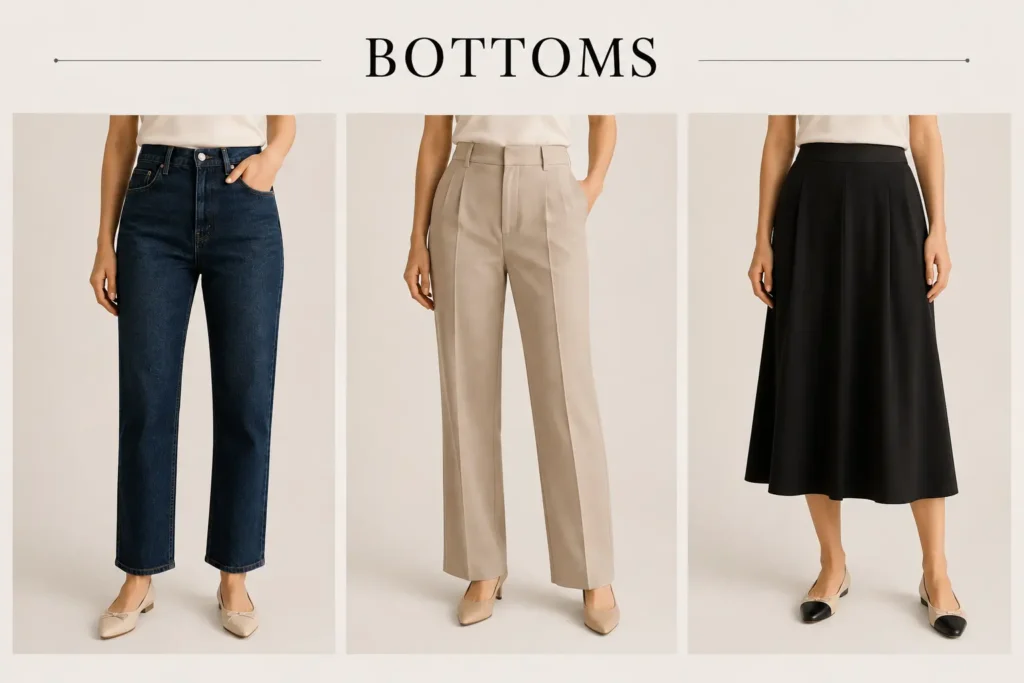
- Straight leg jeans in a dark, clean wash. Dresses up with a heel, down with a sneaker.
- Tailored trousers in your base neutral. The piece that makes everything look intentional.
- A midi skirt or wide leg trouser. For movement and a different silhouette so your wardrobe never looks same-y.
Layers (2)
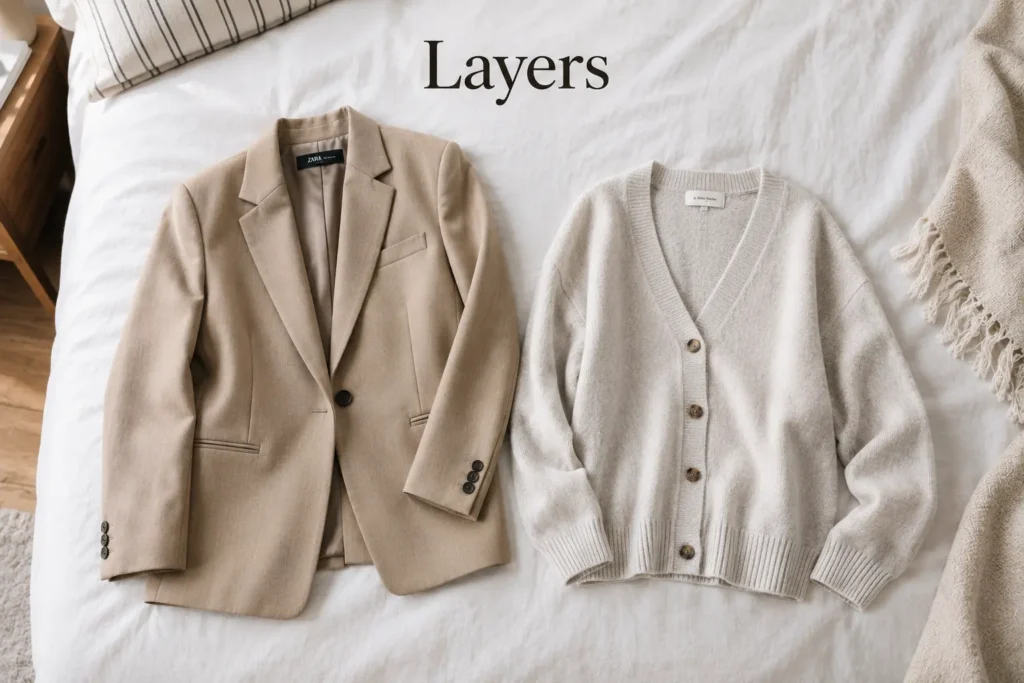
- Structured blazer. Your instant authority piece. It finishes jeans, trousers, and a plain tank in one move.
- Relaxed cardigan or second knit. The softer layer for casual days and transitional weather.
One and done (1)
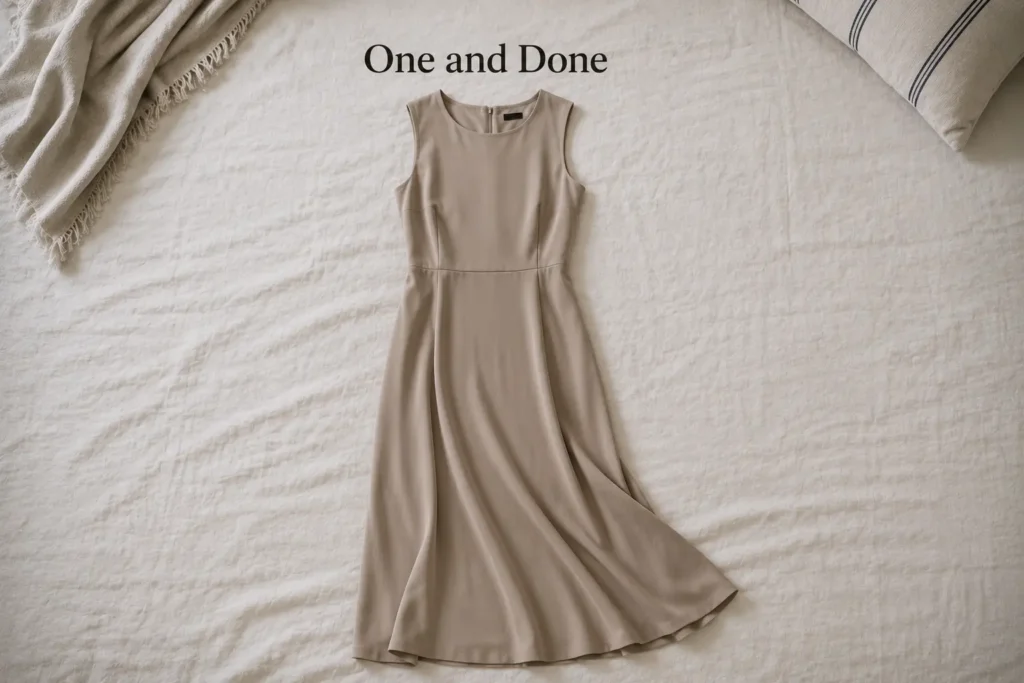
- Simple dress or jumpsuit in a neutral. The outfit that’s already an outfit. Add a layer for work, a heel for dinner.
Shoes (2)
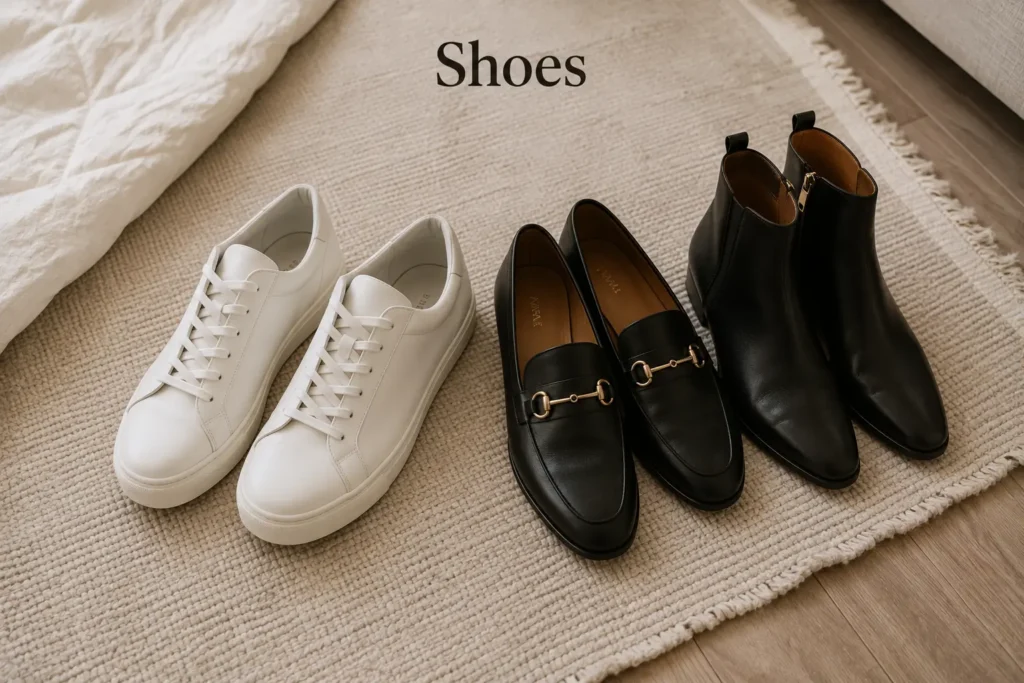
- White leather sneaker. Clean, everyday, quietly goes with everything.
- Loafer or ankle boot. The grown-up shoe that dresses any look up half a notch.
The multipliers (accessories)
Not counted in the 12, but they’re where a neutral capsule becomes adaptable: a woven or leather belt, one good crossbody or tote, and a little gold or silver jewelry (matched to your undertone).
Because the clothes are doing so little shouting, these small details get heard. A single warm leather tone or a richer accent reads as deliberate against a quiet backdrop.
Want the shortcut? Grab the free printable neutral-capsule-wardrobe-checklist to take shopping. It lists every piece above with fit notes, so you can tick them off as you build your neutral closet.
30+ Outfits From Your 12 Pieces (The Proof)
Everyone promises the outfit math. Almost no one shows it. So here it is, a real breakdown of how those 12 pieces combine into more than thirty outfits, organized by where you’re actually going. (Your accessories and that one accent piece push the number even higher.)
Work and office (8 outfits)
- Button down + tailored trousers + loafers
- White tee + blazer + trousers + loafers
- Knit + midi skirt + ankle boots
- Button down + straight jeans + blazer + loafers
- Dress + blazer + ankle boots
- Tank + blazer + trousers + loafers
- Knit + trousers + loafers + belt
- Button down (tucked) + midi skirt + belt + loafers
Everyday casual (8 outfits)
- White tee + straight jeans + sneakers
- Tank + cardigan + jeans + sneakers
- Knit + jeans + sneakers
- Button down (open) + tank + jeans + sneakers
- Tee + midi skirt + sneakers
- Cardigan + tank + trousers + sneakers
- Dress + sneakers + cardigan
- Tee + wide leg trouser + sneakers + belt
Date night and dressed up (6 outfits)
- Dress + ankle boots + statement jewelry
- Tank + blazer + straight jeans + loafers
- Button down + midi skirt + heels or boots
- Knit + tailored trousers + loafers + gold jewelry
- Tank + midi skirt + blazer + boots
- Silky tank + wide leg trouser + heels + clutch
Travel and weekend (6 outfits)
- Tee + cardigan + jeans + sneakers (the plane uniform)
- Knit + trousers + sneakers + crossbody
- Button down + jeans + loafers
- Dress + cardigan + sneakers
- Tank + blazer + jeans + sneakers
- Knit + midi skirt + ankle boots + tote
Relaxed at home (3+ outfits)
- Tee + cardigan + wide leg trouser
- Tank + relaxed knit + soft trouser
- Button down + straight jeans, sleeves rolled
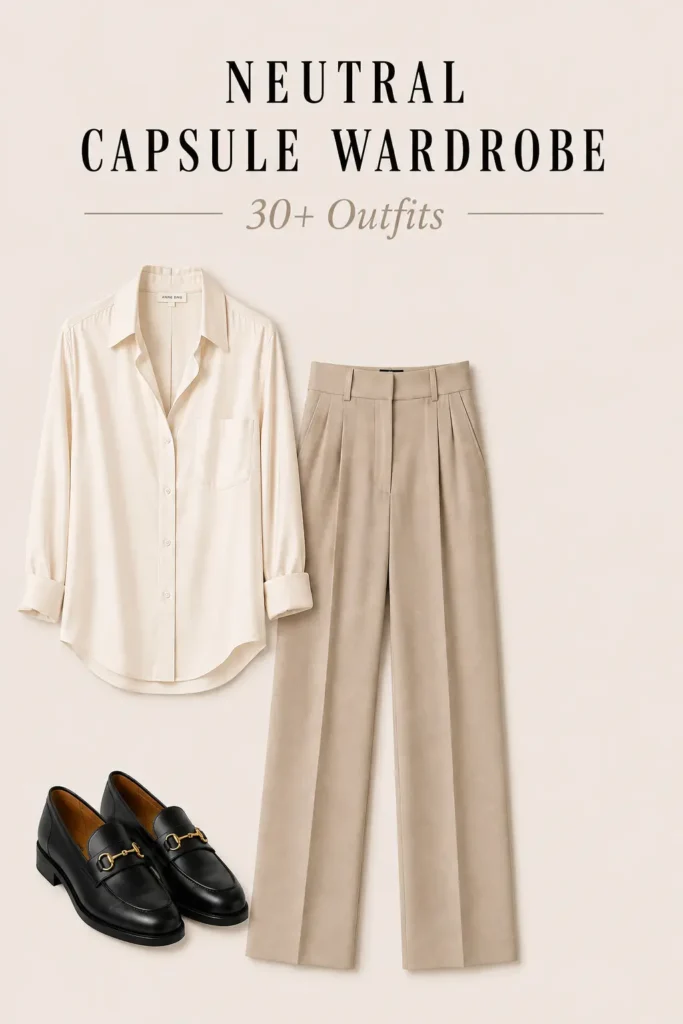
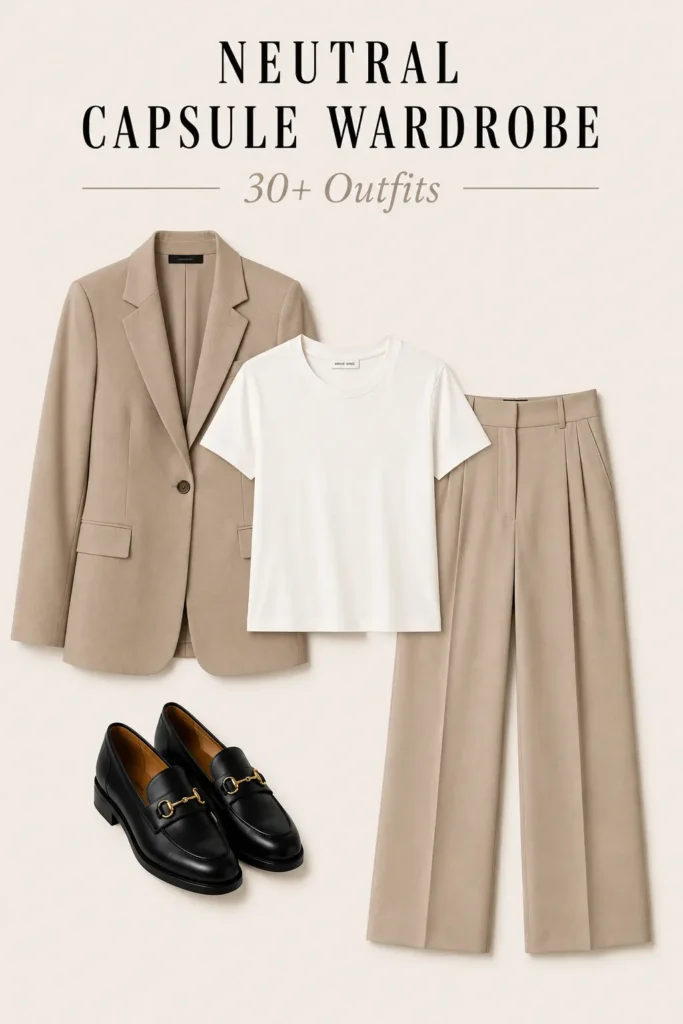
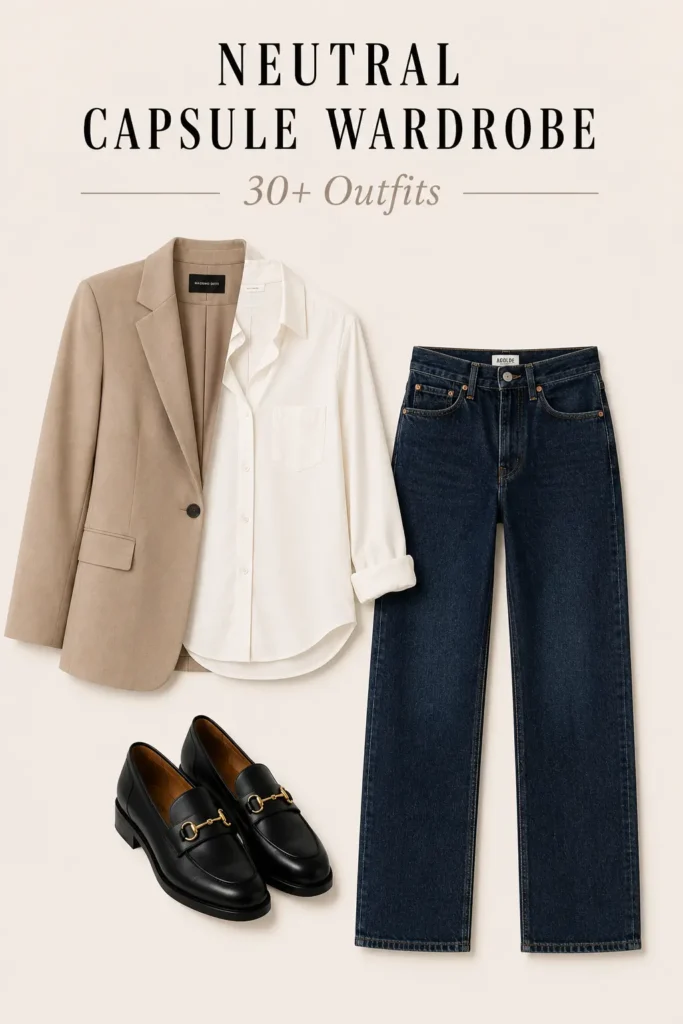
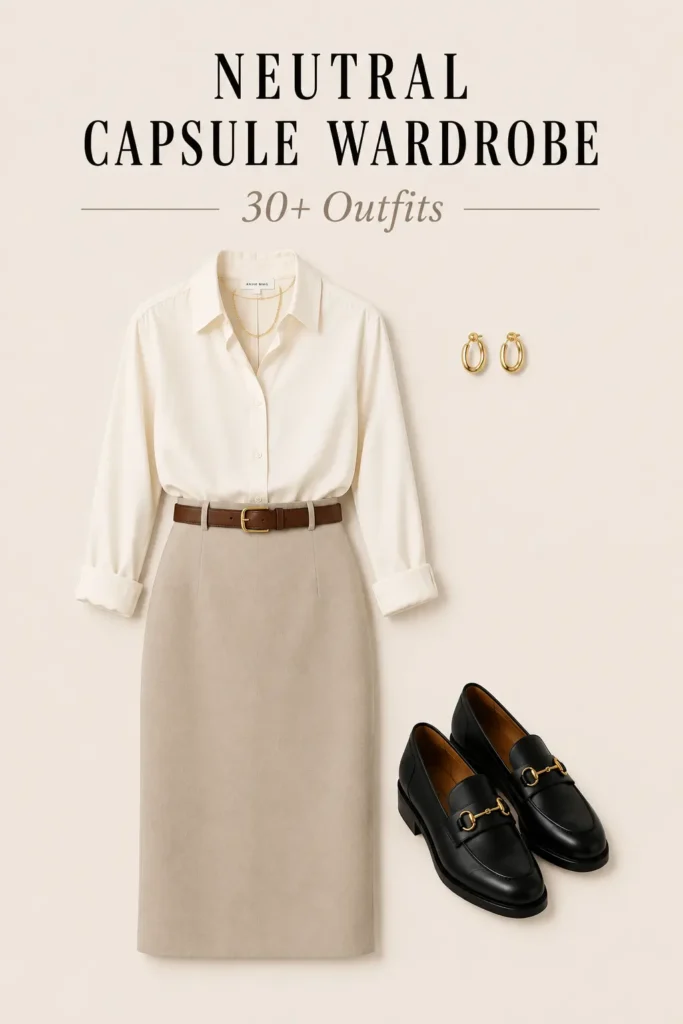
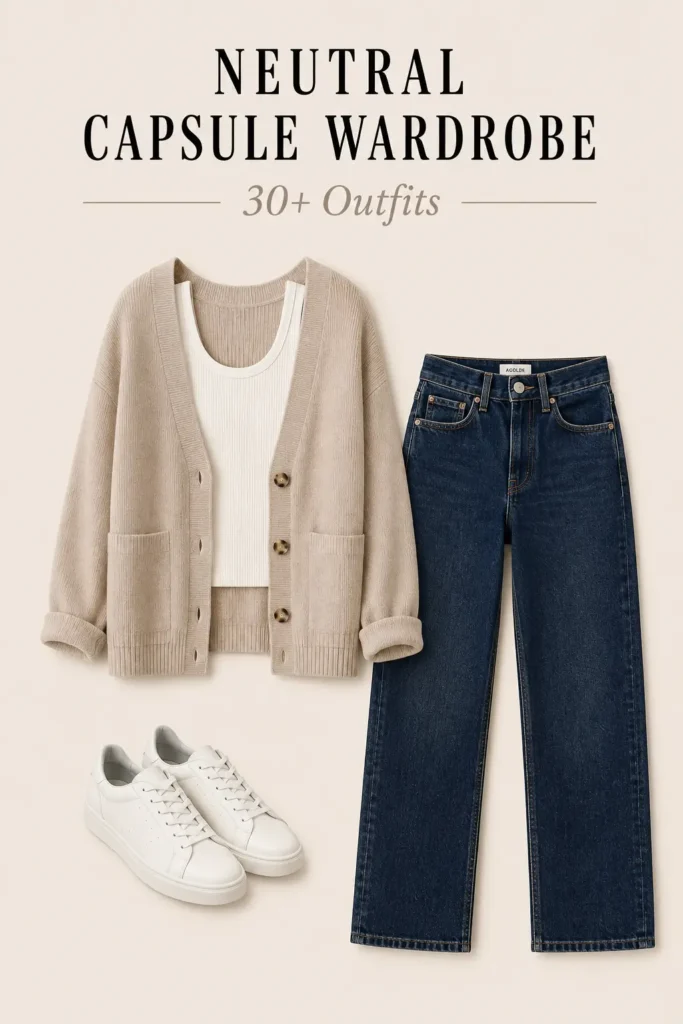
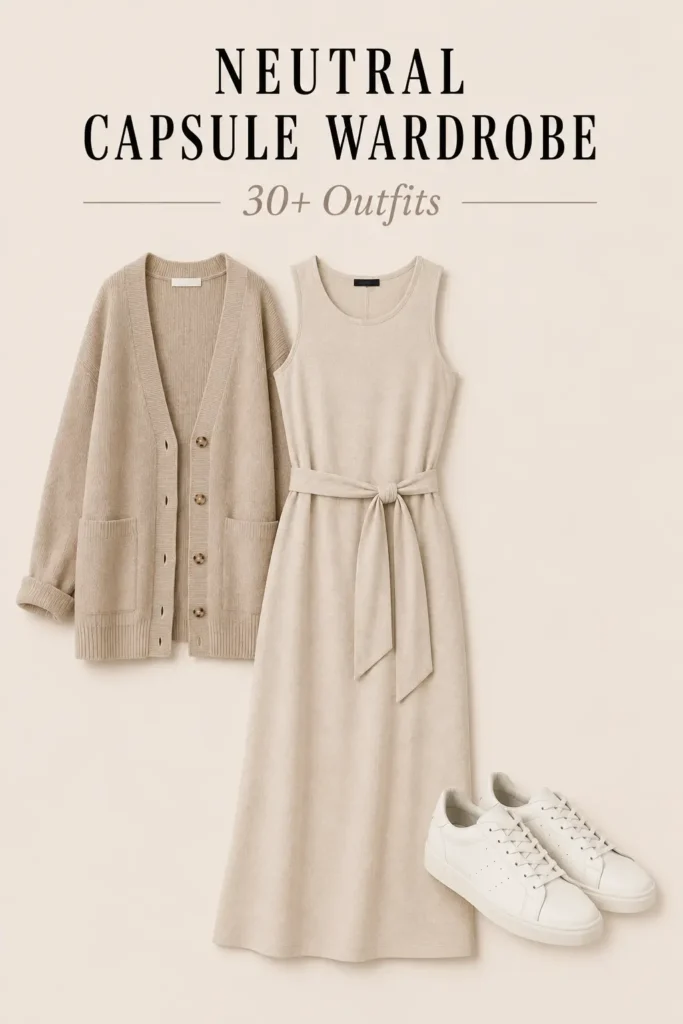
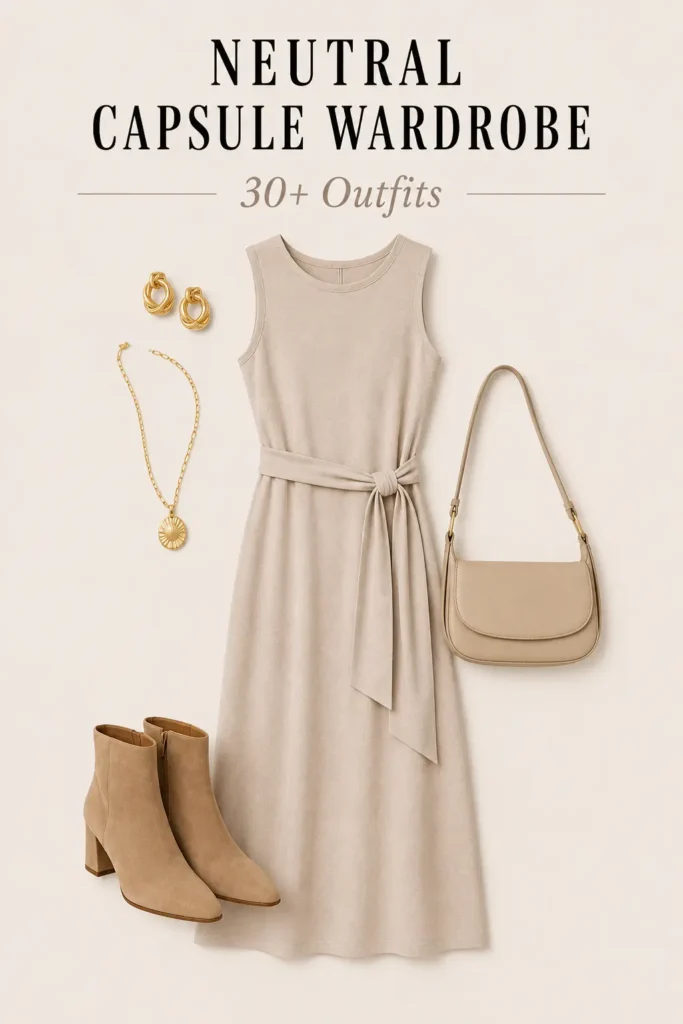
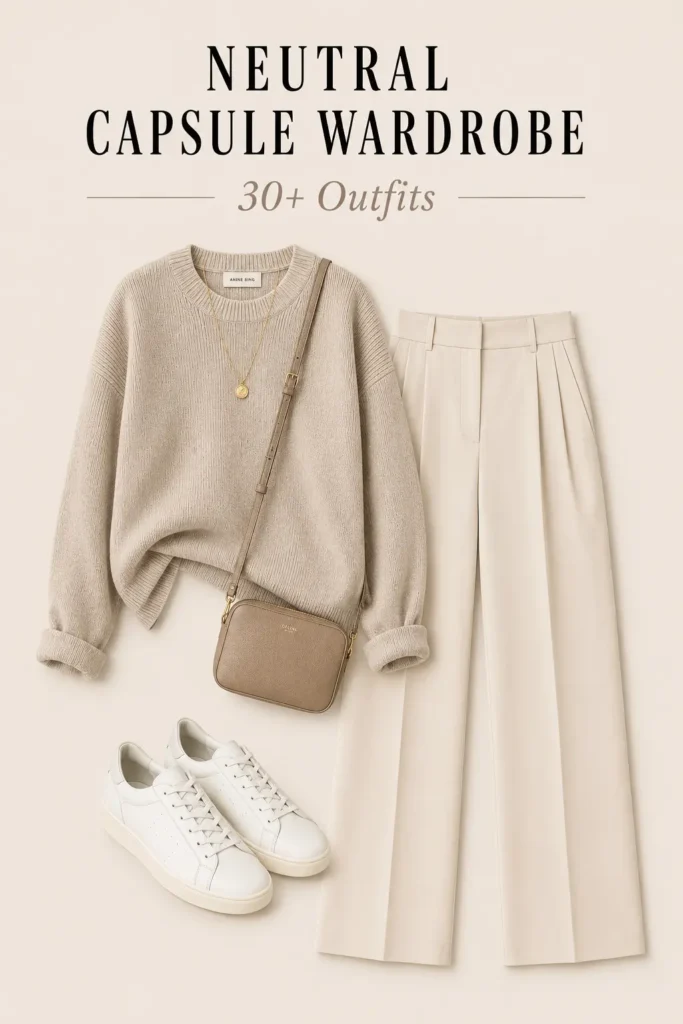
That’s 31 without breaking a sweat, and swapping the accent scarf, changing your belt, or adding jewelry turns many of these into two looks each.
This is the quiet magic of a well built neutral wardrobe capsule: the pieces were designed to interact, so variety comes from combination, not from owning more.
The same principle makes a neutral base ideal for packing light, which is why it works so well for a travel capsule wardrobe or a tight carry on capsule wardrobe.
Neutral Styling Formulas That Multiply Your Outfits
So how do 12 pieces stretch this far? A handful of formulas do the heavy lifting. Learn these, and you’ll never run dry.
Column of color. Wear a top and bottom in the same or similar depth, then add a contrasting third layer. Black tank and black trousers under a camel blazer. Cream knit and cream trousers under a chocolate coat. This monochromatic trick lengthens the body and looks expensive automatically.
The third piece rule. A base of two pieces (jeans and a tee) can look unfinished. Add a third piece, a blazer, cardigan, or belt, and the same outfit suddenly looks intentional. The third piece doesn’t need to be dramatic. It just needs to create a silhouette.
Texture contrast. When color is stripped out, texture carries the whole look. Pair a chunky knit against smooth cotton, a fluid tank against structured trousers, a crisp shirt under a soft sweater. That interplay is what keeps a tonal outfit from reading as a uniform.
Silhouette and neckline variation. The most common capsule mistake is buying pieces that are all the same shape. Vary your necklines (crew, V-neck, open collar) and your lengths (cropped jacket, full trouser, midi hem) so a small wardrobe keeps producing fresh combinations.
Accessories as the mood shifter. The same trousers and knit can go polished daytime with gold hoops and a loafer, or dinner ready with a heel and a lip. Accessories are how one outfit becomes two.
Build It on Any Budget
You can build this whole thing at almost any price point. The method matters more than the price tag, and the four step process in my guide on how to build a capsule wardrobe applies whether you’re spending a little or a lot.
The $300 starter version. Prioritize the pieces you’ll wear most: the white tee, the jeans, the trousers, the blazer, and the sneakers. Buy these in solid, mid weight fabrics from accessible brands, and fill in the rest over time. A neutral palette actually makes budget shopping easier, because you’re not chasing a specific trend color that has to match one other thing.
The investment version. Here you spend on the anchors, the blazer, the trousers, the coat, the leather shoes, because those are the pieces that read “quality” and get the most wear. Better fabric drapes better, lasts longer, and looks more expensive in photos and in person. This is the spirit behind an old money capsule wardrobe or a quiet luxury capsule wardrobe, where restraint and quality do the talking.
Either way, the math favors you. A well made piece worn a hundred times has a tiny cost per wear; a cheap impulse buy worn twice is the expensive one. Buying less but better isn’t a sacrifice in a neutral wardrobe. It’s simply where the numbers land.
Adapt Your 12 Pieces to Your Body and Lifestyle
The 12 piece framework flexes to your real life. Keep the count; swap the specifics.
If you work from home: lean the layers toward soft knits and relaxed trousers, and let the blazer be the piece that makes you presentable on a video call in ten seconds.
If you’re in an office: make the tailored trousers and blazer your anchors, and choose a button-down and loafer that skew a little sharper. A neutral base is the perfect starting point for a dedicated work capsule wardrobe or a business casual capsule wardrobe.
If you love dresses and rarely wear trousers: swap a bottom or two for a second dress. Two neutral dresses plus a blazer, a cardigan, and both shoe options will still generate dozens of looks. The formulas don’t care whether your base is trousers or dresses.
Body and proportion notes:
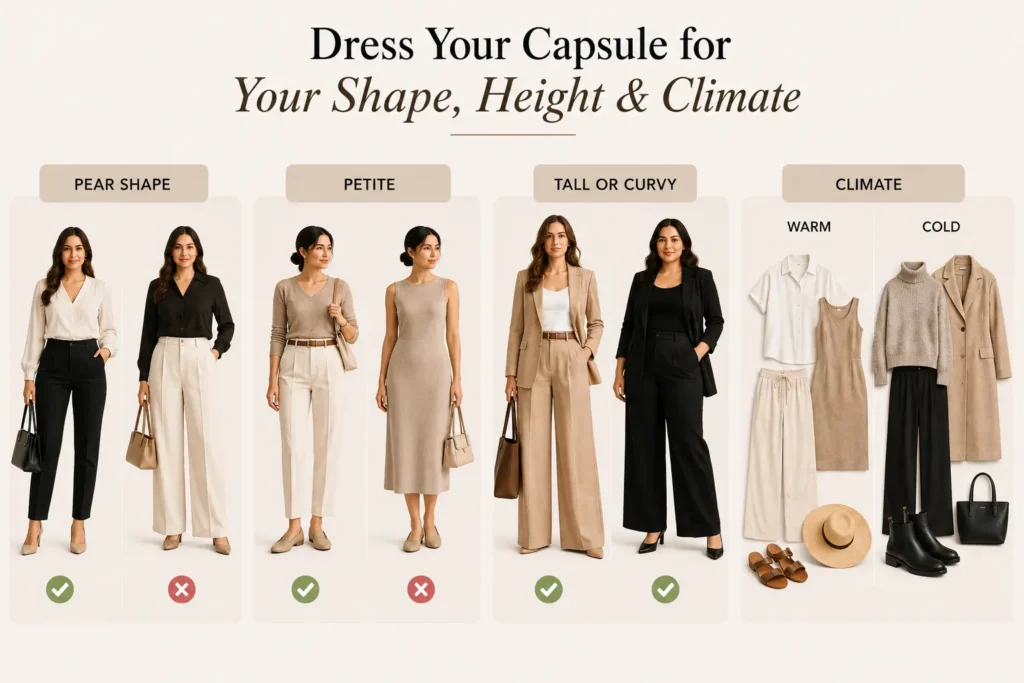
- Pear shape: keep bottoms in a darker neutral to streamline, and put your lighter, brighter neutrals up top near your face.
- Petite: favor a column of one color and midi (not maxi) hems to keep your frame long. There’s a full petite capsule wardrobe guide if this is you.
- Tall or curvy: wide leg trousers and longer line blazers tend to balance beautifully, and the plus size capsule wardrobe guide has more on proportion.
- Climate: warm regions lean into linen, cotton, and lighter neutrals; cold regions swap in wool, heavier knits, and a proper coat as the outer layer.
Age and stage matter too. The same neutral core adapts cleanly for a capsule wardrobe over 40, a capsule wardrobe over 50, or new mothers building a maternity capsule wardrobe, because neutrals stay flattering and forgiving through every change.
Common Neutral Capsule Mistakes (What NOT to Buy)
A few traps I see constantly. Avoid these and your neutral closet holds together effortlessly.
- Buying too many pieces in the same shape. Five crewneck tops in three shades isn’t a wardrobe, it’s one outfit repeated. Vary necklines, lengths, and fabrics.
- Occasion pieces disguised as basics. A beige sequined top is still an occasion piece; a neutral color doesn’t make it versatile. Ask: can I wear this at least three ways?
- Mixing undertones carelessly. A cool ash grey next to a warm golden camel will always look slightly wrong. Stay in your lane.
- Trend cuts you already suspect will date. If a silhouette feels very “this season,” it probably won’t survive to next year. Neutrals are your trend resistance strategy, so don’t undercut them.
- Thin, twisty fabrics. Paper thin jersey that pills or twists after one wash undermines the whole quiet luxury effect. Substance reads as expensive.
The test for any piece is simple: can it move across settings with a change of shoe, bag, or layer? If yes, it belongs. If not, it may be lovely, but it isn’t core.
Maintain and Evolve Your Neutral Closet
A capsule fails when it’s treated as a one time cleanup. It works when it becomes a light, ongoing habit, and the neutral closet is easy to maintain once it’s built.
Use the 30 wear rule. Before buying anything new, ask honestly whether you’ll wear it at least thirty times. If yes, it’s worth it. If it’s beautiful but perpetually waiting for the right occasion, it belongs in a different category, not your capsule. If you love strict limits, the Project 333 challenge and the 10 item wardrobe method both pair well with a neutral base.
Edit seasonally, not emotionally. You don’t start over each season; you swap. Linen out, wool in. Sandals back, boots forward. A lightweight shirt gives way to a heavier knit. Small, strategic changes keep the wardrobe current without churn. If you’d rather build one set that never needs swapping, a year round capsule wardrobe is the neutral lover’s dream, though seasonal versions for spring, summer, fall, and winter give you more precision.
Care for pale fabrics. Neutrals, especially the light ones, show wear faster than dark clothes hide it. Wash lights together, treat marks quickly, steam your blouses, use proper hangers, and refresh a tired piece before it drags the whole palette down. A dingy neutral loses the exact quality that justified it.
Replace with intention. When something wears out, replace the role, not just the item, same job, better version. That’s how the wardrobe improves over years instead of ballooning.
Conclusion
A neutral capsule wardrobe isn’t about owning less for its own sake. It’s about owning the right twelve things, in colors that cooperate, in shapes that flatter you, so that getting dressed becomes the easiest decision of your day. Almost anything pairs with almost anything else. Your mornings get shorter. Your cost per wear drops. And you look, somehow, more put together than you did with a closet three times the size.
Start with your undertone. Choose your three colors. Build your 12. Then watch how far they stretch.
Ready to build yours? Download the free neutral-capsule-wardrobe-checklist and take it shopping, and start with the one step that changes everything: finding your undertone.
Neutral Capsule Wardrobe FAQ
How many pieces do you need for a neutral capsule wardrobe?
A core of about 12 pieces is enough to generate 30 plus outfits once you add styling formulas and accessories. Many people expand to 20 to 30 pieces across a full season, but 12 well chosen items are the ideal foundation for building a neutral wardrobe you’ll actually wear.
What is the best neutral base color?
It depends on your undertone. Black, navy, and charcoal are excellent bases for cool undertones; camel and chocolate suit warm undertones. Navy is the most universally flattering if you’re unsure, since it’s softer than black and works across casual and formal looks.
Can you really make 30 outfits from 12 pieces?
Yes. Because every piece shares a neutral palette, nearly all of them combine. Add the column of color and third piece formulas, vary your accessories, and 12 pieces comfortably produce more than 30 distinct outfits, as the breakdown above shows.
Can you wear black and navy together?
Absolutely. Once considered a faux pas, black and navy now read as intentional and modern, especially when you vary texture (a navy knit with black trousers, say). Keep the two shades distinctly different in depth so the pairing looks deliberate.
How do I start building a neutral wardrobe on a budget?
Start with the five hardest workers: white tee, dark jeans, tailored trousers, a blazer, and white sneakers, in solid, mid weight fabrics. Add the remaining pieces over time. A neutral color capsule wardrobe is budget friendly precisely because everything already matches, so you never buy an extra piece just to make one thing work.
Are neutral capsule wardrobes boring?
Not when they’re built well. Neutral is only boring when everything is the same shape and texture. Vary your silhouettes, lean on texture contrast, and add one considered accent, and a neutral wardrobe reads as quietly expensive, not dull.

Emma studied fashion but could never get her own closet under control. Capsule wardrobes finally fixed that. Now she writes about what actually worked for her, in the hope it saves you a few frustrating mornings.